
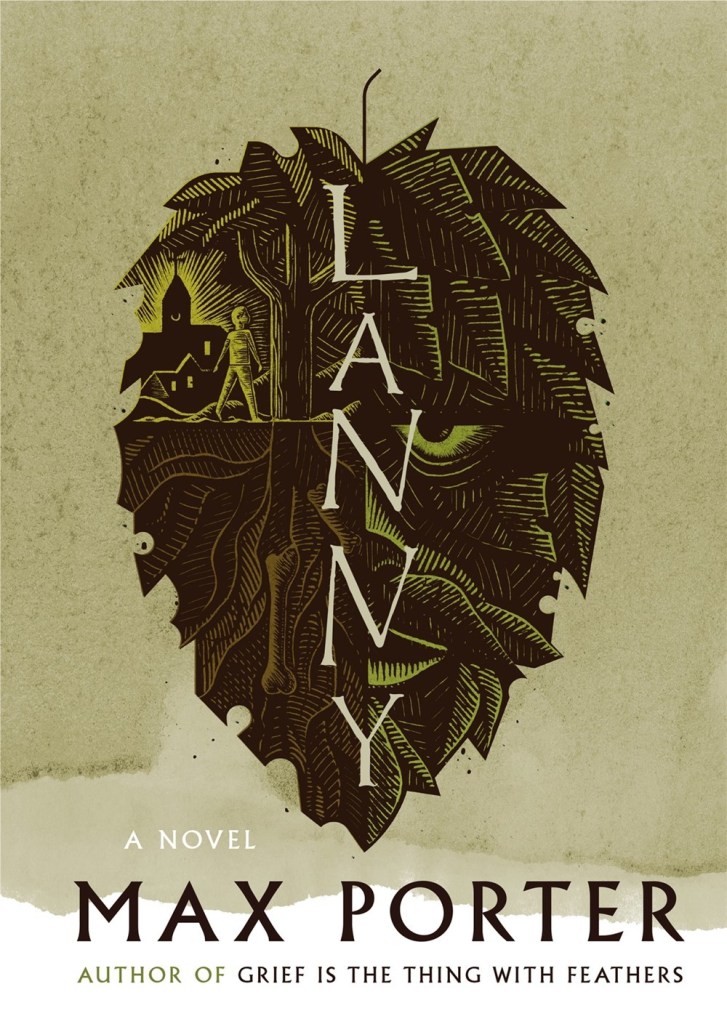
This is the third, and probably final, Literary leaning novella I’m reading for this project. If we’re nitpicking labels, Lanny is probably closest to Magical Realism, but I think it generally defies easy categorization. It took me a while to settle into Porter’s rhythm, but portions of this book had me in a stranglehold. I think it’s a more approachable entry point into Literary writing, only one step beyond The Spear Cuts Through Water. It’s a personal and intimate window into the souls orbiting around a very special young boy named Lanny and the village where he lives.
The Premise:
Lanny is a very special child. In his life are parents Jolie and Rob, an older artist named Pete who bonds with Lanny during art lessons, and the mythical creature Dead Papa Toothwort. Lanny is in tune with the supernatural, able to defy logic and physics. When Lanny disappears, the town blames Pete, who gets cast as a pedophilic gay man. You’ll enter the mind of townsfolk, visitors, and our core cast of humans. Part three sees them seeking out Lanny in the domain of Dead Papa Toothwort, and mostly reverts to the original prose style. Throughout the book, we never experience Lanny’s POV.
Read If Looking For: experimental storytelling techniques, nature and humanity elementally joined, gritty human relationships, joyful human relationships
Avoid If Looking For: good dads, the magic to make sense, pain-free books, standard narration and dialogue
What Worked for Me
Who is the main character of this novel? Who is the protagonist? I’d argue that none of our viewpoint characters are actually protagonists. The closest is probably Dead Papa Toothwort, but he disappears for the entire middle section of the book. I know many see Lanny as the protagonist, as he is the center of all our main (viewpoint) character’s emotional orbit. I, however, felt like the town itself was the protagonist. It pushed the story along and carried far more complexity and thematic weight than Lanny himself did. In part this is because Dead Papa Toothwort is almost the town itself. Throughout Part 1, he hears fragments that dance and curve across the page. People gossip about a woman who gained weight, about tonight’s casserole, the tits on the barmaid, and burping when you’ve had too much red bull. There’s joy, but there’s darkness lurking underneath the surface. Dead Papa Toothwort himself revels in death and violence, including a particularly disturbing moment when Jolie killed a Hedgehog (to end its misery, to be fair), with a knife that got too much use.
In American fiction, small towns are typically either idyllic utopias or redneck central. I don’t know if the stereotypes of small towns in the UK matches, but Porter crafted one of the most realistic portraits I’ve seen. My hometown wasn’t quite as small as where Lanny lives, but the smiling faces covering an insular and guarded community was spot on. For those who belong, there is an easy familiarity. For those who do not, it is nearly impossible to ever find true acceptance. The rotten core grows and festers in Part 2, as you see extraordinary circumstances bring out the worst, not the best in the community. Everybody knows everybody elses’ business, and dirty laundry gets aired when the chips are down. I am realizing that all this sounds horrible, but I think it’s not too far off from any insular community (small towns, churches, weaving guilds, etc), and small towns are simply a good encapsulation of one part of the human experience. Dead Papa Toothwort himself is something between village and nature, the history of the town bundled up with its life today.
Porter’s exploration of characters is really intense. He gets at some pretty heavy topics, such as spousal resentment, grief, and self-doubt. The writing here is raw, like you could claw apart the tissue paper separating you from these humans. They all felt so very real, even as Lanny was something of a manic pixie dream child. These darker portraits get treated with the same amount of care that Peter and Lanny’s shared joy is given. Reading this book is like walking through a thin forest, stepping rapidly between shadow and light, where the constant contrast is as natural as breathing. There isn’t any sense of whiplash, but the book will swallow you whole if you let it.
All of this gets blown up in Part 2, which was far and away my favorite portion of this story. Porter swaps abruptly from an extended study of four characters to bouncing rapidly between perspectives, all focused on Lanny’s disappearance. There is Pete’s interrogation by the police, pub regulars complaining about the crowds, kids writing letters apologizing for how they bullied Lanny, phone calls Jodie makes asking for news, and on and on and on. Each bite feels fully realized, a puzzle piece to the oppressive atmosphere of the town. For those familiar with Scott McCloud’s writing on the underlying structure of comics, this section is a huge set of Aspect to Aspect Transitions, showing a collection of separate moments connected to a single specific moment in space and time. They all came together into something that I couldn’t put down.
There’s a brutal restraint in Part 2. Some characters get a page devoted to their thoughts, but typically you’ll live in the brian of a character for three or four sentences, many of which are dialogue without any explicit context given. I think this chunk of reading was perhaps the single best piece of writing I’ve consumed this year. It’s clear while still taking risks; it is emotional without telling you how to feel. I’m not sure whether the whole book is enough to put it in my top 10 of the year (out of an estimated 200 titles), but it’ll be in the conversation for sure.
There’s a lot of writing here, but I still don’t really feel like I’ve captured what it’s like to read this book. A really unusual and unique experience, and each of the three parts of the book uses completely different tools to break from the mold of how stories are told. I haven’t even gotten into some of the cool bits, such as how Dead Papa Toothwort got depicted. To avoid rambling too much, I will leave you with this quote (there are so many good spots in this book to pull from)
His body is a suit of bark-armor with the initials of long-dead teenage lovers carved in the surface.
Is the same character as
He splits and wobbles, divides and reassembles, coughs up a plastic pot and a petrified condom, briefly pauses as a smashed fiberglass bath, stumbles and rips off the mask, feels his face, and finds it made of long-buried tannic acid bottles. Victorian Rubbish.
He’s just got such a good duality to him, and Porter really captured the essence of something weird that is both familiar and utterly unknown. Compare this to the unvarnished reality of the human characters, and it’s a really great contrast.
What Didn’t Work for Me
Clearly I had a lot of good things to say about this book. However, from a pure enjoyment standpoint, this book triggered my secondhand embarrassment so much. This is a testament to how well-rendered his characters are. It was like watching acting without a soundtrack. My discomfort means his writing was achieving what it set out to do. Excellent craft, but not always a fun read for me. I also generally thought the final third of the book was the least interesting by far, as it felt like Porter got a little heavy handed and direct with his messaging about his various characters. Pulled the story into something a little more artificial, perhaps?
I’m also just really, really burnt out on asshole dads right now (asshole parents more generally; lots of shitty moms too, though it doesn’t apply to Lanny). This is novella #20, and Shitty Dads have been in 11 of them, across a fairly wide spread of subgenres. If anyone has recs of protagonists who don’t have horrible relationships with their parents, I’d appreciate it. Anyways, I think the dad struggled the most as a viewpoint character. He’s much more unlikable; both spouses bear responsibility for their marital issues, but him moreso. He realizes during Lanny’s absence that he quite literally doesn’t feel emotions (or believe that others actually feel things), and that it’s more convenient for him that Lanny doesn’t come back. He’s also a hallmark ‘big city’ main character from a Hallmark Movie wrapped in a Literary trench coat. The village isn’t perfect, but the big city has zero positive things associated with it, and Rob is the stand-in for all things urban. Tough for me to know if this would have bugged me if I hadn’t been encountering it so much recently.
Conclusion: I think it’s an excellent pick for anyone interested in a magical realism story that is on the light and readable side of experimental Literature.


This definitely sounds fascinating. The style of the second part of the novel has me particularly intrigued with so many switches of perspective and so much insight into how the town reacts individually and as a whole. I love when a book uses a slightly different style to usual. Last year I read one where you only really got one chapter from each POV but it was a real deep dive into their pasts and presents and I really enjoyed it. So I think I’ll have to try this one for the unique style at the very least.
Sorry to hear that the abundance of bad dad’s in your recent reads is getting to you. Ive always noticed that bad, or absent, parents are pretty common in YA novels too. In that case I assume because decent parents would probably intervene given some of the events within them.
LikeLike
When I do my book club introduction talks for my 6th grade fantasy unit, the running joke is that every parent is kidnapped, dead, or a horrible person. The only one I can think of off the top of my head that has supportive and healthy parental figures is Root Magic by Eden Royce, which is one of my all-time favorites for that age group.
What’s the book the jumps POVs each chapter? I read Floating Hotel by Grace Curtis a year or two ago, which uses the same technique, and absolutely loved it. It was such a great way to capture the space-yacht’s different tension points without having a single protagonist. Lanny kind of pushes that idea to an extreme, and I’m slowly realizing that POV hopping is just something I enjoy a lot. Chain Gang All Stars also has a massive number of POVs, which I thought worked very well there too, though most of those we return to several times throughout the book.
LikeLiked by 1 person
Ooh I havent heard of that one before and will have to look it up. If I’m remembering correctly the father in Kingdom Of Souls was decent although the mother was awful. Besides that I can’t think of any off the top of my head either.
Thats the exact one I was on about! I loved how deeply it dived into everybody’s pasts whilst also exploring the setting. I found a couple of the characters a bit too prickly but other than that I loved it. Such a wonderfully intriguing writing style. I’ll have to try that one out sometime too. I’ve got it on my TBR but wasnt aware that it also had a lot of different POVs.
LikeLike
Chain Gang All Stars is pretty intense. The author puts you in the mind of some truly horrible people (and some people who start feeling like us and turn slowly into the monsters) as a way to show how our world has slipped into a dystopia while everyone sits by and accepts it. I don’t think the book will win over anyone who starts disagreeing with its message, but its a very powerful piece of writing
LikeLiked by 1 person