
I’ve been feeling like 2026 is going to be a very good year for books featuring queer men. The Iron Garden Sutra is my first of the lot, and I enjoyed it a lot! The book has a bit of a weak opening 100 pages, but once it hit its stride I loved it. Unconventional Gothic settings have been growing more and more on me, and this book did a great job of blending a tense atmosphere with the portrait of a man facing an existential crisis. Kind of feels like a darker, more serious Becky Chambers book. It’s not going to be for everyone, but it sure was for me.
Read If Looking For: haunted spaceships, characters coming to terms with death and mortality, explorations of autonomy and personhood, the crumbling of religious conviction
Avoid If Looking For: flawless prose, logical worldbuilding, characters who can put the pieces of the puzzle together
Comparable Media: A Psalm for the Wild Built, Mexican Gothic, A Botanical Daughter
Elevator Pitch:
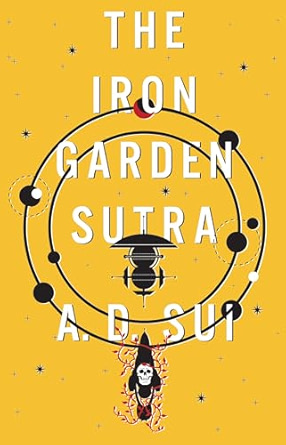
Iris is a monk of the Starlit Order. He is a Vessel. As he travels the universe, he performs funeral rites, comforts those about to die, and helps their loved ones mourn. His newest assignment is to perform last rites for a Generation Ship that has turned up after it’s long voyage and, like all other Generation Ships, don’t have any living humans aboard. He is greeted by carpets of moss, curtains of vines, and a cohort of academics intent on studying and exploring the ship. Yan, an engineer who specializes in AI negotiations, has a special hatred for Vessels; Iris is of course forced to spend some uncomfortably close time with him. It becomes clear that someone – or something – doesn’t want them to leave alive.
Note: The Starlit Order is a futuristic religion inspired/referencing Buddhism without directly replicating it. I’m not familiar enough with Buddhism to comment on this aspect of the story more than this.
What Worked for Me:
This book is one part haunted house story, one part existential musings on death, on part crisis of faith, and a half-portion of gay longing. It’s not really a jump-scare book, and isn’t going to be the most intense horror you’ve ever read, but I think it does an excellent job of using a Science Fiction setting to create a successful Gothic story. Iris walking barefoot across mossy floors, sudden bouts of violence, and the sense that everyone is on the edge of a breakdown really create an immersive setting. A vast abandoned spaceship filled with corpses is a delightful place to set an introspective horror novel, and Sui really executes on that premise. I don’t think this is going to win any awards for the best haunted house story written, but it also didn’t overplay its hand here, which I appreciated.
On the philosophic/religious side of things, I found this book has a lot of interesting things to say. Sui writes in their authors’ note that they wrote this while grappling with their own encounters with death, and that shines through strongly. Iris’s relationship with death (other and his own) begins firmly established at the start of the book. He’s not a perfect monk by any means, but he’s dedicated and an asset to his order. Death is a natural part of life: not something to be rushed into, but something that Iris has accepted as part of everyone’s journey, even his. He is used to facing death and helping those in need before moving on. As the story progresses, he forms bonds with the academics on the ship, and those deaths start to dislodge his own religious convictions. Is this emotional distance from death truly the way he wants to live his life? Has his work meant anything over the past twenty years? There’s a lovely visual metaphor running through the story of Iris’s clothing. He comes in pristine white robes and garments; he folds them carefully when taking them off, frets over each small stain. As his religious convictions begin to erode however, his robes grow dirtier and dirtier, and Iris’ care for them grows more and more lax. By the end of the book, he sits in a pool of blood, and both the man and the robes are unrecognizable from where the novel began. This is the story of someone falling out of a faith they devoted their entire life to and struggling with accepting that fact.
Iris’s religious development goes hand in hand with how he views relationships with other people. As a monk, he took the Vow of Solitude, remaining alone and untouched (literally) as often as possible. His in-built AI companion VIFAI is a messy relationship; can friendship exist when one half of the relationship has so much power over another? However, Iris remains distant from others until circumstances force him to do otherwise. Caring for others, clinging to them, forever shifts Iris’s worldviews. He’s not a perfect person – leaving religion doesn’t ‘fix’ Iris’s many traumas – but I found his character arcs much messier than I was anticipating, and I grew to love him as a point of view character. His relationship with Yan becomes all-consuming (again, not a healthy dynamic), and becomes a major driver for his actions without the book feeling like a sappy romance. Iris is messy, contradictory, annoying, and reminded me a lot of when I was grappling with my own religious beliefs.
The ending of the story hit very hard. I have no idea where the sequels are going, but the developments in the climax and epilogue leave me excited and intrigued to see what happens to the characters who survive their time on the Nicaea.
What Didn’t Work For Me:
I enjoyed the second half of the book way more than the first half. Around 100 pages in, I wrote down that this book was less that the sum of its part, which I stand by overall (but most especially for the opening). I enjoyed the book, but I had to talk myself into picking it up instead of something lighter. The prose was a little clunky, the characters pushed too much into stereotypical boxes (very clearly overplaying Yan’s assholery in an attempt to craft a rivals-to-lovers dynamic), and Iris’ reflections on death didn’t hit as well as I hoped. I was emotionally distanced from the story and found myself not quite caring when the first dead body turned up. Most of this cleared up for me; I more or less read the last 200 pages in a single sitting. I’m glad I didn’t give up on it, but it was a close thing.
A big contributing factor to that feeling was some unrealistic premises that you’ve got to swallow if you want to enjoy The Iron Garden Sutra. Sui was unable to convince me that a society which sees implanting AIs as immoral breaches of AI personhood would make exceptions for Monks. The other profession that gets to use them are Pilots who benefit from the increased computing power. The given reason for Monks to use them – enhanced memory while travelling – just did not ring as authentic, and AI personhood is a pretty major portion of this book. I really enjoyed how Sui wrote the human/AI relationship between Iris and VIFAI, but I had to put some effort into accepting the premise this relationship was built on. I do think VIFAI is a more complex character than Iris gives him credit for, and the snippets we see when we dip into his POV are really interesting.
I also didn’t buy that only ~7 people would be on the academic team sent to research the Generation ship. It’s routinely described as a career-making find, yet barely any resources have been allocated towards it. Even without other interlopers visiting the ship, you’re telling me only one Archaeologist came? One botanist? They didn’t bring their teams or students? It makes for a conveniently small cast, but stressed my immersion in the story. As fantasy and science fiction readers, there’s always a suspension of disbelief required to enter the story. However, Iron Garden Sutra is a story that asks you to take it seriously; this isn’t a fun action story with a tournament arc. There’s a lot of challenging assertions that Sui makes at the start (and sometimes near the end) that you’ve got to accept for the story to work. This is not a good example of Science Fiction that takes the Science part of the story seriously. These negatives were strongest at the start of the story and faded more to the background as the book continued, but they never truly went away.
Conclusion: a weak start and a strong finish. The Iron Garden Sutra has some issues, but I’ll gladly pick up the sequel.
 Marked for Plot