
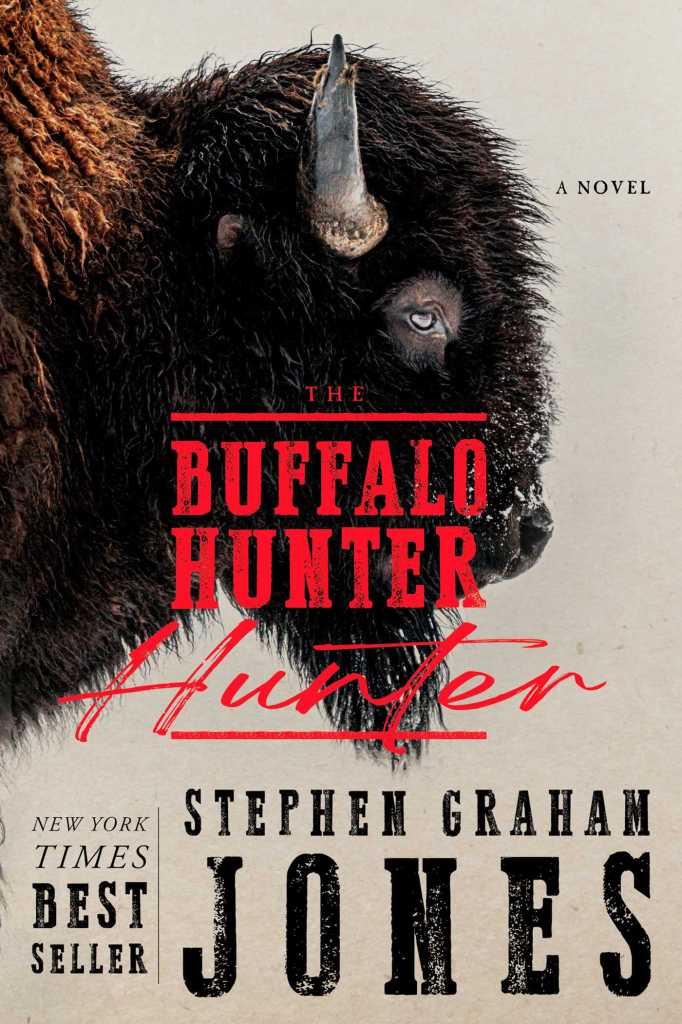
As I continue exploring whether or not horror is the genre for me, Stephen Graham Jones has flitted in and out of my orbit. I had mixed feelings about Mapping the Interior, but Buffalo Hunter Hunter not only had glowing reviews, but also has one of my favorite covers of all time. There’s a lot to love here, but I found myself wishing it were a lot shorter than its actual length. Mixed feelings overall, but Stephen Graham Jones is definitely an author I want to read more of, because the parts of this book that worked really worked.
Read if: you like epistolary horror and framing narratives, enjoy framing narratives and/or epistolary formats, don’t care if the dog dies
Avoid if: you prefer books that get to the point right away, want traditional vampire representation, have an aversion to graphic depictions of violence – including historical events
Comparable Works: The Route of Ice and Salt, The Black Hunger, The Woods all Black
Elevator Pitch:
This is a story within a story within a story. A PHD student studies the journal of her great, great, great grandfather, hoping to convert its contents into a tenure track position (note: this gets the least screentime). Said man is a Lutheran priest in Montana in the 1900s who is visited by a mysterious Blackfoot stranger. This man tells his own life story over the course of several conversations. He is something akin to a vampire, telling the story of how he got his powers and how he began to use them. The tone shifts into something more and more sinister as the tale continues.
What Worked for Me:
I spent the first half of the book a bit bored, if I’m honest. Nothing in the story was bad (Jones is a competent writer at the sentence level), but I struggled to figure out what had gripped people so much. In the second half, things began to pop off and Jones showed some serious skill at crafting disturbing scenes and conversations dripping in tension. I think Jones’ mastery of the epistolary format does a lot of heavy lifting here. This book feels like a series of diary entries and spoken histories. This is no framing narrative for the sake of having one, but rather leveraging the format as a tool to manage tone, information, and tension in the story.
Arthur/Three Persons (the Lutheran Pastor) and Good Stab (the Blackfoot man) each bring their own perspective, biases, and personality to the story. For great sections of the book, I felt immersed in the Great Plains of Montana and the unique claustrophobia that can come from wide open skies and the smoky interior of a church.The slide of their relationship from one of cordial conversation to open conflict was handled really well, and I appreciated that Jones didn’t rely on jump scares for the horror in this book. You’ll get some graphic descriptions of gore, but there’s a lot more psychological horror happening in Buffalo Hunter Hunter that really worked – and were some of my favorite parts of Mapping the Interior. Without a well-realized core duo, the book wouldn’t have functioned at all.
I want to acknowledge in particular how Jones explored a person’s conception of language. Both Three Persons and Good Stab found themselves adapting and adopting the speech habits of others throughout the book. In some ways they were a mirror of each other. As Good Stab lost connection with his people, he began to use the language of those who would see him and his people murdered. Meanwhile, Three Persons slowly adopts more and more indigenous terms as he listens and internalizes Good Stab’s story. It was a subtle and nuanced way for Jones to examine how people change when placed under systemic or personal pressure. Good Stab’s journey in particular – even beyond language – was a masterclass in characterization by showing, instead of just telling. Jones did rely on some explicit thematic reflection (the episodes with the beaver had me in a vicegrip) but you can read far more deeply into his journey than what’s on the surface, and the words they chose to use (and felt comfortable using) was a powerful psychological tool for Jones.
What Didn’t Work for Me:
I wish this book were a novella. I think Jones could have managed the same effect in 150 pages that he did in 450 while removing an awful lot of bloat. The storyline of Etsy (the PHD student descended from Three Persons), could have been cut entirely. Currently, she serves only as a bookmark at the start and end of the story while our other two narrators bounce back and forth. Good Stab and Three Persons’ stories probably could have been condensed to slash a lot of setup that didn’t ultimately pay dividends. Did we really need an entire section of the story about Three Persons finding a cat to bring to the church, visiting a whorehouse to get one? It would have been just as easy to shorten that to a paragraph or sentence. Did we need a visiting sheriff to share news of California and seek out Good Stab? Probably not. Did we need a thorough accounting each of the memories he shared? I don’t think so, as most of the thematically and tonally relevant sections are on the shorter end.
Its clunky pacing in the first half meant that I almost put down the book and moved on; I’m glad I didn’t, but it was a close thing. I think Jones wanted to have lots of Vampire elements alongside an exploration of the genocide that American history rests on. However, I don’t find he merged those two storylines as well as I’d have liked. Typically characters were focused on discussing or thinking about one or the other, but they rarely intersected outside of a relatively straightforward revenge storyline that popped up around the halfway point. However, i never felt like they merged at a thematic level, and his attempt to build out the foundational elements of a vampire story (with all the details how he became one and learned his powers) took up so much space without anchoring itself in the deeper messages of the work. The structural and thematic elements never found common ground, which made the opening sections feel to much like ‘things happening’, which typically isn’t a style of story I enjoy.
Finally, the dreamer in me kept hoping for engagement with one of the most quintessential parts (in my opinion) of vampire stories: their queer roots. Graham doesn’t have much (any?) explicit queer rep in his backlog. I wish he’d explored indigenous queer identity a bit in this story as a way of connecting his work to the legacy of vampires in the horror cannon. Instead, vampires were thematically used mostly as an analogy for being labeled monstrous, which isn’t particularly unique to vampire stories. It was certainly a cool spin on vampires (they begin to adopt the traits of the species whose blood they drink) but not one that cared much about the literary roots of vampires. In the acknowledgements, Jones discussed that he mostly didn’t rely on any previous work or research as he crafted the vampire elements of the story, which wasn’t much of a surprise. Again, I’m not mad at it, but a boy can dream.
Conclusion: while I think the book had some serious pacing issues, there’s a lot of great horror in this book if you’re willing to stick it out
- Characters: 4
- Setting: 4
- Craft: 4
- Themes: 3
- Enjoyment:3
 Marked for Plot