
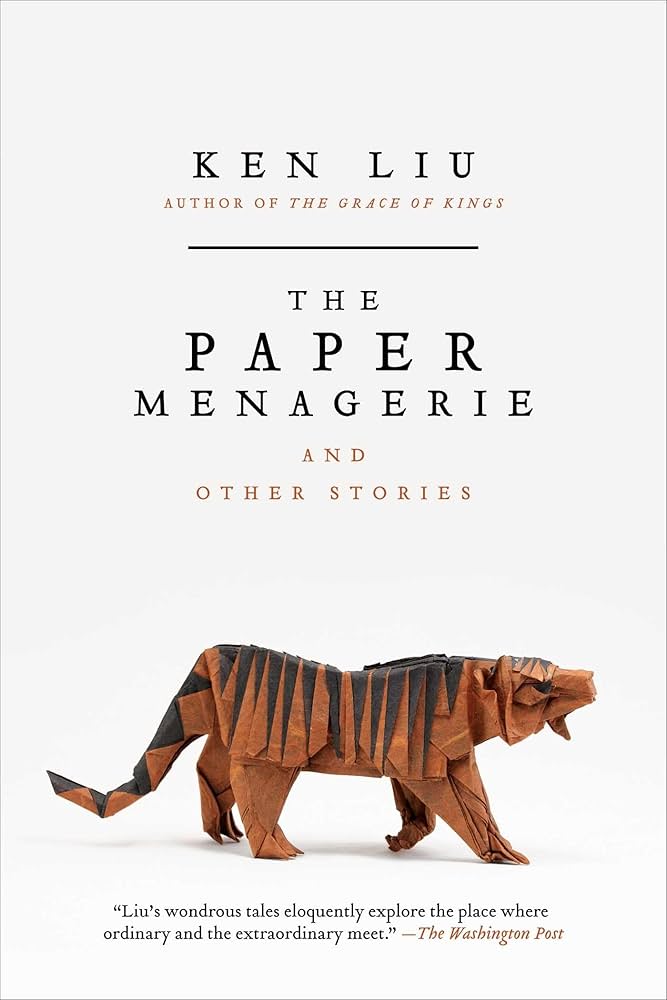
One of my 12 Must Read Books of the year, The Paper Menagerie and Other Stories is the type of collection that gets spoken alongside Stories of Your Life and Others, by Ted Chiang. I think this is a classic example of when I need to divorce my own reading experience from the hype a title collects as it gets recommended and re-recommended. Ultimately, this was a good collection (especially in the midpoint and back half). However, it didn’t match the pedestal I had placed the book on. In fact, I don’t think it would hit my top 5 anthologies of all time, and I haven’t read that many. I think I was expecting a bit more magic, a bit less of a history lesson. And while history lessons aren’t bad, Liu’s approach in some of these stories felt less like storytelling and more like lecturing. It didn’t help that some of the weaker stories (in my mind) were placed up front, and that Liu is perhaps too fond of parallel narratives as a framing device for his shorter work. Not a bad technique, but tiring and predictable when they come in a constant stream.
The collection was at its most successful when it explored ambiguity, moral nihilism, and the complexity of family relationships. All of my favorites explored various familial ties (an estranged father and daughter, a woman navigating the grief of her dead daughter, a son’s reflection on how he treated his mother, etc. There’s some emotional gut punches, interesting thought experiments, and moments of wonder here. Had I entered the collection with no prior knowledge, I think I’d have enjoyed it more.
Below are my short thoughts on each story. However, my highlights were Simulacrum, The Regulator, The Paper Menagerie, and The Man Who Ended History: A Documentary
The Bookmaking Habits of Select Species: this is less a story and more a thought experiment on how different alien species might view writing as a reflection of their unique physiologies and psychologies. Interesting, but I wish there were something a bit meatier tying the different sections together.
State Change: this follows a world where people’s souls are objects, which tend to influence their personality and how others see them. We follow a woman whose soul is an ice cube frantically monitored and insulated to avoid its melting. I liked this story a lot, and thought it was a smart metaphor to think about the different ways people think about their own limited lives.
The Perfect Match: a story focusing on a young man who comes to terms with how an AI (think google meets Siri) is controlling his life in unhealthy ways, eventually joining a plot to bring it down. There’s definitely an interesting core here; I think stories that force us to examine our relationship with technology are important and meaningful. However, this story was so terribly preachy that it dulled out a lot of the meaning. In a story about an AI telling you how to think about various things, the narrative telling you how you should feel about various developments was ironic and disappointing. I’d have appreciated more showing, less telling. This includes (perhaps even especially when) twists happen that are meant to reframe the plot and theme from what’s been built up so far.
Good Hunting: a story of a child who hunted supernatural forces adapting and becoming a mechanist as magic fades when he grows older. I wasn’t sold on this story at first, but by the end it really won me over. This story, perhaps more than any other, embodies the tagline on the front cover ‘the place where ordinary and the extraordinary meet’ (a quote from the Washington post yes, but still on the front cover). Beautiful imagery, interesting topics explored, not too blatant in its messaging.
Literomancy: I … really didn’t like this one. It seemed to exist mostly as a way of teaching about Chinese history, as well as America’s violent interventions in it. Blended into that were literomancy lessons to our white protagonist. Unfortunately, it read just enough like a history textbook that I’d rather have picked up a history book on the topic. Of course, I probably wouldn’t have read about it at all without reading this story, and it seems like the ‘reads fantasy but not history books’ was the target audience for this one. Finally, I have a deep love of framing narratives, and a deep hatred of people who write a character telling a story that is indistinguishable from the narrative voice of the author. Just not any subtlety at all here. I wish the author would have leaned more into how these experiences changed our child protagonist. We got there in the end, but I wish the history would have been presented more through the lens of characters vs narration.
Simulacrum: This is the first story in the collection that really clicked for me. It’s a series of interviews (Liu can narrate in-character after all!) of the inventor of Simulacrum technology. Think interactive recordings that allow the program to improvise after capturing the core personality of their subject. It’s about the broken relationship between father and daughter, how humans and technology alike have a habit of trying to ‘freeze’ someone in a single moment, and the painful process of navigating evolving relationships with our parents. It was emotional, heartfelt, and let the story do the thematic heavy lifting, instead of the narrator. No notes, this was really perfect.
The Regulator: This is a thriller/detective story with relatively few supernatural elements (light cybernetic modifications, such as optical cams and hormone regulators). It bounces between a serial killer who targets high end prostitutes and a private detective hired to solve one of their murders. Liu did a really good job of building psychological tension in both characters, and this felt a lot like reading a John Grisham Science Fiction story. Quick moving, intense, and visceral in all the best ways.
The Paper Menagerie: I’d already read and fallen in love with this short story, and it was just as good on a reread as it was originally. I’ve spent a long time thinking about my own regrets in terms of how I’ve treated people in my life, and this really tapped into something raw and visceral. As a teacher, I get a firsthand view of how children and parents relationships can fracture, and Liu did a great job of capturing the moments when teenagers are perhaps not as generous or open with their parents as we might like (as compared to SImulacrum, which swings the other direction). Just really well done, and I wouldn’t change a thing about this story. It makes me cry every time.
An Advanced Readers’ Picture book of Comparative Cognition: This story had a lot of similarities with The Bookmaking Habits of Select Species. It also explores other potential forms of alien life, this time around types of cognition. However, it is interspersed with the story of a married couple navigating the desires of one to explore the vastness of space, and the other to stay on earth. This duality lent itself to some deeper thematic explorations, and I generally think it worked better (especially in conjunction with The Paper Menagerie, Simulacrum, and The Waves as a mini-series exploring family dynamics.
The Waves: Another story bouncing between parallel storylines. Here we get creation myths mixed with the story of a ship carrying the next generation of humanity to their new home across the stars. They grapple with a new immortality technology, but would using it remove their humanity? The story also explores how that choice impacts family dynamics, individuality, and eternal childhood. Perhaps not as emotionally charged as I would have liked, but I think this was the strongest use of parallel narratives in the entire collection.
Mono No Aware: Are parallel stories really the theme of this novel? This one is more straightforward, bouncing back in time between a child on earth when an asteroid strike is imminent and their future on a vessel venturing into space. I loved the use of Go imagery in this story, and it did everything it set out to do. The ending has full of strong emotions. The story didn’t wow me, but I’m glad I read it.
All the Flavors: One of the novellas of the book, All the Flavors is a parallel story bouncing back and forth between mythology of a Chinese God of War (who started as a normal person) and a Chinese logging camp in Idaho as a young white girl there grows to know and love them. I can’t help but feel the similarities between this and Literomancy were fairly pronounced. It’s an attempt to educate about historical events using a white girl as a POV – there’s something here about female childhood standing in for presumed innocence and how parents are worried she’ll be corrupted, but it feels a less intentional choice and more a bias Liu himself is leaning into without realizing it – but ultimately I thought this was more successful because it mostly featured the story over long history lessons. Unfortunately, I thought the emotional punch was less. I wish I’d experienced Literomancy’s story in the style of All the Flavors.
A Brief History of the Trans Pacific Tunnel: This is an alternate history exploring if the pathway out of The Great Depression was not The New Deal, but rather an underground tunnel connecting China, Japan, and the United States. In some ways it paints a rosy brush of how history could have gone (the Nazis never rose to power!) and in other ways it indulges that racism isn’t going to vanish just because East Asia and the US got buddy buddy(ish) in the 30s.
The Litigation Master and the Monkey King: This story was a ton of fun which drifted into something darker (also a trend in this collection). It follows a maverick lawyer who likes to stick it to the rich before he stumbles upon secrets the Empire does not wish him to have. It’s about sticking to one’s convictions even when it means a bad ending. A good story, but it didn’t blow me away.
The Man Who Ended History: A Documentary: The collection certainly ended with a bang. This is both the most thematically ambitious and successful of the whole collection. Like with some other stories, it is examining thorny elements of history, but uses that topic as a way to explore different conceptions of history, accountability (or avoiding it), and our relationship with the past. It refused to preach, presenting characters as characters in order to build meaning from the foundation.
 Marked for Plot
Lovely review. Its a shame the hype affected your experience with this one but its unfortunately unavoidable at times. I think the history involved here could interest me bur the preachy tone you’ve mentioned has me worried as I’ve been burnt by that in other books before. It sounds like an interesting and varied collection of stories on the whole and its good to know that some come with a great depth of emotion.
LikeLike