
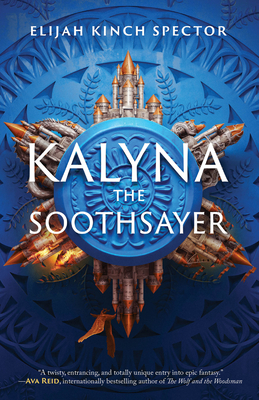
One of my favorite things to do is read books nobody is talking about other than a few people who relentlessly hype it. Kalyna the Soothsayer was brought to my attention by u/RheingoldRiver over on the Fantasy subreddit. I’m a bit sad that it took me so long to finally pick this book up, but I really enjoyed it! It’s got a good amount of political intrigue, a delightfully unreliable narrator, and a setting that feels just weird enough to be noticed without distracting from the corruptive nature of power or xenophobic social orders. It’s not a comedy, but it’s got a relentlessly dry sense of humor. It isn’t epic fantasy, but the stakes are high. It’s not a crime novel, but our protagonist’s string of cons and lies were entertaining and filled with tension. It doesn’t quite hit my ‘all time favorites’ list, but it’s good enough that I’ve already put in an order for the sequel.
Read if Looking for: long cons, a bucket of assassination attempts, characters using nontypical weapons, Jewish-coded protagonists, chaotic bisexuals
Avoid if Looking For: kind and sympathetic nobility, fight scenes with consequences, supportive grandparents, long chapters
Comparable Reads: The Justice of Kings, A Mask of Mirrors, The Blacktongue Thief
Elevator Pitch
Kalyna comes from a long line of Soothsayers who can see into the future. Her family is from everywhere, but belongs nowhere. They’ve been run out of more than one town with pitchforks, and they’re always the first to take the blame when things go wrong. Unfortunately, Kalyna failed to inherit her family’s gifts, and her ‘prophecies’ rely on guesswork, rigging the deck, and knowing when to get out of something bad. She’s caught the attention of the Prince of Rotfelsen, a nation that mostly exists in the tunnels running through mineral-rich mountains. She and her family find themselves kidnapped and forcibly placed in the Prince’s service right when assassination plots against the King are on the rise. Kalyna would like nothing more than to run away from this horrible situation, but escaping without killing herself, her loving father, or her viper of a grandmother will require careful planning. Until then, she’s got to fake some fortunes for a paranoid prince and hope things don’t go too sideways in the meantime.
What Worked for Me
Some people have pitched this book as a comedy, which was the lens I approached the story initially. While I don’t think this is a Comedic Fantasy book, I do think Spector infuses humor into a pretty serious exploration of what it means to be the Other. The book is pretty tightly welded to Kalyna’s perspective. This book, like a few I’ve read recently, is explicitly a retrospective of a character recounting their involvement in the turning points of Empires. Kalyna does have a wonderful sense of humor, and many of my favorite parts of the book leverage this without fully committing the book to being a comedy proper. Before the story even starts, the dramatis personae is titled “Some of the People Who Made My Life Harder”, and is filled with amusing (and accurate) descriptions of characters such as “Eight-Toed Gustaw from Down Valley Way: The name tells all you need to know.” Her observations about humanity, her willingness to hold a grudge, and her daydreams about abandoning her grandmother to a brewing civil war kept me smirking, but perhaps not laughing, for the whole story.
Kalyna herself isn’t the most reliable narrator in the world. She regularly monologues on how much she’s messing things up, yet from an outside perspective she’s insightful and socially aware, making the best of bad situations. Her reactions are shaped by a lifetime of being berated by her grandmother, being othered by any community she visits, and being excluded from the gift that has formed the lodestone of her family’s identity for centuries. Spector doesn’t spend a lot of time explicitly reflecting on the themes of the book, and he won’t step away from Kalyna’s perspective to point out all the interesting things happening. Kalyna the Soothsayer explores racism, trauma, and ethno-centrism all featured in the story, but the book doesn’t hold your hand with them. It’s the type of story a reader can choose either turn their brain off or invest in thinking through all of Spector’s subtle messaging. I think the book works great either way.
From a setting perspective, I really loved how Kalyna the Soothsayer came together. It’s inspired (but not modeled) after research done into some of the lost European nations in the 1300s, and how the conception of ‘nationhood’ looks radically different today than throughout history. While I disliked some clunky exposition dumps (Kalyna will explicitly state she’s explaining this because she doesn’t know where the reader is from, and wants you to have the proper context), the world itself feels quite plausible and immersive. To a certain extent you get nations that feel like ‘that one under a mountain’ or ‘that one split in half by the ocean’, which err on the side of simplicity. The way that the characters feel like products of realistic social pressures however, was quite well done. While I want to read more because I liked Spector’s style and plot, I mostly just want to take a romp through other parts of the world and meet new people. It felt like the purest joy of why I read fantasy as a child.
What Didn’t Work for Me
Kalyna the Soothsayer’s biggest challenge was pacing. The book feels like it should move quickly: its ‘chapters’ are frequently only 1-2 pages long, with fairly descriptive names informing you what you’re going to read about. However, I found the book dragged a bit, especially at the onset. I think Spector intended to use his opening section to establish Kalyna’s bonafides as a con woman (and introduce a few characters who will be relevant later). Unfortunately, Kalyna’s least interesting fake-prophecy happens at the beginning of the story, and I think Spector could have reworked the situation enough that we begin with Kalyna’s abduction en media res. Chop 50 pages off this book, tighten up some of the sentence-level pacing, and I think this book would have been fairly perfect for me.
A more minor complaint was the book to invoke soldiers akin to Storm Troopers. Kalyna herself is a rather poor fighter – though there were some fun discussions about Sickle Combat Treatises that are based in the historical record as a way to let commoners defend themselves with less efficient weapons than the nobility – but she seemed to kill an awful lot of professional soldiers without getting significantly harmed in the process. The fights were typically chaotic, with Kalyna’s victories attributed to luck, improvisation, and strong allies. Really though, I couldn’t help but feel that she probably should’ve been dead (or maimed) about three or four times by the book’s end. Not a major complaint really, but worth mentioning since I don’t have any other major negatives.
Conclusion: a wry fantasy mostly free from magic, filled with con jobs, political intrigue, and a man far too obsessed with fruit for his own good
- Characters: 4
- Setting: 5
- Craft: 4
- Themes: 4
- Enjoyment: 4
 Marked for Plot
Oh, I massively appreciate the new Comparable Reads section at the beginning! That’s such a great idea.
I ended up really frustrated with this one, but the sequel looks much more my thing! Are you planning on giving it a go?
LikeLike
Ironically, I saw yours on goodreads just after I posted my review there. Your sentiments are a bit more in line with consensus on the book, I think. Your criticisms on the political simplicity is one of the things that got carried away in my suspension of disbelief, but probably would come up as a major critique in books I was enjoying the experience of reading less. I’m absolutely reading the sequel. I’ve heard it’s much different stylistically, but I’m interested to see where it lands.
LikeLike