
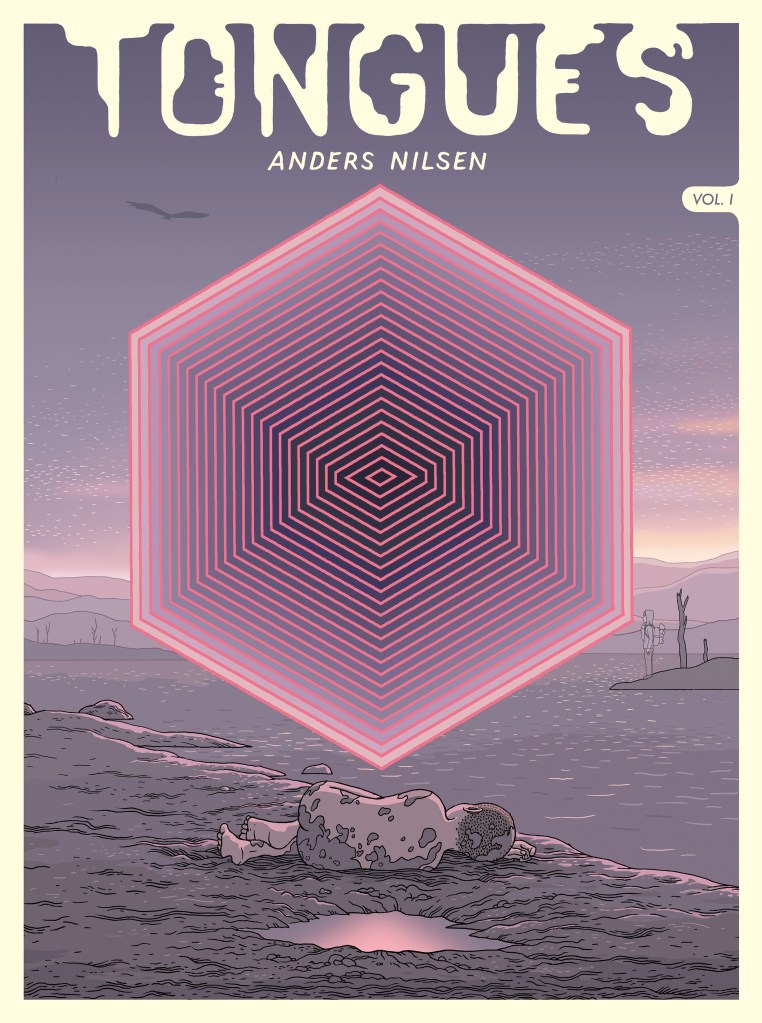
It has taken me much longer to write this review than is normal. It’s tough to figure out how to talk about this book, or why I enjoyed it so much. I found this to be a bit like trying to point out a bird in the forest. The problem lay not with getting a friend to find the bird on the tree, but rather trying to get them looking at the right tree in the first place. Too zoomed in on specifics and a review loses any sense of cohesion, but too zoomed out and you have nothing interesting to say. There’s a lot to say about Tongues. Even when I end up disliking the choices an author makes in stories like this, I appreciate the gradual blurring of lines between Literary Fiction and Genre Fantasy. Thankfully though, I ended up liking Tongues a lot.
Read if Looking For:
– something weird
-something disturbing
– something baroque
Avoid if Looking For:
– something quick
-something sweet
– something simple
Elevator Pitch
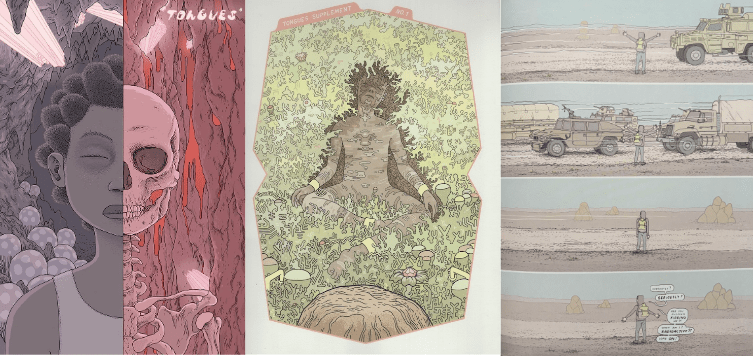
This is a book that takes a bunch of elements from Greek myth (or, our cultural ideas about Greek Myth smashed into something eldritch and ancient) and fast-forwards the see how they’re interacting with the modern world. Prometheus befriends the Eagle who eats his liver each day. A teenager with a teddy bear on his back wanders through the war-torn landscape of Afghanistan. A girl is tasked by eldritch creatures to kill a god. A mysterious cult is gaining prominence in the region.
What Worked for Me
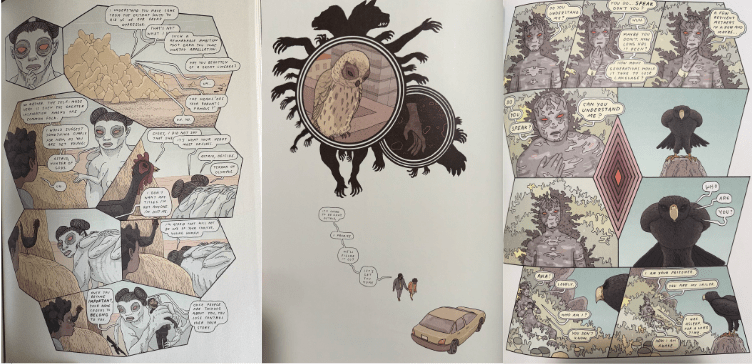
Tongues is perhaps the single most ambitious comic I’ve ever read. Some of this is due to art choices. Tongues is littered with abnormal panel layouts, folding paper, and boldly monochromatic pages. The book is filled with color and illustration, but the eye is always guided naturally to focal points. Some of the ambition comes from the story’s unwillingness to bend towards traditional retelling tropes. None of this ‘poor misunderstood character’ who is actually a hero. No attempts to couch mythological elements into cute references and easter eggs. This is probably best considered more of an extension of Greek Myth than a retelling of it. You’ll shift across time and dreams, never quite treading the same path forwards you were ten pages ago.
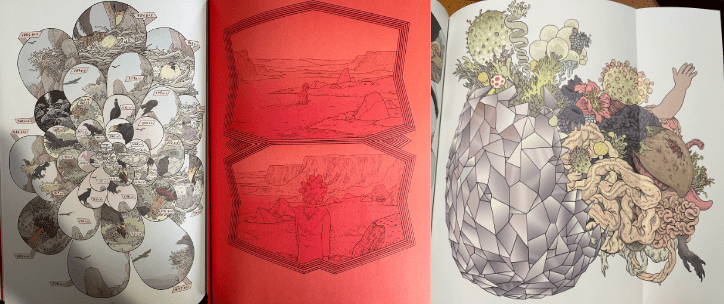
Importantly though, Nilsen never leaves you feeling totally unmoored from the events of the story. I don’t quite understand the plot, the timelines aren’t all lined up properly in my head, and I still don’t know which gods some of these characters are supposed to represent. However, I never felt uninvested in what was happening, even when things got crazy. Individual scenes are (usually) straightforward even when their connective tissue escapes me. What does divine politics have to do with a thematic exploration of humanity’s slow destruction of the environment? How does the mysterious suitcase fit into the puzzle, and what’s up with the rainbow goop Zeus is obsessed with? It’s the type of story that feels like you’re slowly assembling a puzzle; each piece placed builds towards the whole, but you’ve got to put in a lot of pieces before the picture becomes clear.
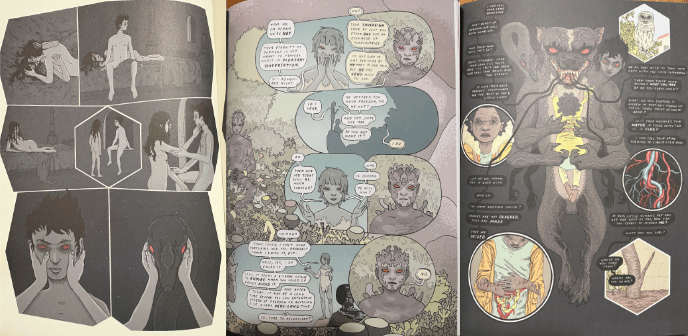
From a character perspective, Nilsen nails the gods. His take on them isn’t straightforward, and their representations are pretty far from any visuals I’ve seen of some of Greek Mythology’s most popular characters. However, each one feels true to the fucked up and cruel nature of Greek Gods. Zeus’s grandiose ego is terrifying, yet he seems desperate when placed next to Prometheus pettiness and forethought. The Titan of Foresight is unsurprisingly the star of the show, an implacable force of nature for whom a millennium is the same as a second. The drama of these divinities unfolds mostly along conversational lines, generally leaving something as dingy as simple violence to the humans that so many of the gods fear, revere, and disdain. Nilsen’s innovation returns here, leveraging panel layout as a powerful tool to reinforce themes and giving words the same impact that many comics give fists or magic.
What Didn’t Work for Me
As much as I’ve lauded the creativity Nilsen leverages in Tongues, I think that it’s Avant Garde nature. To quote Peter Griffin, It Insists Upon Itself. For people who enjoy what Nilsen is pushing, this is very much a benefit. For those whom the conceits of Tongues don’t initially click, I think they will see this comic as belabored and baroque, perhaps even masturbatory at the expense of existing as a concise and readable text.
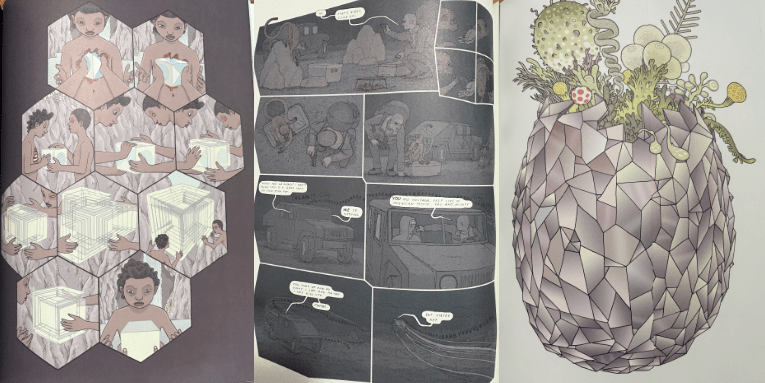
From an accessibility standpoint, Tongues is probably not a great book for folks who have significant vision impairments. I don’t need glasses, and even I struggled with some of the night scenes, which were illustrated in near-monochromatic black. In perfect light they look okay, but it’ll be a challenge in most situations. At times, text was small enough that I needed to bring my eyes closer to the page to read. Generally I saw the artistic merit in these decisions, but think it’s worth flagging here as a potential issue. In some ways, I think Tongues could be a great electronic comic, where e-reader features could bypass some of these challenges.
Conclusion: if you like Greek Myth and Experimental Writing (comics or not) Tongues might be for you
 Marked for Plot
One thought on “Tongues”