
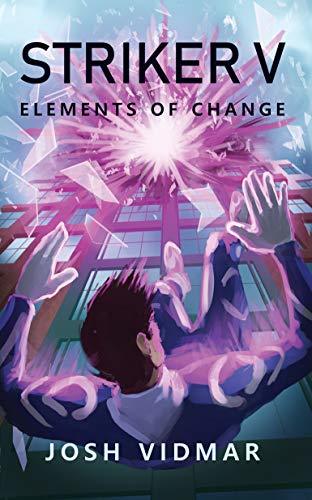
This was meant to be a book I read when I was on the treadmill, taking a break from curriculum writing, or when I couldn’t fall asleep. The type of story it didn’t matter much if I drifted in and out of. I was reading it on my cell phone, not even a damned e-reader. Striker V gripped me in the early chapters and didn’t let me go for a good long while. This novel examines Superheroes from a more person-first perspective than the standard, caring just as much about how humans would react to the constant violence of superhero activity as the fights themselves. It didn’t quite stick the landing, and I have some issues with the resolution of the story. However, it did things I haven’t seen much in superhero stories, and those bits felt just as interesting as The Watchmen.
Read if Looking For: mental health struggles, governmental bureaucracy (and sometimes humor), dystopian superheroes, happy endings
Avoid if Looking For: nuanced climaxes to nuanced conflicts, creative superhero powers, villains that make sense, tonal consistency
Elevator Pitch:
Striker is the fifth superhero with his name. He’s got seven years until retirement and two years until he reaches his heroic lineage’s average age of death (none have survived to retire). He’s got big muscles, a massive healing factor, and some touch-based mind syncing. He’s been worn down by the constant pain of his existence, the fear that no matter what he does his bones will be ground to dust over and over while the public excitedly waits for him to fall from a skyscraper one more time so that Subway will give away free promotional sandwiches. The shifts have been longer recently with increased villain activity, and the book opens with him in a desperate battle against his best friend in the world, who has just now gone rogue.
What Worked for Me:
Vidmar does an excellent job of painting the bleak side of superheroic culture. Neil is a jaded veteran who doesn’t see the light. His government employers don’t see him as anything other than a tool, and the only thing holding him together is a relationship that even he can see needs some work. He’s constantly in his head, trying to just survive the onslaught that life throws at him. He doesn’t want to be here; he didn’t even want to be a superhero. It was decided for him as soon as his powers manifested. Striker V really nails internal dialogue as a driving force in this storyline as Neil begins to break more and more from his training and his government.
The setting for this reminded me a lot of The Incredibles, specifically the portions in the Insurance Agency when Mr. Incredible feels hopeless. The superhero world is lovingly webbed in red tape until it can’t move anymore. Sometimes this is humorous: ripping the license plates off cars before chucking them at a monster for insurance purposes. Sometimes this is fucking sad: see the Subway promotion relating directly to Neil crashing hundreds of feet to the ground – he heals but he has no pain dampening powers. Sometimes it’s hopeful: new supers learn to rip doors off hinges instead of kicking them in as a way to minimize civilian casualties. Sometimes this is Utilitarian: supers aren’t allowed to intervene in minor crimes for fear of humanity becoming reliant on them. Vidmar did a great job creating something believable, dystopian, and three dimensional in his take on superheroes.
Outside of striker, our cast of characters is an interesting if 2-Dimensional bunch. They were all fun, but nobody other than Neil was particularly nuanced. It seems like book 2 focuses on other characters (the no-nonsense government supervisor, the devil-adjacent superhero who travels through hell, the plucky sidekick with Luck powers), and I trust that each of them will get fleshed out like Neil did in this book.
What Didn’t Work for Me:
The first half of this book had so much potential! So much promise! The second half … well it went downhill pretty quickly. Partially, this shift in my enjoyment was because the book itself ended up feeling a lot more like a traditional superhero book towards the end. Lots of fight scenes, a big ass villain, world-ending threats, etc etc. Not only did Neil’s depression take a backseat, but it became a nonissue rapidly and cleanly. Suddenly his life was full of joy and potential and he clearly saw the path forwards. While I’m sure that some people have had this experience, it didn’t ring authentic to me. This is a shame considering how much Neil’s internal demons made the first half of the book a standout. It wanted a classic happy ending without doing any of the hard work needed to get there, and was a bit letdown.
Our villain is also a major sticking point for me. Without going too much into spoiler territory, they single out Neil as especially deserving of punishment compared to other Supers, and proudly claim to be saving him for last. He’ll have to watch those he loves die horribly, etc etc. The villain’s motivation for this laser-focused hate? Neil was visibly depressed in interviews, and seemed broken to the villain. It didn’t make sense to me, especially when other parts of this villain were legitimately interesting and had things to say about the ethics of superhero in a more environmental approach. It felt forced and inauthentic compared to other parts of this story.
Based on the summaries of other books I’ve seen, it seems like this series will continue to straddle more serious takes on mental health, trauma, and healing with a traditional tropey superhero storyline. I hope I enjoy the heroic elements more in the sequels, otherwise book 2 will be the end of my time with the series. Time will tell, I suppose.
Conclusion: so much promise, so many good ideas, but an ending that didn’t live up to the potential. Very enjoyable overall though.
- Characters: 3
- Setting: 5
- Craft: 4
- Themes: 5 (first half) 2 (second half)
- Enjoyment: 4
 Marked for Plot
One thought on “Striker V: Elements of Change”