
This is a book that’s been sitting on my ‘priority read’ bookshelf for about three years now. New Weird is a genre I’d been interested in, and Miéville’s reputation as an author who is concerned with his books as political objects pushing against the autoritarian status quo of fantasy really appeals to me. However, I’m finding that extremely large books put me off more than they used to, and I kept pushing it off until I was in the right mood. I left the book with mixed feelings. In some parts I felt in awe of what Miéville was accomplishing, and elsewhere I was disappointed in the choices he made to the point where I considered stepping away for a week or two. I have the feeling that I’ll be thinking about this book for a while, as it seems the type of story to sit with you.
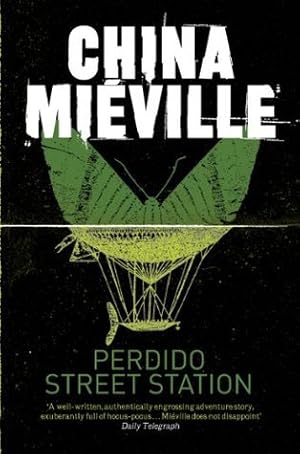
The Premise
New Crobuzon is a dirty, grimy city. It’s filled with trash, corruption, and enough police brutality to make Vladmir Putin proud. It’s also home to humans, cactus-people, women with scarabs for heads, avian humanoids, literal demons, hands that can posess people, a whole caste with intensive plastic surgery forcibly grafting on mechanic or animal parts onto their bodies, among other things. This story mostly follows a dating couple: Isaac (a scientist) and Lin (an artist). Isaac gets recruited by a bird man without wings to get him to fly again, and Lin is recruited by a crime boss to create a masterpiece sculpture. Events spiral out of control, bizarrely leading to eldritch abominations let loose across the sprawling metropolis.
Read if You Like: unhinged worldbuilding, examinations of power and culture, eldritch horrors, characters without happy endings, books to chew on
Avoid if Looking For: fast paced stories, consistent female characterization, happy and mindless books
What Worked for Me
China Miéville has a gift of imagination and worldbuilding. I can’t claim that he’s realistic in how he portrays fantasy worlds (he might be, but I can’t confirm that), but his ideas spark a lot inside of me. Perdido Street Station surpassed my already high expectations of the setting of this story. It reads as something utterly unique, while also being intimately familiar to anyone who has lived in the grime and chaos of a metropolis. The neighborhoods are lovingly realized, and Miéville will frequently diverge from the plot to discuss the history of a neighborhood, or a business, or a portion of the government. It is lush, grotesque, beautiful, and mind boggling in scope. I could have read an entire book of short stories set in this city and complained for not a minute of it.
Another strength of this book is how Miéville is able to modulate the tone of the story. The first half of the book is a hodge podge of character work, worldbuilding, and laying some thematic groundwork. There is a plot that Lin and Isaac make their way through, but it’s not the singular focus of the story until the halfway point. This book makes phenomenal use of short scenes to help build tension and mystery in the story. Two of my absolute favorite moments of the book was a postal worker stealing part of a package, and the corrupt mayor visiting the ambassador of demons to consult on problems facing the city. These moments drip with explicit foreshadowing, riling you up as you return to one of Lin’s sessions building her maserpiece sculpture, or Isaac grabbing drinks with his friends in a dive bar run by a vaguely toadlike barkeeper who revels in the filth of his establishment. It’s tantalizing hints of what to come: the unknown and the mundane placed next to each other and ehancing each other.
Finally, I loved the political work, as expected. This book isn’t shy or subtle about police brutality, political corruption, and the levers by which those in power try to retain their control and dominance. While he’s not shy or subtle about this, it’s handled with a remarkable level of nuance and thoughtfullness, and is given space and time to be developed fully, instead of lazily be slapped on because corrupt governments are a common trope. It helps that he’s also intrested in exploring immigrant communities (Lin’s reflections on her childhood, and the animosity between the two main communities of her species is fascinating), various frameworks of ethics and morality, and a person’s role as part of a larger societal machine are all explored. This is a book that has plenty to think about, and I anticipate many will react strongly to the ideas within. It’s a lot bolder than most fantasy I see, much more in line with the norms of how science fiction generally interacts with societal depth.
What Didn’t Work For Me
Broadly speaking, this book is simply bigger than it needs to be. An extremely verbose and expansive style works well for Miéville as he is establishing the world, creating atmosphere, or delving into character’s psyche. However, around the halfway point the story shifts from it’s juggling act of exploring every nook and cranny of this city through the eyes of characters. It instead pivots to a realtively straightforward monster-hunting scenario. The monsters are horrific and evocative to be sure, but its still just a monster hunting plotline. Now the extended travel scenes, the constant reminders of grime and filth and poverty, distract from the sense of tension that Miéville so lovingly built up. His style needed to adapt for the shifts in the nature of the plot of the story. When we follow only a single character (for the most part) instead of rapidly shifting perspectives every ten pages, the writing slows down immensly. And so I found myself in the position of the book not only becoming more straightforward and less imaginiative than the first half had led me to believe, but it also doesn’t excecute the more common story structures as effectively as it did the weirder bits. It felt like the less interesting path was always chosen, and it happened to also be the longer path. I would have loved if this book had 200 pages trimmed from it.
I also have issue with Miéville’s handling of women in the story. At its core we have two female characters of any real significance: Lin (a full protagonist), the scarab-headed sculptor working on her magnum opus and reflecting on her relationship with her own people and their status as refugees. Then there’s the more minorly featured Derkhan, a reporter for a communist newspaper. Derkhan’s role at first lay in a dockworker’s strike storyline, along with her job as a reporter. Both compelling, interesting, complex characters with unique perspectives on the city and events of the book. Neither gets particularly happy endings, in fact parts of their stories are downright brutal. That doesn’t bug me however, since that’s the norm in this book.
The problem lies in the climactic turning point halfway through the book (where we enter monster-hunter territory) both of these characters vanish. One quite literally, the other remains on page but suddenly seems a shell of her former self, not at all up to the characterization standards in the rest of the book who are also processing trauma. All of the thematic tension, the individual motivations, and personal agency were gone from her writing. Even for our truly vanished character, I found that it would have been a much more interesting to stay with her through the end of her storyline. Learning her eventual fate, there were plenty of options to preserve her agency in the story (or at least depict her lack of agency, a state that Miéville explores deeply in other characters). This all coincides with Miéville more broadly losing track of what I think made this book special, enhancing the problems I mentioned above.
The highs were high, but the lows were really unfortunate.
Conclusion: a mind-shatteringly compelling first half, let down by a bloated and straightforward second half that sidelined the female characters
- Characters: 3 (female), 4 (male)
- Worldbuilding: 5
- Craft: 3
- Themes: 4
- Enjoyment: 4
 Marked for Plot
I continue to love your ‘Read if you like/Avoid if looking for’ summaries at the start of each review. I never knew Perdido Street didn’t have a happy ending! I can cross it off my tbr now (I don’t mind stories getting dark/depressing, but I do need them to end well), and I can do that even before your review properly starts! I just think that’s neat, and also I’m grateful!
I think you might be missing a word here ‘At its core we have female characters of any real significance’? I had not heard this critique before, so I’m very glad you mentioned it, because finding out as I read the book would have been a blow.
Really liked how you broke down the issues with the writing style not changing between the first and second parts!
LikeLike
Looks like there were more than a few typos in this one (and it isn’t alone). My gut is that a lot of his stuff is going to end dark, but I don’t mind that. It isn’t what I normally look for, but I do love when a book takes me by surprise in that way. It’s so at odds with how my romance reads end up, where a happy ending is more or less guaranteed, and I like that contrast.
LikeLike