
It’s been a while since I read a book whose back cover so poorly represents what is in the book itself. Anton Hur was done dirty by his publisher on this one, because the premise for the book is much more interesting than what’s shared. I expected a story about how society is adapting to technology that turns people immortal, with a focus on a patient/researcher and his poetry AI bot. While all that is indeed there, this story is actually a millennia spanning reflection on what it means to be a person, a unique individual, and how choices can echo across time. It has at least seven different POV characters who almost never repeat past a single chapter. A much more ambitious novel than it appears; it reminded me a lot of The Vanished Birds by Simon Jimenez, which is about as high of praise as I can possibly give.
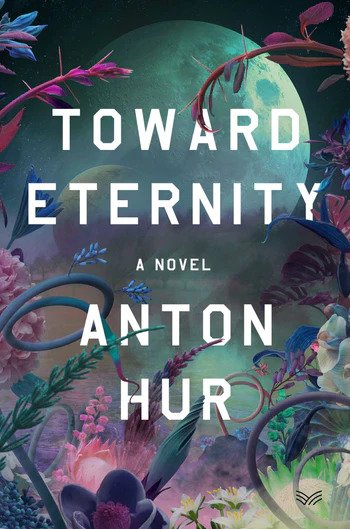
Read if Looking For: books spanning millennia, philosophical musings, epistolary novels
Avoid if Looking For: straightforward stories, single POVs, everything explained in the end
Elevator Pitch:
Okay, let’s try to do a better job than the publishers. This book starts in a near-future world where emerging research shows nanomachines can turn you immortal and cure pretty much any ailment. Dr. Beeko runs this lab with Yonghun (who has undergone the research) and who has disappeared mysteriously. One of the only witnesses is Panit, Yonghun’s AI poetry-analysis machine who has been collecting dust for years. From this setup, we start exploring these events from these character’s points of view, then shifting to other patient’s experiences with nanotherapy, before jumping forward in time to explore a new version of the world where we see how these nanobots have shifted the world again … and again … and again. To give some sense of scope, the book is split into five sections: near future, future, distant future, very distant future, and eternity, and the choices of the original cast filter down into later storylines, they aren’t lead characters continuously throughout the novel.
To give credit to the publishing house, I don’t think this was that much better, and I’m missing some nuance. It’s tough to actually talk about the future sections content without spoilers, but I’ll do my best.
What Worked For Me:
For a book like this to work, it needs connective tissue that goes beyond the plot itself. There needs to be thematic and structural glue that holds the story together. In this case, what it means to be a person is a pretty central question. Perhaps more importantly, what does it meant to be an individual with a unique identity? I thought near the start of the book that the central theme would be exploring the Ship of Theseus experiment (if you replace every piece of a ship one by one with identical pieces, is it the same ship? If not, at what point does it stop being the same ship) but with humans. Is a human whose body has been turned into nanobots, who upload their personality and memories, the same person? How does one deal with that existential dread, that liminal space of being and not being someone else. It wasn’t ever explored with the depth that I wanted it to (the story headed in other delightful directions) but this book lobbed questions at you to consider, even if it never got around to providing answers of its own.
Running through this all is the 19th century poetry that Yonghun and Panit studied together, influencing characters in the far future, even when the poems are far divorced from their original context. I’m not a huge poetry fan. It was my least favorite part of the English major I had to get to become a teacher, and while this book reminded me of that, I think Hur did a good job of finding a balance of poems that were accessible to casual readers that also had solid connections to the depth of the storyline.
I’ve been complaining that some of my more recent reads don’t do a good enough job distinguishing between character voice. Hur nailed this without differentiating the voice so much that the specific characters felt corny or overwrought. There was one especially notable section where a character whose body was composed of nanobots decided he wanted a child, which was an extraordinarily emotional section of the book for me, the person who likely won’t ever have kids – and certainly wouldn’t be creating them the old fashioned way.
What Didn’t Work For Me:
In the end, I think this novel spun out of Hur’s control a little bit. The last third filtered between something very experimental and cool, and something that felt very tropey and close to classic Science Fiction takes on the dangers of technology. I don’t think he found a way to blend them properly, and I definitely found my interest waning for the last 50 pages of this 250 page book. I think it also didn’t help that I didn’t totally buy into the thematic thread about poetry’s eternal existence, but again that may be my own bias talking. It definitely left me with a vague sense of dissatisfaction at the end that didn’t match the engagement I felt in the first half. It just didn’t have the level of subtlety and nuance that the opening four or five POV chapters did.
Conclusion: an ambitious book investigating identity and technology across many viewpoints and thousands of years. Great ideas and opening, but didn’t quite stick the landing.
- Characters: 4
- Worldbuilding: 3
- Craft: 3
- Themes: 4
- Enjoyment: 4
 Marked for Plot