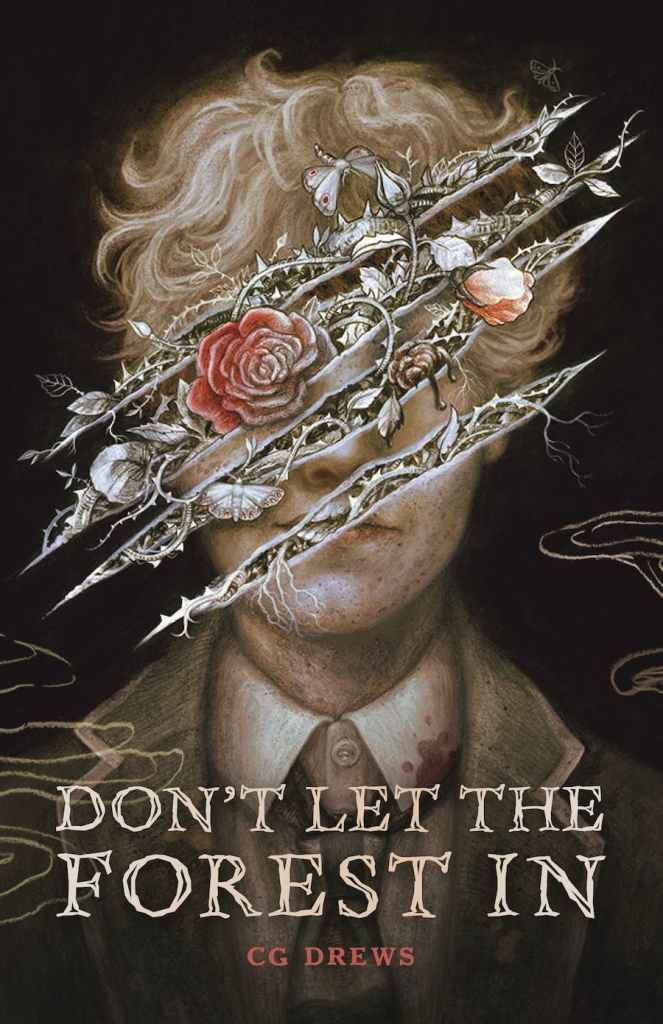
Despite being a middle/high school English teacher, I don’t actually read much Middle Grade or Young Adult works these days. Sometimes I’ll preview a book for class, but rarely for personal pleasure. Oddly, the vast majority of YA that I read is horror, despite it not really being my favorite genre (it’s growing on me, I promise!). I picked up Don’t Let the Forest In in as some first steps to introduce more aro/ace representation into my reading diet. Overall, I thought this was a good book, and one that I’m glad I read. While I think some elements will frustrate readers who primarily pursue adult books, I think it’s got enough good things going on to be worth recommending to a broad variety of people.
The Premise
Andrew and his twin sister Dove attend a prestigious and remote boarding school, courtesy of a rich (and largely absent) father. Dove is a straight-A student, but Andrew is listless, reserved, and anxious. The only thing keeping him afloat (other than Dove making sure he doesn’t fail any classes) is his best friend/roommate/crush Thomas. Thomas is wild and abrasive, the visual artist to Andrew’s creative writing. But Thomas’s parents are missing, presumed dead, and Thomas is a prime culprit. Things between them aren’t the same as they used to be, and that’s before Andrew realizes that creatures from the forest are trying to attack the school every night.
Read if You Like: unreliable narrators, endings that stick the landing, impactful twists, creepy forest monsters
Avoid if You Dislike: archetypical side characters/set dressing, romantic tension derived lack of effective communication, slow pacing
What Worked For Me:
I was not sold on Andrew and Thomas as lead characters at first, but they really grew on me over time. Andrew is absolutely the type of person who would annoy me in real life, constantly second guessing every interaction and struggling with being proactive in nearly any sphere of his life. It’s absolutely a personality profile that many people possess, and one that tends to clash with my own (as I am perhaps unhealthily opinionated and driven to keep doing things when I really could benefit from shutting up and taking a minute to slow down). Once I got over that initial friction however, he was a great vessel to see this story through, especially with Thomas as a foil in almost every way. They ended up feeling very much like people that could (and do) exist. I especially enjoyed the intense relationship dynamic between the two of them, perhaps because there was a level of unhealthy codependence happening. I love happy queer folks living their best lives, but saccharine gays have been the norm now. I appreciate the growing push in the opposite direction, allowing queer men to have messy and complex relationships that aren’t always perfect.
Andrew’s romantic and sexual identities were also handled really well. Asexual representation was a big reason I picked this book up – you don’t see much of it right now in traditionally published adult works – and Andrew’s struggle to articulate to others what his experiences were like were some really impactful parts of the story.
Finally, the twists in the final third of the book were perfection. They were well foreshadowed without being blindingly obvious (to me at least, but this is always subjective), and in hindsight put a lot of puzzle pieces together and shed a whole new light on the rest of the story. It was really well done, and pulled me back into the story after my attention had been waning.
What Didn’t Work For Me
I’m going to sound like a broken record for folks who have read my other reviews, but this book would have been better as a novella. When I consider the core elements – horror, identity, and romance – a lot could have been cut out that didn’t really contribute to the forward momentum of the story. I also think the book started far too early, and the first 20% of the book could have been condensed into 1-2 chapters without much being lost. The atmospheric writing just wasn’t strong enough to support such a long-form work. found when the monsters weren’t on page, or when the central relationship wasn’t being explored or developed, the book lost a lot of what made it special.
Part of this is because everything other than our key trio of characters are straight out of a stock photo catalogue. There’s the asshole teacher who uses his power to relentlessly bully his students at all times. There’s the cosy art teacher who is supportive and worried. There’s the jock bully who has it out for Andrew and Thomas. The school has a zero tolerance policy for bullying, but only really applies its strict rules to our protagonists, and never anyone else. Additionally, because the horror elements come from the forest, instead of the school itself, it lacks the sense of unease and dread that my favorite horror tends to have. Could all these elements be plausible? Absolutely. But it felt like a much lower level of writing quality than the parts of the story that seemed to be the focal point of the story. It’s unfortunate we spent so much time on these details, because I think this book could have been really phenomenal had they been pushed further to the background. Was the prominence of the school bully really necessary for this book to succeed? I don’t think so, especially when I could find carbon copies of him in a million other books executed better.
In Conclusion: a compelling psychological and fairy tale horror story with great asexual representation is let down by a subpar school setting that gets more attention than it should have.
- Characters: 3
- Worldbuilding: 2
- Craft: 3
- Themes: 4
- Enjoyment: 3


I suspect you’re right that this would have been a great novella, but I enjoyed the prose so much I was perfectly happy for it to be novel-length. I highlighted so many sentences!
Do you think you’ll read the author’s next book, Hazelwood? I have an arc but haven’t started it yet.
LikeLike
Ooohhh, Hazelthorn looks cool! I always get nervous when Andrew Joseph White gets mentioned as a reference. He writes phenomenal books, but Body Horror is probably my least favorite type of horror. I get very squeamish in surgery scenes in medical shows, and his books are explicit and evocative enough in their descriptions of dismemberment that I oftentimes have to skip scenes
LikeLike
That’s very fair! I actually don’t like his writing style much – I think it’s too plain, so his horror doesn’t move me (I need sensory details to make it land and he doesn’t provide them) even if in other ways his prose is great. But you should probably avoid Gretchen Felkner-Martin, if she’s not already on your avoid list! She does body horror too and hers is much more visceral/descriptive. Kind of flawless, if you like body horror. (Which I don’t, really! But her writing and themes are just too good for me to skip, even if they also give me nightmares.)
LikeLike