
Utopias are oftentimes criticized for being boring, and impossible to tell interesting stories in. Monk and Robot, a pair of books (Psalm for the Wild Built and Prayer for the Crown Shy) by Becky Chambers defied the saying entirely. I found myself quickly drawn into the world of Panga, enjoying my time with a cup of chai – fitting for a pair of books featuring a tea monk as a lead character.
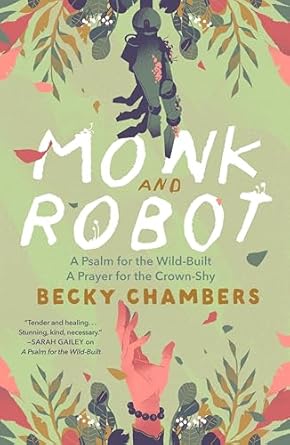
Read if Looking For: low stakes stories, philosophic pondering, quirky robots
Avoid if Looking For: high octane stories, books with violence or external conflict
Elevator Pitch:
Humanity has sworn to avoid repeating the mistakes of the past. After machines came alive, humans committed to more sustainable living, building communities focused on supporting people’s needs, and generally living up to what we all have been trying to achieve for our lives. Nobody wants for food, or shelter, or access to any sort of necessities. And yet Dex finds themselves unsatisfied with life, drained from the work they choose to take on (and which they enjoy). And so they take their wagon into the wilds, where they meet Mosscap, a robot on a quest to ensure humans are doing okay. Together they will explore the wilds (in Psalm for the Wild Built) and society (in Prayer for the Crown Shy) and reflect on themselves and their place in this world.
What Worked for Me
This book really nailed cozy vibes for me. The writing is hopeful, contemplative, and seeks to always place positive intentions first. Careful descriptions of nature, slow pacing, and a foundational stance that people want to do the right thing form the foundations of the reading experience. Assuming that you can buy into those premises, you’ll be in great shape to enjoy these stories. However, if you’re interested in picking apart the realism of the world and how we get there, this book will leave you sorely disappointed. Chambers accepts that the utopia is possible, building from this premise instead of trying to identify how we get to the utopia at all.
I do think Psalm for the Wild Built is the stronger story. It’s central questions – can one struggle for meaning in a perfect society? Do people need to have purpose? – were poignant and deeply explored. Easy answers aren’t provided, but instead Dex and Mosscap manage to have fascinating conversations with each other as they navigate two utterly different conceptions of what it means to be alive, trying to find common ground to help each other. Mosscap’s distance from humanity is refreshing, and Chambers’ dialogue from him doesn’t reinvent the robot characterization wheel, but it does allow her to push the reader to reflect on their own lives.
For me, Psalm hit me hard and got me to really challenge myself on my own work-life balance. As a teacher, its easy for me to disregard my own personal life in favor of work. There will always be more to do as a teacher. In theory, with infinite time and energy, I would connect with each of my 150 students’ families every day. And so every teacher must find their line, where they choose to allow themselves to exist outside of work. This book moved the line for me.
What Didn’t Work for Me
In general, Psalm for the Wild Built was a 5/5 for me. It was focused on interesting questions, explored them deeply, and had a phenomenal mastery of Mood. Prayer for the Crown Shy, however, is less successful. It’s not bad, but it’s not great either. It shifts some of the more philosophical quandaries to Mosscap, as he tries to figure out what it means to be a robot, and how far you can change before you no longer fit in with your community anymore (Theseus’s Paradox isn’t named, but it’s certainly referenced in this book). Similarly, there’s a subtheme of isolation that got some screen time, but ultimately failed to go anywhere interesting, likely because the author wanted to split chapters up by location, without building the thematic connective tissue into each of these locations.
I also think the sequel tried to put more of a focus on how the utopia worked, which unfortunately led to things falling apart a bit. When the perfect society was a background element, it was easy to accept and move on from. When placed in focus, as Mosscap learns about different communities and how they function, I found my suspension of disbelief challenged more routinely. How did society flip so quickly? How did they magically find so many technology replacements that mirror our own that aren’t bad for the environment at all? And these questions get in the way of the tone and messages of the book, leaving it a generally less satisfying experience. I still liked it, but it was the weaker book.
In Conclusion: calm, contemplative, bittersweet. Follow a tea monk in a utopian society exploring their own sense of purpose (or lack of it) with a robot companion
- Characters – 4
- Worldbuilding – 3
- Craft – 4
- Themes – 4
- Enjoyment – 5
 Marked for Plot