
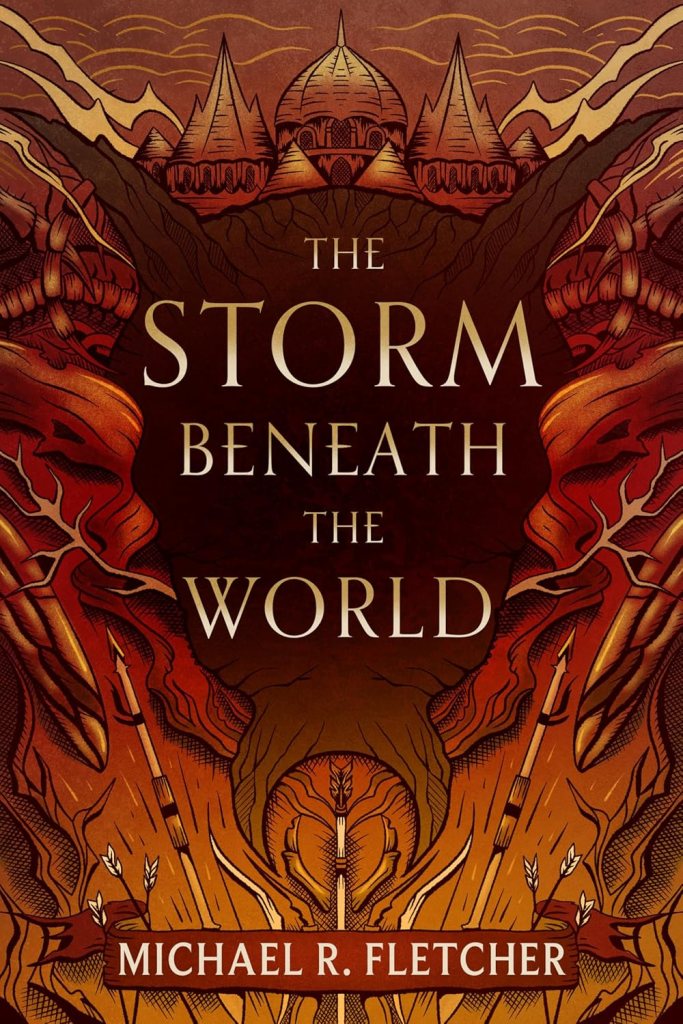
As and English teacher, I constantly tell my kids not to judge a book by its cover. Dumb advice, but I have to try to get them to give Tamora Pierce a try somehow. It’s also undoubtedly true that a good cover is far more likely to get me to actually look at a book and give it a shot, and great cover artists are hard to find (especially since they and the authors rarely get a lot of say in what the cover looks like). And I’m ashamed to say that, with two horrible covers, I didn’t give The Storm Beneath the World a shot the first few times I saw it. Eventually, the premise of excellent fantasy featuring insect-people got me to pick it up, and thank goodness people kept hyping it. I’m now happy to say that it has a third, much better cover (for my tastes at least), and I think epic fantasy fans will find a lot to love here.
Read If Looking For: classic epic fantasy style writing in a totally alien setting, insect characters, ethical quandaries
Avoid if Looking For: books that avoid brutal violence, books with familiar settings
Elevator Pitch:
The world is a river of wind, through which continents on the back of ancient tentacle creatures host countries of insect-folk with some serious aristocracy issues. Four POV characters discover their Talent, a unique skill your are a prodigy at, but that has a serous dark side. Talents can be … well anything. Pottery, farming, conjuring fire, being lucky, sensing lies, etc. But using Talents overloads your brain with bliss leading to addiction, religious and social ostracization, and the promise of a relatively quick death as you ignore basic life needs to live in the bliss of your Talent. But with war looming as the Mad Queen Yil’s island approaches, these four protagonists find themselves pressed into service of Queen Nysh, putting their powers to use for the good of their society.
What Worked for Me
It’s not a secret that the highlight of this book is going to be the worldbuilding, and it really exceeded all my expectations. The author did a great job of capturing the feel of a sexually dimorphic insect culture. It was a bit overwhelming at first (so many new terms, four arms, two separate and interlocking ways to indicate status [brightness of carapace and number of names] four different POV characters who do not start immediately connected with each other) but once I settled into the world it was really excellent. The author walked the fine line between making something feel alien and new, while also keeping just enough relatable that you don’t feel totally unmoored from the characters. It was a setting unlike anything I’ve read, and wow did it impress.
A big part of my enjoyment was how the gendered nature of insects played into culture. On the surface there’s a fairly obvious flip of gender roles. Females are physically larger/stronger, longer lived, more aggressive, and very much the socially privledged group. Males perform primarily domestic tasks, and are brushed off as foolish, silly, and submissive. Thea author weaves in insect flavoring into it enough for it to feel fresh, but it remains a really transparent commentary on our own world in a way that I thought was very effective. To be clear, it doesn’t imply that one set of traits is better or worse, but the characters certainly think so. The ‘social distance’ from our own world lets sitting in the head of sexist characters (both internalized and not) work really well as a way of reflecting on the same exact issues on earth. The book occasionally launches into some commentary around this (including a fun nod to fridging in books) but mostly just lets the casual and nonchalant writing of a blatantly sexist society do the heavy lifting, without needing to constantly dissect the ethical implications of it.
Mental deterioration linked to use of magic isn’t novel (Wheel of Time being the obvious example) nor is this sort of ‘unique talent’ version of magic (readers of Graceling will see a lot of overlap between Graces and Talents). I think it works well, despite some early hesitations. While the book doesn’t read like a superhero story at all, it is what superhero type characters in a dark-ish epic fantasy setting would look like. Specifically, the powers the hero’s have are dangerous to themselves and their allies in many ways, and a significant chunk of the novel is dedicated to Joh (one of our four POVs who is about as low status as you can get with a classic fantasy backstory of a deceased abusive father) exploring the ethical challenges of his suggestion-based talent, and whether he can have any sort of meaningful or honest relationship when he can accidentally force his ‘friends’ to do whatever he wants, including liking him.
What Didn’t Work for Me
The only thing that’s keeping this from being a 5/5 read is that the author made a really big choice to give one of our POV characters a disability that was unlike anything I’d seen in fantasy. I was astounded by the nerve of it, especially because it had the potential to be a really interesting book 2 set of POVs. Unfortunately, this got resolved almost immediately in a way that I felt sapped almost all the interest out of making that choice, and played into the trope of disability being healed by magic instead of actually engaging with what living with a disability looks like. Tough to talk more about without spoilers but it was a pretty major issue for me. I still have major respect for the author and am exceedingly excited for the sequels, but was worth signposting here.
In Conclusion: Probably the best epic fantasy I read in 2024, with a really ambitious world, engaging characters, and a wonderfully dark plot.
- Characters – 5
- Worldbuilding – 5
- Craft – 4
- Themes – 4
- Enjoyment – 5
 Marked for Plot