
I credit my relatively newfound love of Novellas to Empress of Salt and Fortune. I used to be the type of reader who loved doorstopper books – and I still do! – but had a ‘more is always better’ approach to books. Now, I think that the length of a novella gives space for writers to do really interesting, focused stories. I tend to find them more cohesive on the whole, and Empress of Salt and Fortune is a great example of Novellas at their finest.
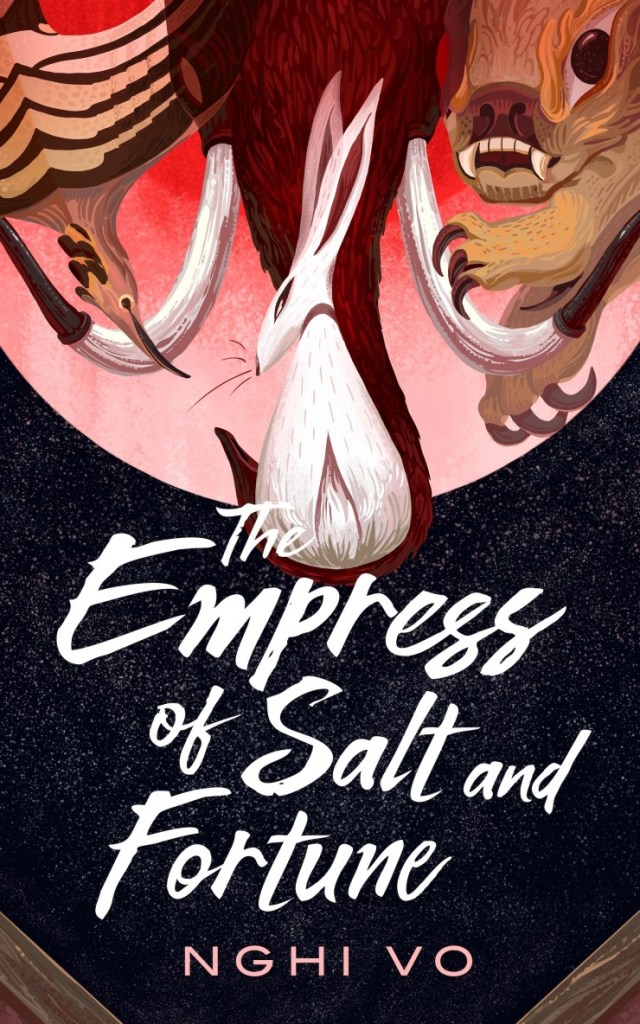
Read If Looking For: framing narratives, the human impact of rebellions, emotional stories, character studies
Avoid if Looking For: traditional action and politics to happen on screen
Elevator Pitch:
The Empress has died, and the spell sealing the home she spent exile in has lifted. At this lakeside villa where she lived after bearing the Emperor’s son and was cast aside, ventures a cleric of an abbey devoted to historical knowledge and truth. Joining them is their eidetic bird companion, and the Empress’s closest handmaiden. Rabbit shares her stories from her time with the late Empress with Chich (the cleric), reminiscing about the past and dwelling on what was was truly important.
What Worked for Me
I’m a sucker for framing narratives, and this one felt especially compelling. Most chapters began with a description of an item found in the lakeside home, listing its materials and appearance much like a museum collection. That item would serve as the focal point for the next part of The Empress and Rabbit’s story. As a child of two museum workers, and who spent his childhood roaming the back rooms of a historical society, the connection between items and stories has been hard-wired into me since before I could write my name. Rabbit would tell its story, and each object managed to become filled with meaning and emotion from that story.
This novella’s other big selling quality is it’s focus. The ‘plot’ of the story would oftentimes skip ahead months or years. The Empress’s gradually forming rebellion and calling of the Mammoth forces from the north through fortune tellers, which in many fantasy books would take center stage, was relegated as an aside, unimportant in comparison with a love stolen too soon, a message of a death from the Empress’s family, or a game of luck and chance next to the lakeshore they found themselves exiled into. The focus on these human moments are what make this story special. And despite the Empress being the titular character, the real protagonist is Rabbit, whose quiet loyalty, despair, and joy were much more rewarding to see. It was a deconstruction of traditional fantasy tropes that wasn’t just experimenting for a purpose; it was inverting what we know and see in order to feature the connections and emotions that form the backbone of most truly great fantasy stories.
Finally, Vo is a great example of how good prose doesn’t necessarily mean fancy turns of phrase, large vocabularies, or opaque metaphors. While all of those have their place, this is a different type of quality writing. She uses simple language like a scalpel, cutting out anything unnecessary for the book she’s crafting. It’s an easy read, but each world is so carefully selected that you can’t tear yourself away.
What Didn’t Work for Me
My only real complaint is that I think the opening scene was, unlike my last paragraph would indicate, more convoluted and wordy than it needed to be. It was an attempt to craft a mystic and haunted world that will follow the rest of the Singing Hills Cycle (a series of novellas that can be read in any order following Chih, our historian cleric), but I think it could have been rendered much better in the simple language of the rest of the book.
In Conclusion: Flipping Fantasy stories on its head, this novella follows the story of a dead Empress and her Handmaiden as they rise to power, with a focus on the human moments and connections instead of political maneuvering.
- Characters – 5
- Worldbuilding – 3
- Craft – 5
- Themes – 5
- Enjoyment – 5
 Marked for Plot