
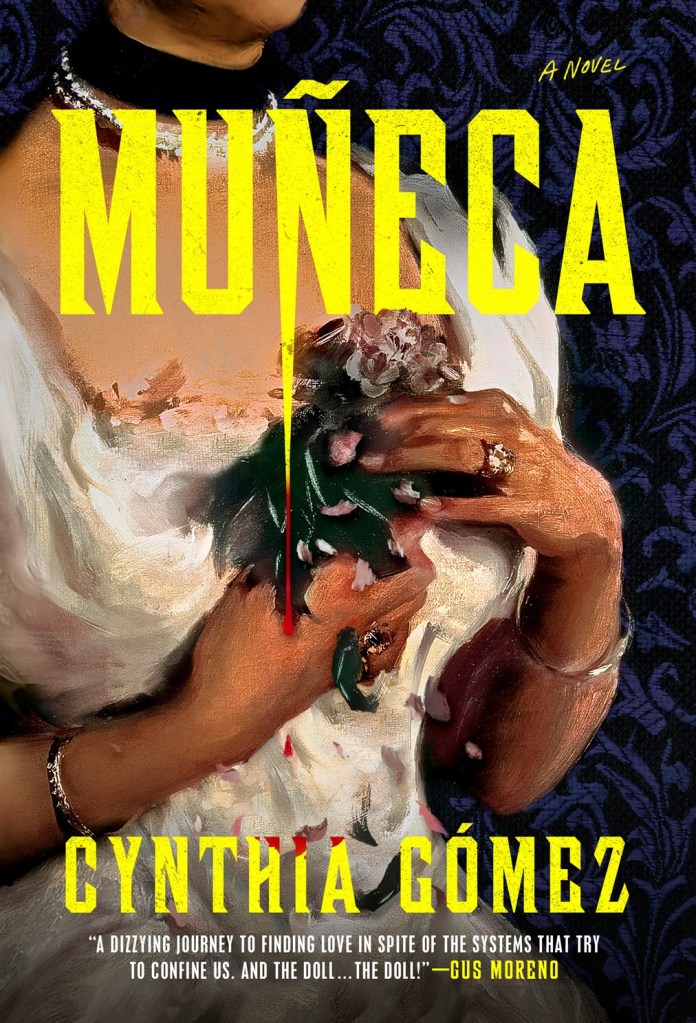
Muñeca was not at all on my list of new releases that I had planned to read. Part of that is Gómez as a debut author in a genre that I don’t closely follow, so I largely wasn’t aware this book existed until recently. It’s got some overlap in both plot and theme to Hungerstone, but I prefer this novella in almost every way. This book is short, briskly written, filled with tension, and was a creepy delight. I’ll keep an eye out for anything Gómez puts out in the future.
The Premise:
Natalia Fuentes wants money, and she finds the perfect opportunity in her late-mother’s old employer. You see, the daughter of the house fell into a coma shortly after marriage, and Natalia is sure its a spell that she can break. Serving as her nurse, Natalia and Violeta learn to communicate, and plot the end of Violeta’s wrenched family. But is Natalia’s any better?
Read if You Like: union women, erotic letters, spooky grandma witches who will fuck you up, female and queer rage
Avoid if You Dislike: implausible romances, explicit sex scenes, a good time
What Worked For Me:
Sex scenes are an art form. While sex can be written solely for arousal – and those are great fun – they also can be written in an attempt to deepen your understanding of the characters involved. Gómez manages both. As a gay man, the erotic language of sapphic fiction sometimes goes over my head. It really worked for me here, especially with how Muñeca wraps up sex and magic and intimacy into a single united package. There’s a sequence where Violeta writes a letter to Natalia, and it’s one of the more intense sex scenes I’ve read this year despite being on the lite side of graphic. Sex can be distracting to some, but it can’t be separated from the success of Muñeca as a novel. Sapphic attraction is core to everything Muñeca is about, and it makes for a powerhouse of a story.
This deftness is a good example of what reading Muñeca was like. The whole novella felt like it was on the edge of being some great Literary exploration while retaining the transparent readability that is common in genre fiction. Gómez’s attention to detail, her choice of sensory input, her impeccable research and rending of a specific moment in the history of our world, her mastery of atmosphere, an all-important element of Gothic Fiction. Muñeca sings with a dark beauty. It’s enrapturing to read, and never lets simple language feel basic or cheap.
Another successful part of Muñeca is the magic, oh the magic! Our first real glimpse is Natalia’s grandmother lovingly forcing a spider to strangle itself. When Natalia asks her ‘why,’ the response is how stupid Natalia’s question was. This sets the tone for the story. Natalia may be trying to forge a different path than her grandmother (who is a bad person who uses magic to profit without a care for who gets hurt), her spells are delightfully villain-coded. Seriously, she’s the antagonist in some alternate reality where Violeta’s mother gets traumatized and institutionalized by Natalia’s magic. To be clear, Natalia isn’t a villain, but neither is she a pure and clean heroine either. She’ll monologue with the best of them as her foes lie shivering in terror, bloody on the floor, and I was cheering her on the whole time.
Which brings us to female rage! Not a terribly original concept, nor is a husband cursing his wife for her wealth (in this case land and historical status; truly this book sparked a lot of curiosity about The California Land Act of 1851), and it wouldn’t have been too hard for this book to have turned out like a pale imitation of Mexican Gothic or Hungerstone. Natalia’s general aura of darkness helps distinguish this series from the ‘tricked by a man, and I’m slowly realizing it’ side of feminine rage. Muñeca comes out swinging and builds a tangible and detestable capitalist misogynist to turn our rage onto, mirrored only by the systems which empower him. Muñeca also delves into the feminine rage at the women who enable these men and stand behind their violence. Hell, there’s rage at Natalia’s grandmother, whom stands exclusively behind herself. Now, I don’t know that there’s anything revolutionary here. Like the rest of Muñeca though, it’s written briskly, charismatically, and convincingly.
What Didn’t Work for Me:
What is it with several recent sapphic reads having the romance originate while one character is caring for the other, whom happens to be incapable of their normal communication? To be fair, in both Hungerstone and The Jasmine Throne it’s drugs, and this is a magically induced paralysis. Still, Natalia and Violeta fall in love through a series of yes/no questions, and one very slow and limited conversation via a doll using a pencil to write words. It beggars belief that an emotional connection forms so quickly and deeply, which leaves me to conclude that Natalia is far more fixated on Violeta’s looks than the narrative voice would suggest. Honestly, been there, so I get it. Once the romance gets online, Gómez sells me on its authenticity. However, I rolled my eyes more than once when Natalia’s inner monologue got sappy in the most saccharine ways possible. You don’t know this woman! You are the driving force of every discussion you’ve had! You like the idea of her, because you don’t actually know her yet! It’s the type of thing I wouldn’t care about if this book were solely a Romance. When you want to dig into some meaty thematic stuff though, I need more from you.
Conclusion: for anyone remotely interested in unconventional gothic settings or sinister witchcraft, this is a must-read. Outside that, I still highly recommend it!
- Characters: 4
- Setting: 4
- Craft: 5
- Themes:4
- Enjoyment: 4

