
2026 has been the year of me dipping my toes into reading nonfiction as an adult. This is my fourth nonfiction book that I read for fun – nonfiction is a staple in my work life. Linguistics is an area that I wish I’d studied more in college, and I wouldn’t mind auditing courses on the topic in the future. Thus, I’m far from an expert. Galer’s work makes a very serious and sad topic accessible and interesting. As with a lot of nonfiction, it’s quite depressing, because it all feels sort of hopeless.
The Premise:
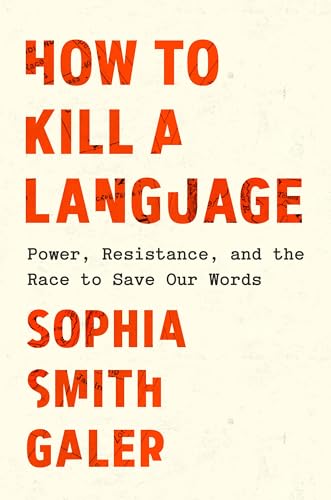
This book explores the ways that languages are killed, exploited, and suppressed around (some parts) of the world. While there is some large-scale analysis and education around theory, Galer chooses to spend most of the book exploring nine different languages as broader examples of how language extinction is accelerating with the rise of globalization and nation-states.
Read if You Like: nonfiction written for those without prior knowledge on the topic, scattered bits of interesting history
Avoid if You Dislike: Nonfiction that focuses on narrative over data, the sad feeling that things are disappearing and there isn’t anything you can do about it
What Worked For Me:
My favorite choice that Galer made was to place humans at the heart of this book. While I think there’s a more technical version of this book I’d also enjoy, Galer has a gift for humanizing the people she’s worked with. It even begins – and ends – with herself, and her attempts to reconnect with her grandmothers’ tongue, which she never learned how to speak. The trials, tribulations, and celebrations of individuals fighting to keep languages alive, of those struggling to communicate with their elders, of the people who are just doing the best they can were well-written, and Galer uses them to illustrate broader points effectively. It reminded me a lot of how I teach kids to read newspaper articles. 11-year-olds see an opening paragraph about a shrimper and assume the entire article is about him. They really struggle with the idea that the shrimper is simply a way to bring empathy to challenges facing The Gulf of Mexico, and the ways that they – as Minnesotans – are partly responsible. Galer does the same here to great effect.
There were interesting things and bright spots in every chapter, but my favorite was probably Ukraine. In some ways it had the most straightforward depictions of how Russia attempted to eradicate its language, but that wasn’t what caught my eye. Galer’s writing about Ukrainian defiance was memorable; the monuments to lost language, the poetry, the reclamation of using Ukrainian was a language with social capital. In close second was Kichwa, a family of languages indigenous to Ecuador, and how well-meaning attempts to support its growth and use instead further alienated and fractured the community.
Overall, I think I’m going to leave this book remembering a lot of what Galer wrote about. It changed the way that I notice and think about language, and my own place as a monolingual speaker of a language with immense social capital. Certainly it reinforced something that was already well-ingrained in me as a teacher, that one of the saddest things in the world is when a child and parent do not share a language in common.
What Didn’t Work for Me:
One of my bad habits with nonfiction (and fiction that attempts to provide historical education) is letting small errors or miscommunications cast doubt on a larger body of work. It’s a tough line for me to walk, since I’m very much not an expert in this field. However, I find most nonfiction books tend to overstate their case. Certainly each of the nonfiction books I’ve read this year has made grand centralizing claims about their topics (Insects, The Great Lakes, and Prairies, before this); this is no doubt a combination of an author’s own personal interest and deep knowledge of a subject, and also a desire to sell more books. Teachers aren’t immune from this either, and secondary staff live in a constant state of feeling like our content is uniquely important while thanking our lucky stars that we don’t have to put up with the annoyances that other subject matters grapple with.
So when the first chapter of the book leverages education as a comparison point, and stumbles miserably, it raises my eyebrows. I can’t quote verbatim (audiobook), but it was along the lines of ‘while we can’t expect schools to teach over fifty languages, they do manage to teach kids 15+ different instruments,’ which is a monumentally ignorant comparison. For starters, the only people going past basic proficiency and actually pursing anything resembling mastery in music are those in private lessons. As the music majors at your local college whether or not they got individual instruction, and the people telling you no will be in the minority. Our current model is setup to cobble together a functional band from a single school, when they’d produce better musicians by focusing on a single instrument. It’s designed to give a broad introduction, but fails at giving those without money an equal shot at the highest levels of performance. The statement also ignores the fact that much of the teaching in music classes does share a visual language. Trumpet and Flute and Tuba are reading the same notation, making band education more akin to teaching related dialects of a language (perhaps Mexican Spanish vs Gallaecian Spanish) rather than different languages entirely. It’s a single mention in this book, but it’s inclusion had me questioning other bold claims Galer made, wondering if she made overstating her position a habit.
I also think the Galer has some blinders on that she doesn’t acknowledge. She’s primarily limiting herself to areas where her languages give her easier access. This is understandable, but it means there’s a lot of focus on areas of the world where Spanish and Arabic are spoken; there’s no extended explorations of East Asia, South Asia, or Oceania. Similarly, Galer’s condemnation of social and ethnic groups who have power limiting language use is a sliding scale. For all she claims to value language diversity, it’s notable when she slips into passive voice, chooses to assign blame on specific individuals vs entire communities, and when she chooses to highlight human stories vs not. I got the feeling that this is a topic Galer is very passionate about, but which she hasn’t perhaps untangled her own personal biases in a book that she’s presenting as something as a wholistic primer on the topic. There’s ardent advocacy for some victims of language violence, but only tepid acknowledgement of others.
Conclusion: an engaging nonfiction suited for those mostly unfamiliar about language loss, with human storytelling at its center


I’ve considered reading this one, but haven’t gotten to it yet. Thanks for the in-depth look at the book!
LikeLike