
I finally got around to reading the third – and final – novel in the Riverside series. While it is a sequel, they can really be read in any order or can stand alone just fine. In this entry, we trade swordplay for academic debate. Other than the shift from sword to pen however, the structural DNA of The Fall of Kings fits with its predecessors. Expect gorgeous prose, political intrigue, problematic queer leads, and lots of guys cheating on their wives.
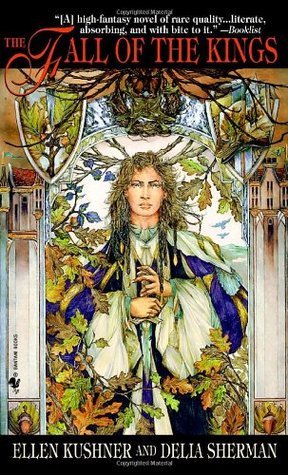
The Premise:
Theron Campion is the heir to House Tremontaine, but he’s more interested in his various affairs than learning anything of politics. His newest infatuation is Basil St. Cloud, a Doctor of Ancient History who is angling for the Horn Chair and a significant pay bump. As the two kick off an affair, Basil begins to grow more and more infatuated with the idea that the ancient Wizards actually were magic, and that the Kings had a magical connection with the land. Theron, funnily enough, is a descendent of both the ancient Kings and the Duke who slew the last one. Their romance, politics (family, academy, city council), and emotions get swept up as part of the newest chapter of a very, very old story.
Read If Looking For: the cluttered posturing of university professors, morally and emotionally dubious characters, slow pacing, the importance of idle gossip
Avoid If Looking For: fleshed out female characters, the swordfights of earlier Riverside books, a book where you understand how the magic works
Comparable Media: Greenwode, The Goblin Emperor, Downton Abbey
What Worked for Me
Kushner and Sherman’s greatest triumph in this book, I think, is their portrait of The University. Individual scholars are constantly jockeying for position, charging individual students who come to too many of their lectures, and carousing in their off hours. Predictably, Basil is a maverick, interested in novel forays into history and a lecturer with a flair for the dramatic. He’s titillated by the prospect of flipping the proverbial table of ancient history and starting anew. But he’s not backstabbing anyone or making deals with the devil. He’s actually a huge softie, and I aspire to be as patient as him while working with my students. In the modern sea of dark academia (which I love!), this attitude was a breath of fresh air. While you do get snippets of lectures (and they’re important!), the book spends more time on festivals and pub chatter than academia proper. The book gets the atmosphere correct, and that’s the essential thing. Had Kushner and Sherman prioritized plot progression in each scene, most of the things that make this story special disappear. Instead they go for a more wholistic and slow moving approach, and it pays off with character you care deeply about.
Thematically, the Fall of Kings is concerned with history as something flawed and misunderstood. Basil St. Cloud is interested in pushing towards a reliance on primary sources over established interpretations of history or governmental lines. This is frighteningly relevant today, and it was fun to see very real pedagogical debates from my world as a teacher find their way into fantasy literature. Sadly, this was written 20 years ago and we’re still struggling with governmental censorship of history, so that’s on the more depressing end of things. This is a story about how knowledge fades during the passage of time, crumbling like the mortar of the Riverside homes themselves. Said ancient novel is magic which, unlike in the other two Riverside books, does make appearances in this story. It’s an amorphous and fickle thing, full of ancient power without the chains of logic and explainability constraining it to something understandable by mere humans. The line between historicity and mysticism blurs slowly and inexorably, disturbing everything in its path as characters get swept up in the becoming of history, rather than the study of it.
Like all the other Riverside books, I’d describe The Fall of Kings as relentlessly bisexual. Pretty much every character (but especially the men) whose proclivities are known is open to sleep with … pretty much anyone if I’m being honest. Theron is a bit of a stereotype, a man known for flitting from partner to partner like a butterfly changes flowers. We begin our story with an absolutely delightful prologue where he’s dumped by a painter while he’s nude and covered in paint. Basil and Theron have delightful chemistry; thank you, oh wondrous authors, for showing us flirting instead of merely telling us that flirting is happening! The two don’t fall in love immediately, but physical connection begets emotional bonding, as is the case with so many gay men in our world. Yes there’s a lot of cliche representation of queer men in this book, but it’s all delightfully well executed and a far sight better than most of what’s put out today. As with the two previous entries in the series, don’t come into this story expecting clean happy endings or healthy relationship dynamics.
What Didn’t Work For Me:
For a pair of female authors, the women in this story are pretty underwhelming on the whole. This isn’t a new complaint for the Riverside series: the vast majority of side characters are men (and in this case our main characters as well), female side characters rarely get as much development or agency as male ones, and there’s more than a few stereotypes. This is probably the best of the trilogy, but not by much. I wish we’d have gotten to see more of Theron’s mother, a surgeon who was waging her own war in the University to carve out more space for female scholars. Instead, this endeavor was dribbled to us as idle gossip instead of spun into anything meaningful.
I also think this book complicates some of Kushner’s thematic work around privilege and power when viewed as a series. The aristocracy has always been portrayed in a negative light: typically their silly power struggles prioritize personal gain over communal prosperity, and inheritance by blood typically leads to more problems than solutions. Theron follows in his ancestors footsteps as being a supremely bratty and spoiled character, so I don’t take his protagonist status as an endorsement of everything he stands for (and he stands for very little; he typically tries to avoid politics as much as he can). However, it is frequently commented that anyone from the north can trace their lineage back to the ancient kings one way or another, so the convenience of a Ducal house birthing the first candidate to be A King in generations definitely grinds against previous elements. This mostly resolved itself to my satisfaction, but I figured I should flag it as a point where The Fall of Kings diverges from its predecessors.
Conclusion: slow, delicious, and magical


2 thoughts on “The Fall of Kings – Political Intrigue in Medieval Academia”