
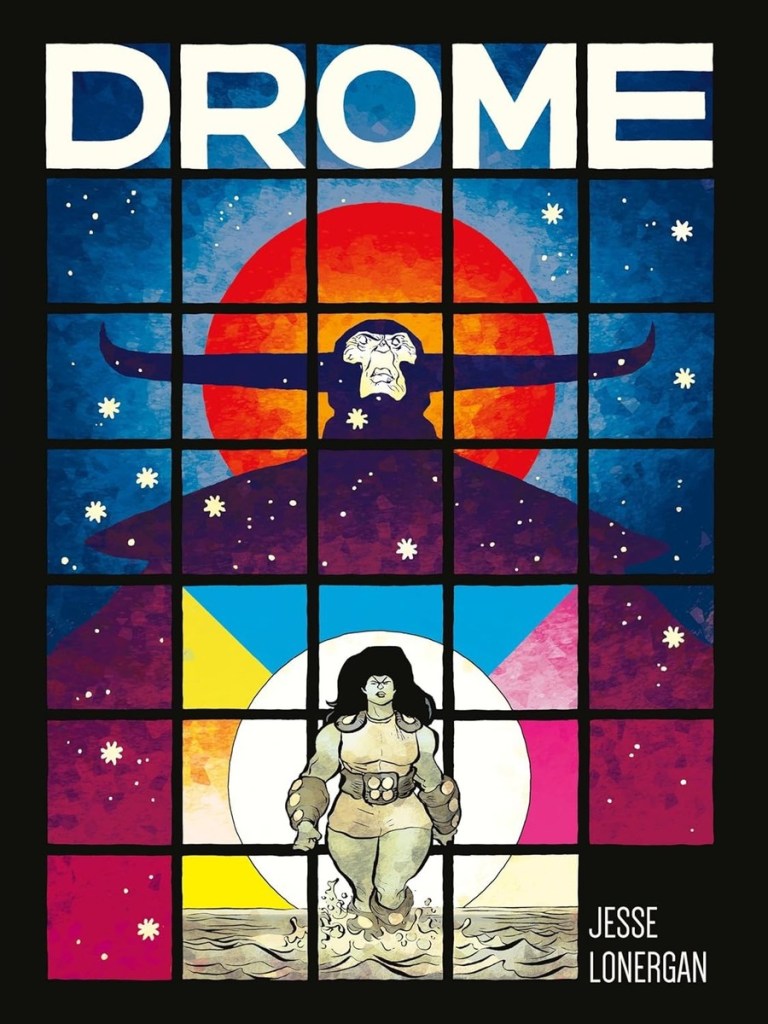
Drome is probably the platonic ideal of comics for me. It was adrenaline injected directly into my brain. I couldn’t stop thinking about it when I tried opening up my current novel. I had meant to spread this read out over five days – the book is split into five sections. Instead I finished it in a single day that was also filled with book club, yard work, and a friend’s Irish folk music concert. While Drome doesn’t quite top the emotional resonance of The Magic Fish, it captures so many of the things I love in Fantasy and Comics. It honors mythology without being a pale imitation, it leverages simplicity for power, and it uses its visual medium as an asset to be leveraged. Drome is on a lot of ‘Best of 2025’ lists in the comic world, and it’s clear why.
For those of you who don’t read many comics, I cannot stress enough that Drome is absolutely worth checking your public library for. Unlike many of my favorite comics, this one doesn’t have the same density, making it a very low time commitment for those who don’t spend much time with comics.
Read If: you love reading about mythological heroes, enjoy visual experimentation, want a grand story that can be read in a single sitting
Avoid If: simple and predictable plots annoy you, you need a simple happy ending, lack of dialogue will hinder your enjoyment of a comic
Comparable Media: Tongues, The Spear Cuts Through Water, Hyperion
Elevator Pitch:
Drome bills itself as a creation myth, but I don’t think that’s accurate. It begins with the creation of life, but it quickly shifts focus. Instead, Drome feels much more like stories of Achilles, Gilgamesh, or Beowulf. It follows a demigod created by Day to bring control to a violent world. This warrior is herself rather violent, but does her best to shepherd humanity into a prosperous future. As with many of the best hero myths, her story isn’t always a happy one, but it’s one of the few modern stories that evokes the feeling of old mythology without retelling original myths.
What Worked for Me:
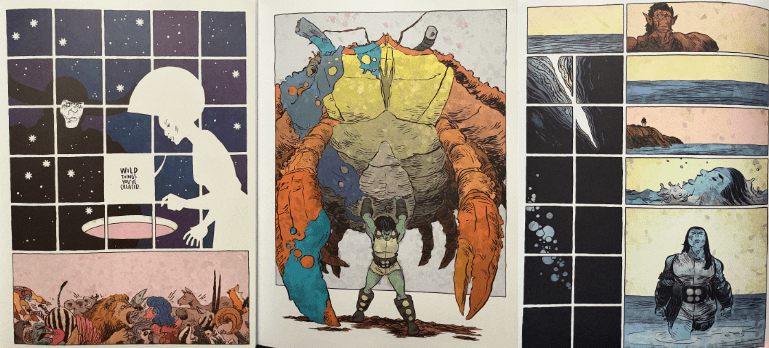
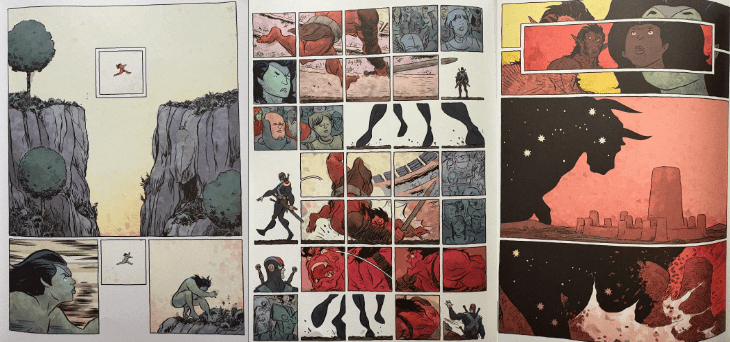
This book is (almost) entirely wordless. The art is unlike anything I’ve ever seen, and it was the cornerstone of what makes Drome so good. Lonergan makes use of a 5×7 grid of cubes as the foundation for Drome’s story. While not every panel uses these small cubes, they’re frequently leveraged and referenced in creative and intense ways. In some pages they break up characters, in other times they serve as a blank backdrop for the gods to overshadow, and in still others they allow Lonergan to rapidly shift between subjects to cause chaos. Panel layouts will force you to read in nontraditional directions, tracing a path down the side of the page instead of travelling across the top line. When the story breaks into concentric circles or swaths of blank space uninterrupted by gutters, it provides weight and majesty to the moment by virtue of the shift from Drome’s default form.
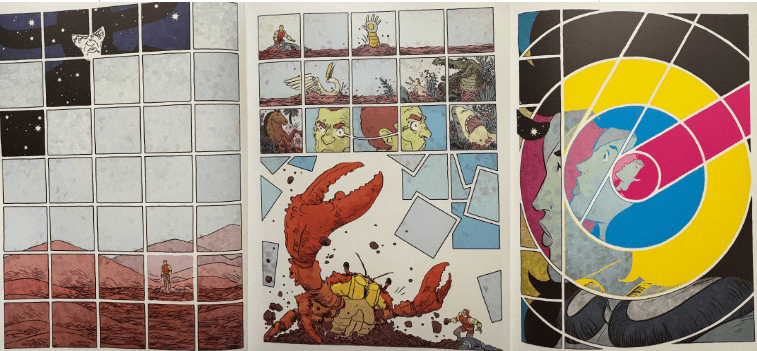
One thing I particularly enjoyed was how Drome’s layout simulated movement in static images. Lonergan uses thick white motion lines (which look eerily similar to Night’s whip and Day’s strings) to force the reader to imagine movement where none exists.. Lonergan will draw stairs without placing anyone on them, encouraging you to fill in the gaps that a character has traveled down them. In particularly dramatic moments, he isolates character movements from panel layouts entirely (or imposes them on a scene which isn’t using the cubic structure) to allow a snapshot to stand in for a movement and an emotion at once. While some of the fight scenes got a bit jumbled and chaotic, I am floored with how Drome maintained a constant sense of both clarity and dynamism.
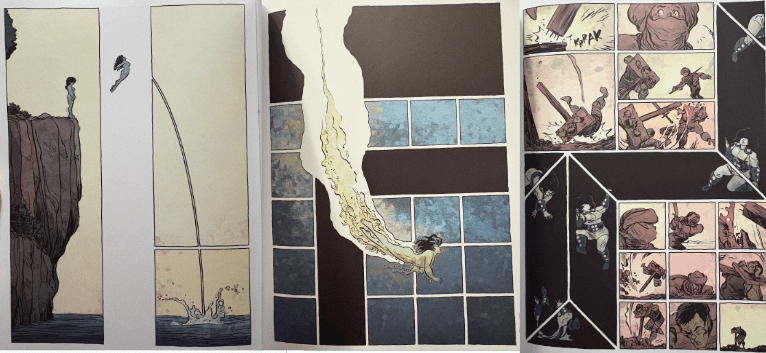
As a complete story, I can see people leveling similar criticisms to Drome as I see towards The Spear Cuts Through Water: that the experimental format and style are trappings to disguise a fairly basic story. This criticism isn’t wrong, but for me the story’s simplicity is a feature instead of a bug. There’s not a ton of social commentary or deep theming in Drome, but it evokes the feel of oral storytelling and interprets that through a comic book medium. The plot is tropey and uncomplicated: our hero helps build society, falls in love, vanquishes monsters, fights villains, and faces the gods. However, by sticking to these classic elements, it lends Drome a sense of timelessness and a mythic quality that much of fantasy is missing. It reminds me of how many of my favorite fairy tale retellings skip the Disney-isms and instead focus on older tales as their origin point. Drome lives in a balance of honoring the history of mythic storytelling with bold experimentation in a visual format.
What Didn’t Work for Me:
Nothing of significance or importance. I don’t love the character design for Night, whose face doesn’t quite fit in with the rest of the comic. I think it’s meant to be diametrically opposed to Day, who uses almost no lines in her design, but it always bugged me a bit when he was on page. I even dislike him on the cover; before reading the book I always thought he was a woman in a flared out dress with her hands spread to hold back … something. It turns out the ‘hands’ were horns, and the ‘dress’ was his neck and shoulders. Whoops!
That’s it. That’s the extent of my negative criticism for this book.
Conclusion: a dynamic and experimental hero-myth that’s well-earned its place on ‘best of 2025’ comics lists.
 Marked for Plot