
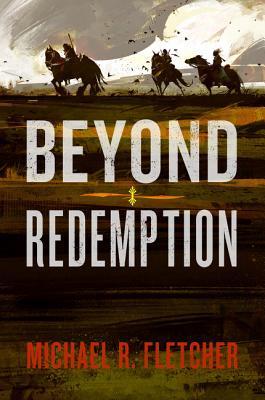
Historically, Grimdark hasn’t really been my speed. Plenty of books I’ve enjoyed, but the hopelessness and gore kept me from picking up the sequels. Beyond Redemption has convinced me that, as with my Horror journey – I might not dislike Grimdark as much as I thought. Certainly it’s reminded me that I need to read more by Fletcher, because I adored The Storm Beneath the World. Beyond Redemption is quick moving, intense, and dark without going too far. The mix won’t be right for everyone, but it worked for me.
Read If You: like an innovative premise executed to its fullest potential, don’t mind a little backstabbing or cannibalism, enjoy dry humor that doesn’t overdo itself
Avoid If You: want heroics, characters who have their shit together, positive representation of … pretty much anything.
Comparable Media: The Storm Beneath the World, First Law, Angels Before Man
Elevator Pitch:
Belief defines reality, which makes the delusional very dangerous indeed. This book follows two main groups within this world: a theocratic ruler with manipulation powers trying to build himself a god, and a trio of criminals who (eventually) get it into their head to kidnap the little boy being groomed to become god. You’ve got gruff veteran soldiers with more scarred skin than smooth, a man turning himself into the greatest swordsman in the world, scientists who try to bring about delusionists with torture, doppelganger trying to take the place of their creator, and a pyromaniac who can light a city ablaze with a thought.
What Worked for Me:
There haven’t been many books over the past month that were impossible to put down, and this was the jolt of adrenaline that reminded me that chasing the high of a great book is worth the time to find it. Fletcher’s prose is smooth, quick moving, and full of the right types of detail. I kept thinking that this book felt a lot like the grimdark reflection of Stormlight Archives, but if it were more focused on characters than plot. It’s a smooth read despite the ocean of unfamiliar (and often unexplained) terms. Fletcher also goes out of his way to balance the darkness of the book with grim (and sometimes chuckle-worthy) humor. Yes, you’ll read about horrible things happening in a relatively constant stream, but you’ll also get the bravado of a swashbuckler peacocking, pranks amongst ‘friends’, and the philosophical musings on why planning is useless. This book is dark, but I never felt that darkness was gratuitous, overly-edgy, or self-aware.
And the characters, oh the characters are wonderful! They’re all miserable people, and you’d hate to be friends with any of them. Nobody is in a healthy relationship with anyone else, but each is their own special flavor of charisma and repugnancy. I’m surprised that with 10+ POV characters (and another handful who only get a single scene from their view), Fletcher had a full cast of realized, nuanced, distinct characters to tell his story through. They don’t grow much – and those which do change mostly do so for the worse – but there’s a clear stamp on each character that makes them feel alive and dynamic. You wouldn’t expect to feel sentimental for the relationships between the criminal trio who constantly planned to betray each other, but I definitely did. I felt sorry for everybody at some point, attached to each of them as they faced their gruesome doom. Of course, I wanted each to die a horrible death, but I also wanted them to emerge victorious at the end of a trail of bodies. Considering the relative lack of strong themes or social commentary, Fletcher’s characterization carries the novel on its back.
What Didn’t Work For Me:
I had a pretty mixed reaction to the way the book handles mental illness. On one hand, the idea that beliefs shape reality – and that those who are more apt at belief have more power – is a really compelling worldbuilding element. On the other hand, I kept feeling like this book probably wouldn’t make it past a sensitivity reader who specialized in the more intense mental illnesses represented in the book. Considering the book (including a helpful index) references specific disorders such as Cortad’s, Schizophrenia, and Sociopathy, this isn’t a subtle inclusion. Most of the characters have these very real disorders (also represented in their magical powers), physical deformities that get elaborated on at great length, and are all horrible people. Some of this cocktail is part of the Grimdark experience, but there are people who are going to hate this book for understandable reasons. I think Fletcher does a great job of being respectful within the framework of what he’s writing, but the very premise will make this book a hard no for some people.
Conclusion: dark, evocative, impossible to put down.
 Marked for Plot