
The Will of the Many was a bit like fast food. I was unable to put it down, burning through the book in little more than a day. I loved every second of it. Afterwards, I began to notice that the story wasn’t as filling as I thought while reading. I knew I wanted to read the sequel, but I entered with reservations. The Strength of the Few was almost exactly what I thought it would be: fun when little thought was applied, but very difficult to ignore some glaring issues that kept rearing their heads. Will I buy the final installment when it comes out? As with the Pokemon games, my answer is always no. As with Pokemon, I’ll probably break that answer as soon as the book releases and end up disappointed.
While this review doesn’t focus on specific plot points, it will spoil the nature of the twist revealed in the Epilogue of Book 1. This information is also located on the back cover of the book, but I figured I should give a heads up.
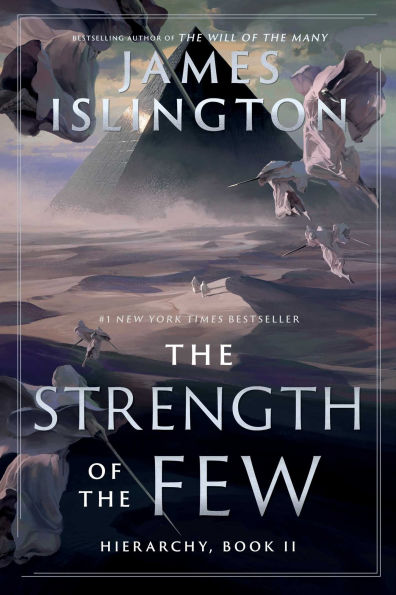
Read if: You want to see Vis keep being awesome in three worlds instead of just one, expansive scope is important to you, there’s even more noble women falling in love with Vis
Avoid if: You were hoping for a political plotline of Vis working from the inside, exploring his moral qualms with Will is important to you
Comparable Titles: Red Rising, The Name of the Wind, Ironbound, Mistborn
Elevator Pitch:
After going through the gate, Vis is cloned to exist in three worlds. Res (the one we already know), Obiteum (a desert world with not a lot of people, but a lot of necromancy), and Luceum (northern European coded with plenty of druids). He is Synchronous, one of the two to exist in all three worlds at once. He is one of two people who can use the magic of all three realms. And the other? He’s the immortal in charge of the end of the world, and Vis must stop him.
What Worked for Me:
As much as can be expected, I think Islington made some smart choices to make the expanded scope of this book work. Islington’s three-dimensions twist meant that we’ve got one cast and plot that we are very familiar with and two that are brand new to us. Res’s story is more or less a direct continuation of Will of the Many. The vibes are exactly what you’d expect. However, Obiteum and Luceum need more fleshing out for readers to get invested, meaning those plotlines operate almost like their own little ‘Book 1’ for their respective stories. Obiteum gets fast-tracked by having a mentor character who can info-dump and a world that’s mostly an abandoned desert with a single dictator-owned city. Luceum is a bit trickier, as Islington pushes it towards Res in terms of complexity and breadth of the cast. He falls back on a school storyline – a much shorter one thankfully – and largely tries to keep the focus on the mysterious figure hunting Vis down in all three worlds. This book could have been a train wreck. While I do think the Luceum and Obiteum sections were on the less interesting side of things, Islington handled the structure of this book with about as much skill as one could hope for.
If James Islington can do anything, it’s dangle a breadcrumb of interesting events to keep a reader hooked. Ironically, I think it worked better here than in Will of the Many because he didn’t chain himself to the school’s hierarchical ladder-climbing system that mostly rang hollow. You’ll get Roman Chariot racing (but with magic), negotiations with assassins, the return of the Deus-Ex-Wolf, and more 1:1 duels where the opponent cheats. As the plot in one world winds down, another picks up. Even when you’re less interested in one version of Vis, you’re always wanting to continue reading to see what the other versions get up to. This aggressive pacing is what kept me in Will of the Many, and it didn’t go away in Strength of the Few.
What Didn’t Work for Me:
One of my big complaints about Will of the Many was that Vis was too good at too many things. I won’t rehash my complaints, but the Gary-Stu protagonist was fine enough in a magic school story. I knew it would be an issue for me if it kept appearing as the series began to expand its scope into something more rigorous and epic. Unfortunately, Islington seems intent for Vis to rival Kvothe in his skillset, and problems exist more or less only to showcase how fucking awesome Vis is.
An early obstacle for Vis is language. Well, it should have been an obstacle. He effectively got yeeted to land that diverged from his long enough ago to make language similarities about as similar as this review is to Old English. No worries! Vis “has always been good at languages,” and during his learning curve, he’s always able to translate or infer any essential information that would be detrimental to his success if he didn’t know. The loss of his arm in book 1, which supposedly has an impact on your ability to use magic (let alone the realities of day-to-day life) is not a problem! He’s not the most powerful Will user his age, but he’s damn close, and his month of farming experience allows him to stay on fairly even ground with a trained soldier while he wields an unfamiliar weapon well. Plus he’s totally a skilled blacksmith capable of articulating a metal arm. Any new problems or skills with Will are conveniently solved by telling us about things they trained for at the academy that definitely didn’t happen in book 1. It seems like the only time Vis’s drawbacks seem to matter are when the stakes of a scene aren’t terribly high. This was annoying, but mostly fine, when the book’s plot felt like a tropey magic school story. Here it’s a sin I find difficult to forgive.
Perhaps this is me harping on an element of the story that Islington would describe as a feature, rather than a bug. Wish fulfillment definitely has its place in fantasy, including some of my favorites. Certainly there should be room for books with massive scope to feature a protagonist who smashes through everything in his way. I don’t particularly like that however, and can acknowledge it’s a personal issue. If you enjoyed this element in book 1 (or perhaps disagree with me that Vis excelled at an implausibly large number of things) then this book might be right up your alley.
While I’m harping on Vis, I might as well add one more gripe to the pile. Islington spent a lot of time in book 1 building up Vis’s strong moral rejection of the will-ceding system of the Hierarchy. He refuses to participate in it, and despises it as a whole. He knows that eventually the day will come when he will participate, but that he will lose something essential of himself when that happens. Book 2 Vis has about three paragraphs of inner monologue when finally joining this system followed by … nothing. No guilt, to feeling of betraying his ideals, not even an attempt to minimize his use of Will when it isn’t absolutely necessary. One of the most interesting internal conflicts vanishes without even a wave goodbye. To a certain extent, any thematic merit introduced largely gets subsumed by the desire for the books to get bigger, grander, and more epic. The series is all flash, no substance.
Conclusion: A real page turner, but thematically I don’t think a lot is happening.
- Characters: 1
- Setting: 3
- Craft: 3
- Themes: 1
- Enjoyment: 3
 Marked for Plot