
I was first (and second) introduced to Yoon Ha Lee through school. His Korean middle grade space opera Dragon Pearl was quite popular for a few years running, and I use some of his short stories from the fairy tale-esque anthology The Fox’s Tower and Other Tales as part of my high school Genre Fiction class. Unfortunately, I didn’t like Ninefox Gambit very much. Lee is a phenomenal worldbuilder who avoids the need to explain every element of the world. In a military-action story however, that choice doesn’t work quite as well. If you’re looking for something weird and trans-coded, this might be for you. Sadly, it wasn’t for me.
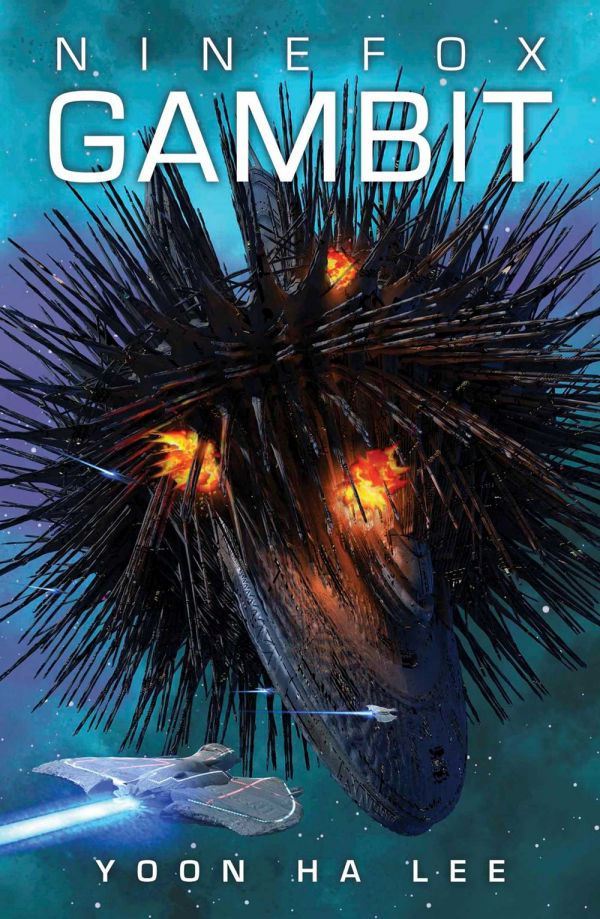
Read if Looking for: calendar magic, military commanders making tough decisions, sieges, sentient robots building their own culture, creepy shadows with nine eyes
Avoid if Looking for: familiar Space Opera ideas, clear space combat sequences, strong characterization
Elevator Pitch:
Cheris is a commander in the Hexarchate’s military force. She’s got a gifted mind for maths and formation tactics derived from the Hexarchate’s calendar magic. When offered a chance at rapid advancement if she can offer a satisfactory plan to recapture a key military base captured by heretics. Her plan? Host the ghost of a long-dead traitor-general who murdered his entire force of soldiers when alive. He’s even more of a genius than she is, but can she trust his motives and advice to be for the good of her empire?
What Worked for Me
There’s some really interesting thematic seeds in Ninefox Gambit about the brutality of war. Our viewpoint is of a commander who is both thrown away by her superiors, and who later is responsible for throwing away her own soldiers, for the sake of victory – not even victory always, sometimes just as a psychological ploy to fool the opponent. Her behavior is disturbing and tactically sound. The Kel (military faction of the government) relies on brainwashing and forced unity to work their magical formations, their shields, and their weapons. This book flirts with a clear endorsement of Utilitarianism. When the end is goodness does the sacrifice of a relatively small amount of human life in exchange for continued stability seem worthwhile? Certainly this is a choice every government on Earth has made willingly, and Lee’s frank engagement with the messy nature of military conflict was a breath of fresh air from both the escapist action sequences or idealistic takedowns we see of governments in Fantasy and Science Fiction. I enjoy both those types of stories, but liked how this didn’t slot easily into either category.
Plus the worldbuilding is both delightfully weird and totally unexplained. Are the ships actually moths? Probably not, but it’s cool that they’re named that way. Calendar setups have tangible impacts on military strength, with heretics adding gasp a whole seventh day to the calendar??? They must be destroyed, though apparently in the past that seventh day didn’t go well for long term health of the Empire. Lee’s world is strange and alluring.
What Didn’t Work For Me
Unfortunately for this evocative ambiguity, Ninefox Gambit’s plot places a great deal of its focus on science fiction military maneuvers and space warfare. The books more or less follows a siege of a rebel stronghold. This setup had the potential to be a major positive. Unfortunately, I didn’t feel like I had a strong enough understanding of how the calendrical powers affected military maneuvering to have an impact. Space battles oftentimes had a bunch of cool words and formation names, but I found they lacked tension for me. I’m sure Lee has a good grasp of formation names and effects, and how this world’s magic technology manifests with space combat. However, I felt like I was reading a bunch of technobabble without the necessary context for me to feel like there were significant stakes in the military end of the storyline. It made a major chunk of the story feel like filler.
Alone, this wouldn’t have been a major detriment, even when it forms a good chunk of the book. Unfortunately, the other pillar the book rests on – Cheris’ complicated relationship with the probably insane general Jedao – similarly felt like it lacked the necessary substance to sustain the ambition of Ninefox Gambit. Cheris herself is the first problem: she’s a bit of a self-insert character. Yes, she’s a prodigy in maths who feels like she’s in over her head. However, I struggle to identify personality or significant character arcs beyond a list of traits, and mostly she just feels bland. Jedao is a bit better. Lee succeeds in making him exceptionally creepy when needed. However, his relationship to Cheris feels tepid and underdeveloped. Their interactions never felt like they were building up to anything meaningful, and while some elements of the ending were a legitimately interesting setup for sequels, the book ultimately didn’t sell me on the emotional connection that should have been a bedrock of the story.
When a book focusing on military conflict and possession by a semi-insane ghost fails to be evocative in either aspect, it leaves me feeling underwhelmed and unengaged. The cool worldbuilding kept me in Ninefox Gambit’s orbit, but was never enough to land the ship.
Conclusion: an ambitious, but ultimately disappointing novel from an author whose fairtyales I quite enjoyed
 Marked for Plot
Sorry you didn’t enjoy this one! I don’t disagree with any of your points, they were just things that didn’t bother me the same or that I interpreted a bit differently, which, fair enough!
I loved the second book much more, but I’m not a fan of ‘well you hated book one but read the sequel anyway!’ so I’m not urging you to give it a try. I do hope you try more from this author at some point, though! From what I’ve read of his work, this genuinely is his weakest novel. His standalone Phoenix Extravagant might be more to your taste?
LikeLike
He’s definitely someone I want to read more of. I like The Fox’s Tower a ton, and The Dragon Pearl was an enjoyable middle grade romp. He’s not a ‘must read’ author, but definitely one that I keep tabs on.
LikeLike