
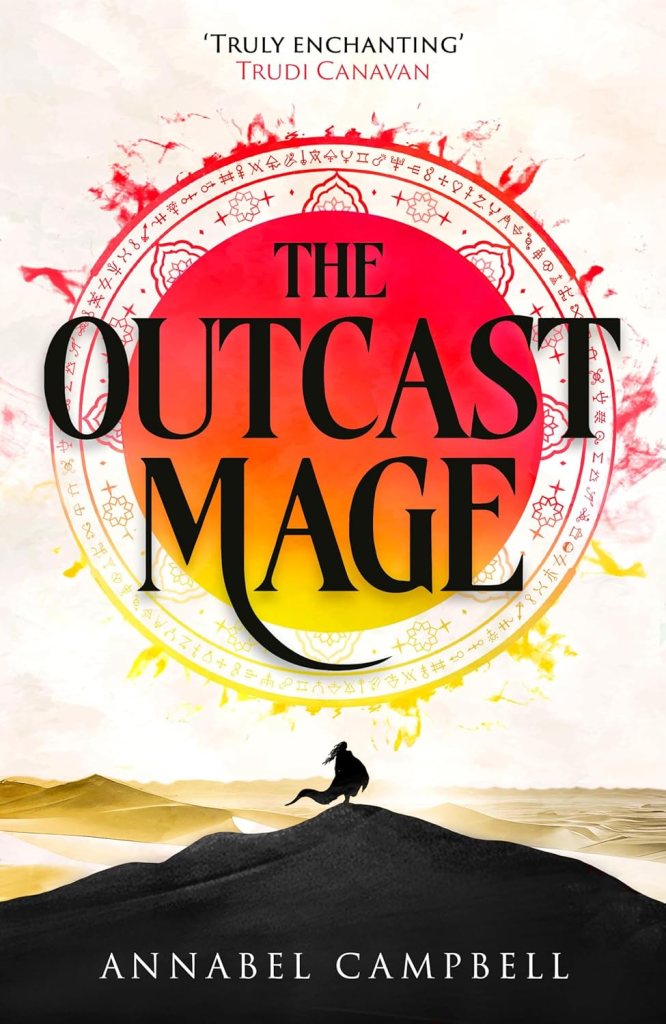
Will February be the month of aggressively mediocre reads? Unclear, but if the last few books I finished are any indication it might be. The Outcast Mage reminded me that I need to DNF more, but kept luring me back in with interesting little tibits. Just as I was about to quit I learn that the spy priest is gay and eyeing up his bodyguard. I can’t stop there! Sadly, this book never quite came together for me, but I think could be a good fit for someone looking for a straightforward and modern take on Epic Fantasy.
Read if Looking For: chosen ones, magic as an analogue for xenophobia, straightforward writing
Avoid if Looking For: intense characterization, nuanced villains, lots of dragons (more in the sequels?)
Elevator Pitch:
Amoria is a city in a glass dome, a refuge for mages who fled persecution. Now however, they perpetrate many of the same crimes against those without magic. Naila lives between: she has the power to sense magic – and is thus a mage – but has now power herself. She is both with and without magic, trapped between two worlds who both view her with suspicion. This is mainly her story, but we also follow the city’s most powerful and arrogant mage, a senator who is Aunt to Naila’s best friend, a spy priest from the country who long-ago hunted down mages, and a strange woman wandering the countryside investigating mysterious calamities.
Musings and Opinions
In a lot of ways, Outcast Mage feels like the quintessential example of what modern Epic Fantasy looks like right now. It’s a novel focused mostly on humans, cares more about exploring a single city than vast travel scenes, uses the fantasy world to comment on societal problems, maintains the chosen one trope but with a twist, and involves some sort of unnatural power rising up at the end of the book to raise the stakes for the sequel. There are plenty of books that fit this mold which I quite like (I’m still waiting on the sequel to Glass Immortals!) but Outcast Mage didn’t feel like it innovated in any interesting way.
Alone, that’s fine. Plenty of books I enjoyed weren’t pushing the boundaries. The Incandescent, The Devils, and The Raven Scholar all were enjoyable reads that I don’t regret, but which didn’t particularly move me. The Outcase Mage left me feeling unsatisfied and bored. I struggled a bit trying to figure out why this novel didn’t resonate with me. In the end, I think that Campbell wasn’t able to find a good narrative voice for her novel. The prose in Outcast Mage is simple, but it doesn’t vanish into the background either. Our four main characters don’t feel significantly different in their narration or internal monologue.There’s some potential for interesting thematic elements, such as a dear friend joining a fascist police force to temper it, only to slowly be consumed by it. Unfortunately, it never particularly felt like this plotline went anywhere interesting. The novel’s premise felt like Blood Over Brighthaven without the nuance or depth.
Even the handling of the Chosen One elements felt unsatisfying. Naila spends nearly the entire book powerless, a magical mystery. When her powers do awaken, Campbell struggles to convince me that she is simultaneously at risk of being overwhelmed while she’s taking down entire legions of trained combat mages. It’s such a rapid shift for a character without consistency, and I don’t think her character arc survived that transition. Naila wasn’t alone in these abrupt shifts either, and all of our characters felt like marionettes dancing on the strings of a predestined plot: never a good thing to think about while reading a book.
Yet every time I thought it was time to put the book down and walk away, there’d be something to pull me back in. An interesting tidbit of lore, a moment of political intrigue, or a moment of attraction. In the end, these little glimpses of immersion never solidified into consistent engagement in the novel.
Conclusion: some interesting ideas, but it felt generic and under-written. Slice 150 pages off it or push the characterization more, and I’d have been a lot happier with this book.
 Marked for Plot
Yep, this is one I DNFed, and none of the reviews I’ve seen have made me regret that decision…
LikeLike