
If you’d like to see my review for book 1 in this gay epic(ish) Fantasy series from the 90s, see Luck in the Shadows.
It’s been a long time since I read a Mass Market Paperback, or enjoyed the smell of an old book. While my hand suffered some cramps during the final 100 pages, it was a nice hit of nostalgia for what reading used to be like. I enjoy reading on e-readers well enough, but the larger-sized paperbacks and hardbacks of our modern printing era are definitely more comfortable to curl up with. That said, I miss how inexpensive books used to be!
Anyways, this was a great sequel to a great opening of a series. As with book 1, be prepared for elements that feel dated and gross in our modern era. This book was a lot less of that than the original though, especially since I’d accepted and and compartmentalized from my significant qualms about how Flewelling set up the relationship between Alec and Seregil in book 1.
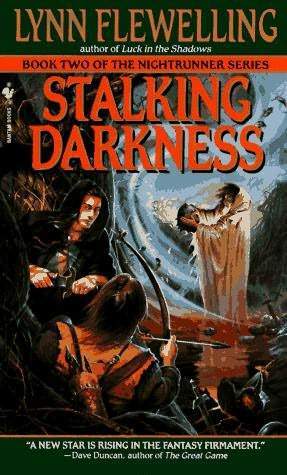
Read if Looking For: political intrigue, brewing wars, so many dreams, angsty pining, a sudden awareness of breasts and pectorals
Avoid if Looking For: books without rape or torture, lots of female characters, moral ambiguity
Elevator Pitch:
This book is a hodgepodge of Alec and Seregil’s adventures as the growing threat of war with Pleminar develops. Seregil goes hunting for more dangerous necromantic relics, Alec starts to do spy jobs solo, and they both keep feeling like people are following them. Alec learns about his past, we get a cryptic prophecy, and the villains make their move. Lots of classic fantasy elements, though this book continues to place a heavier focus on political or urban exploration elements than extended travel across fantastic terrains or grand battles you see in other epic fantasy works of the time like The Wheel of Time.
What Worked for Me:
Stalking Darkness does everything I’m looking for in a good sequel. Luck in the Shadows was mostly a spycraft and political intrigue book; Stalking Darkness kept that core while expanding the scope of the story to include more military and occult elements. Alec and Seregil form the backbone of the story, but a side character named Bekah slowly gets more and more perspective chapters as she is slowly integrated as a major character in her own right. The stakes of conflict are raised, and lots of big plot elements are resolved. Honestly, this could have been the finale of a duology, and it would have worked just fine. Stalking Darkness was everything I hoped for. After a disappointing set of sequels in December, this was a breath of fresh air.
The writing of Seregil and Alec’s relationship was a big improvement from book 1. As a slow burn romance, this entry in the saga mostly saw them coming to terms with their feelings for each other – and avoiding talking about it at all costs of course. I needed to mentally shelve my qualms around Seregil’s role as Alec’s mentor and his perception of Alec as a child from book 1. Neither are present in this book, and it was easy to imagine the single year that passes was in fact three or four. In deciding to pick up the sequel, I accepted that I wouldn’t let these issues ruin my experience unless they kept popping up. It truly feels like an entirely different dynamic, especially since Flewelling stopped infantilizing Alec. The biggest highlight of the entire book was a set of brothel scenes featuring delicious teasing as Alec gets in over his head at a gay brothel and overcompensates, Seregil tries to make sure he has a good time by taking him to a straight brothel, and Alec ends up with a woman he only finds attractive because she looks like Seregil in drag. Fun times all around.
This book has the classic 80s/90s trend of despicable and irredeemably evil antagonists. You’ve got a pair of necromancers – my favorite of which is a very flirty Litch whose skin is blackened and scabbed, an aristocrat who treats torture like morning tea, and a few villain-of-the-chapter sorts who provide foils to antagonists with more gravitas. The book toes the line of dark without venturing into excessive territory, but Flewelling made absolute evil much more interesting than other authors I’ve read from the time. I’m not always in the mood for classic fantasy vibes, but this series looks to be a reliable option for when I am.
What Didn’t Work for Me:
One of the things I’d heard about this book was a rather influential scene featuring a sexual assault that isn’t handled well. I’m inclined to agree with these assessments, though it had a smaller impact on me than for a lot of readers. A Sorceress casts seduction magic on Alec, and they have sex. This experience leads to a sexual awakening. While many characters were critical of the Sorceress, they also found the situation & Alec’s later reactions humorous. It wasn’t a particularly strong condemnation of her actions by the characters. However, it never felt like the narrative (or the author) was positing this as a good thing. It wasn’t handled perfectly, but it could have been much much worse. As with book 1, it helped for me to view this book as a product of its times (1997, which wasn’t actually that long ago) and make an intentional decision on whether I’d let this affect my enjoyment of the rest of the book. Your milelage may vary depending on how important this issue is to you though.
The story was also rather liberal with throwing around long extended names of people, places, and events that didn’t end up particularly relevant (so far). I find this style of writing more in older books, and I definitely have a preference for the more modern way of handling worldbuilding. On one hand, it’s nice not automatically knowing that someone is going to be plot relevant simply because they get a name (potentially ruining a surprise or twist), and it makes the world feel more fully fleshed out. On the other hand, it forces me the reader to either spend a great deal of time organizing my thoughts despite relatively little information mattering or to ‘go with the flow’ and be moderately confused. Reading the series immediately back-to-back likely would have helped with this problem, but it did impact my enjoyment of some of the political wrangling that happens in this story.
Conclusion: a satisfying sequel full of deeply evil villains. Had I not known the series continued on, I would have assumed this was the end of the series.
- Characters: 4
- Setting: 2
- Craft: 3
- Themes: 3
- Enjoyment: 4
 Marked for Plot