I came for innovative queer worldbuilding, and I stayed for dinosaurs. This book kept coming up on lists of stories with queer worldbuilding elements, came off my shelf because I wanted to read a story about dragons. While I liked the book a lot, it didn’t succeed on either count, and folks coming to this story looking for queer representation will find themselves disappointed, despite a 5/6-gender society and cultural clashes over the morality of homosexuality being major elements of this book. Hopefully that shifts in the sequels, but right now it’s probably better to think about this as a more plot-focused Game of Thrones style story.
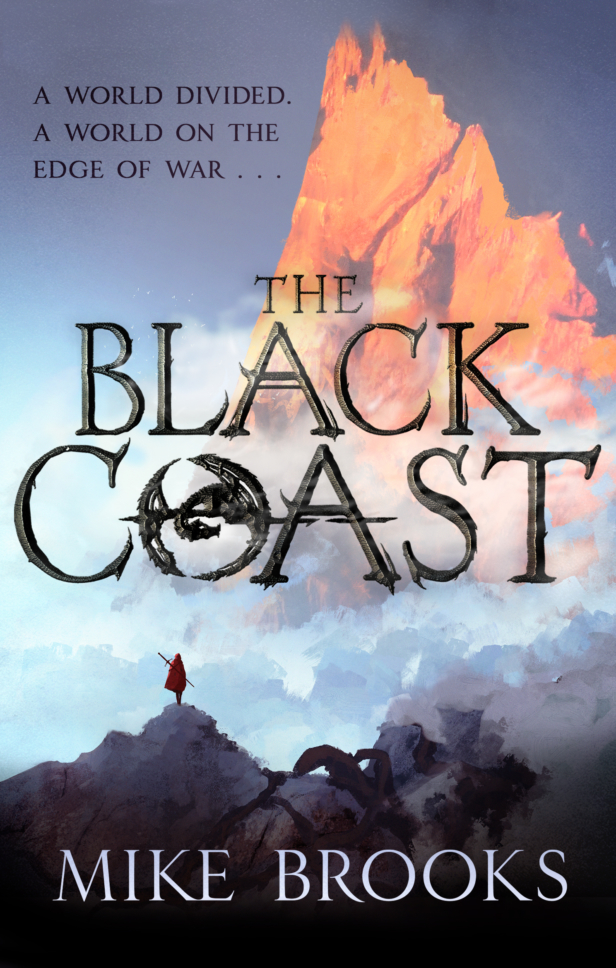
Read if Looking for: Dinosaurs, codes of honor, more POVs than is wise, cultures inspired by Feudal Japan and Scandinavian Vikings
Avoid if Looking For: magic, character-focused stories, travel & journeys
Elevator Pitch:
There’s two main storylines happening in The Black Coast. The town of Black Keep is visited by raiders (who are fleeing an undead monster on their home islands) who wish to settle the land instead of fight. The stepson of the town’s Thane betrays his own honor to allow them to settle, capturing his stepfather (who has anger issues) and imprisoning him to prevent a bloodbath. They must learn to live together while other raiders hunt them down and convince other Thanes that the raiders shouldn’t be slaughtered. Meanwhile, the sister of the Emperor travels to Alba (a neighboring nation) under her second life as the Queen of the Underworld to arrange the assassination of a family that claims the rightful inheritance of the God-King’s blood that (in theory) was inherited by her brother. In that same city is a thief just trying to survive.
What Worked for Me
I loved how Brooks thought through the connection between language and culture! So many authors don’t think about language much, but it formed a centerpiece of the setting and plot points in The Black Coast. You’ve got the Albans, who have six genders (well, 5 genders and a genderless identity), each with different accent marks. It’s odd at first, but as you settle into the rhythm of these sections you begin to internalize how characters are indicating (or withholding) their gender in conversations. The townsfolk’s culture doesn’t have traditional first person pronouns, instead using ‘this ____’ to identify oneself. The word chosen changes based on your relationship to the other party, reflecting the formalized class structures of their world. It was just a great way to incorporate worldbuilding into the passive reading experience, and the choices were well thought out. It reminded me a lot of The Mask of Mirrors by MA Carrick: a great slow burn fantasy featuring a con artist who takes on personas from a few cultures and changes her speech based on her persona. Anyways, this nerd who wishes he’d taken more linguistics classes in college had a great time with this part of the book.
Also, this book has dinosaurs! They’re called dragons, but they’re very clearly dinosaurs. I did not realize how much I needed faux-Japanese samurai riding faux-Triceratops. Not-Velociraptors also play a fairly significant role, especially as a few characters are training them up as animal companions. I’m excited to see more of literally all of this in the sequels. Full disclosure, I was totally a dinosaur kid, and seriously considered going into geology in college. My enjoyment of this may be significantly higher than the average reader’s.
Beyond this, Brooks was able to build towards some really intense moments. There weren’t a ton of twists and turns, especially since we spend a decent amount of time in the perspective of various antagonists as their paths cannonball towards the main characters’. However, the moments of climax are rewarding and mostly exhilarating. While there are great fight scenes, Brooks succeeded at diversifying how characters solved problems, which kept the book from feeling monotonous. I generally found the payoff to be much more enjoyable than the set-up, but the payoffs were a lot of fun.
What Didn’t Work For Me
I think the scope of this book was too wide. It’s not short, but many of its 600 pages are blank buffers between chapters, and generally short chapter length means Brooks didn’t dig in too deeply into any single character before moving on. I counted 11 different POV characters spread across 4 locations, though a handful of these characters only ever got a single chapter. It’s got the ambitious scope of something like Game of Thrones, but even that series started in a more concentrated place before allowing the characters to wander all over the place. I ended up feeling like most storylines were rushed for time, and it left precious little time for Brooks to dive into themes or allow his prose any level of reflection or contemplation. It’s all plot, all the time, even when there’s a really interesting core scenario to be explored – the raiders-turned-settlers storyline. I wish the scope of this book had been chopped in half to allow for those ideas to really bloom. Book 2 could have expanded the scope of the story, and I don’t know how much the Alba storyline was needed in this volume.
There were also a continuous number of small moments that made me feel like Brooks hadn’t really thought through his worldbuilding. Some of these were small and forgivable: the Emperor’s sister (and the real political power player of the royal family) lives a double life as the kingpin of her Kingdom’s criminal underworld, and literally nobody has realized. Not her bodyguards (which are separate based on the persona at the time), or her advisors or her ladies maids. I don’t care how competent a character is, it’s unrealistic. That said, Tila’s fun, so I can accept this as a poorly thought out premise to move the plot forward. It would have been so easy for her to just have some bodyguards in on the ploy though, to make things more realistic.
Other elements bugged me a lot more. Considering how much thought Brooks put into the 6-gendered society of Alba, his decisions on how cultures in the raider/town storyline view homosexuality are bizarre. It’s a major point of friction between the leaders of each faction, and the prime example of how both communities need to work through cultural differences. The raiders think homosexuality is abhorrent, while the townsfolk see it as totally normal. The problem here? Black Keep is part of a culture with extremely rigid gender roles, a culture where women are second-class citizens. One of their foundational texts says “It is to men […] we must entrust our future: and men it must be, for the Unmaker was a she-demon of great power […] and so we may judge that women will ever be weaker and more corrupted than men.” Meanwhile, the raiders are more than happy to have kids out of wedlock, and they don’t seem to place any cultural importance on gender in a person’s place in their society. It just felt so backward; the town which has separate unmarried women’s housing than men’s to keep them apart is really okay with homosexuality? I could have just rolled my eyes and moved on, but it kept coming up. For a book interested in queer worldbuilding, it was a big miss, especially since the only POV character who is homosexual got one POV chapter, and is otherwise a pretty minor character. To be fair, it was probably my favorite chapter in the whole book, because few things are more exhilarating than queer rage.
Conclusion: A plot-focused epic fantasy with lots of interesting elements in isolation. I don’t know that they came together perfectly, but I’m interested in reading more.
- Characters: 3
- Worldbuilding: 2 or 4, depending
- Craft: 3
- Themes: 3
- Enjoyment: 4
 Marked for Plot