
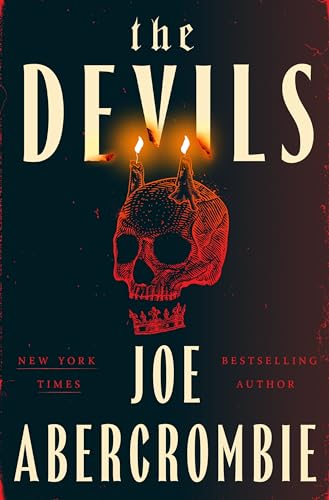
I shouldn’t have been surprised at how controversial Joe Abercrombie’s new release would be in parts of the fantasy fandom. The Devils is a departure from Abercrombie’s reputation as a character-focused writer interested in deconstructing classic fantasy tropes, and a popular author straying from their niche invariably invites criticism. At its core, this is a misfit adventure novel with a collection of villain archetypes as major players in an ensemble class. I thought the book was fun, a great audiobook to listen to at the gym, but probably not one that’s going to get recommended by me unless it’s a unique fit to someone’s requests. Had a great time with it though.
Read if Looking For: villain of the chapter, big personalities, extended fight scenes
Avoid if Looking For: a carbon copy of First Law, historical accuracy, a book impossible to call ‘safe’
Elevator Pitch
Brother Diaz is a monk who thought he was destined for greatness when he was granted an audience with the Pope. Instead, he’s put in charge of a ratag group of prisoners to escort the long-lost princess of the Empire to take her throne. He’s got to wrangle a suave vampire, a bloodthirsty werewolf, an elf assassin, an egotistical necromancer, an immortal paladin, and a normal woman who has worked any job you could possibly imagine for at least a few weeks. Together, they must beat the odds – mostly just dead Empress’ four sons, all of whom want the princess dead – and complete their holy quest despite none of them wanting to be there (other than the paladin).
What Worked for Me
As an Ensemble novel, this book’s success mostly rested on the backs of the lead cast of characters. Thankfully Abercrombie was able to adapt his style into something more casual while still delivering on excellent dialogue and character development. You won’t get anything as nuanced or deep as his previous work, but each of the ‘Devils’ has a satisfying character arc that sees them grow and change across their various bloody adventures. In particular, I though Balthazar Sham Ivan Draxi (one of the three greatest necromancers in Europe) was a delight. His self-assuredness was comical enough to keep me laughing without ever tipping into something outrageous. Vigga, the werewolf with anger and memory problems, was a more straightforward comic relief, and Baron Rikard’s characterization mostly comes from how others swoon at the sight of the vampire’s mesmerism. The group was balanced enough that you’ll probably find a few characters that you love, and likely one or two that bug you. Abercrombie practiced a lot of restraint in this arena, and I think a less skilled author would have let these characters fully off-leash and take over the story. Instead, their realizations and internal journeys were meticulously managed (perhaps too much so), and everyone ended the story at a different spot than they began.
On a prose level, Abercrombie nailed it as well. He’s not a dense writer, but his accessibility is insightful, and filled with creative metaphors and descriptions that capture the emotion of something without belaboring the point. His plot keeps to rigid structures while avoiding a constant sense of ‘everything is a chase scene’ that I’ve seen these style books devolve into from other authors. Honestly, this entire book didn’t blow me out of the water, but really made me want to revisit the First Law universe, where I’ve only ever read the opening volume.
What Didn’t Work For Me
I had some minor nitpicks with this series (the ‘main two’ of the ensemble cast are on the boring end, some small plot holes and character inconsistencies) but overall found this enjoyable read. However, I wish it had been shorter. 547 pages is a bit too long for a book that isn’t mindless fun, but doesn’t have a ton of depth either. Abercrombie committed to ‘dark yet tropey’ as the vibe of this story, which (in my mind) would be perfect in the 300-400 page range. There were 4 main villains, each of whom got a pretty large multi-layered fight scene dedicated to their death. However, I don’t think the book would have missed out on anything particularly important if there had been only 3 villains and the book was 25 percent shorter. My attention began dragging towards the end despite not having anything concrete to actually be complaining about.
Additionally, this book was perhaps too tightly written? As much as I praised how the characters each had discrete journeys, and how Abercrombie diversified his conflict structures to keep from repetition, I could feel the pressure of the outline for the entire story. This kept things fairly predictable. I knew exactly when a twist would hit (though perhaps not what the twist was), when the story would escalate, and when we’d dip into introspection and more focused character work. There was a sense of rawness missing from this story that kept me from ever fully committing to the narrative. I think back to some of my favorites, such as Welcome to Forever by Nathan Tavares, which are books that have more concrete flaws, but which manage to encapsulate something special and powerful. Vigga was in a constant battle to keep the wolf in check, except when she needed to let her monster out to hunt for The Good Meat. Abercrombie could have let his monster out a little bit too, and I think the book would have been better for it.
Conclusion: a fun romp, but ultimately an unmemorable one I think
- Characters: 4
- Setting: 3
- Craft: 5
- Themes: 2
- Enjoyment:3
 Marked for Plot