
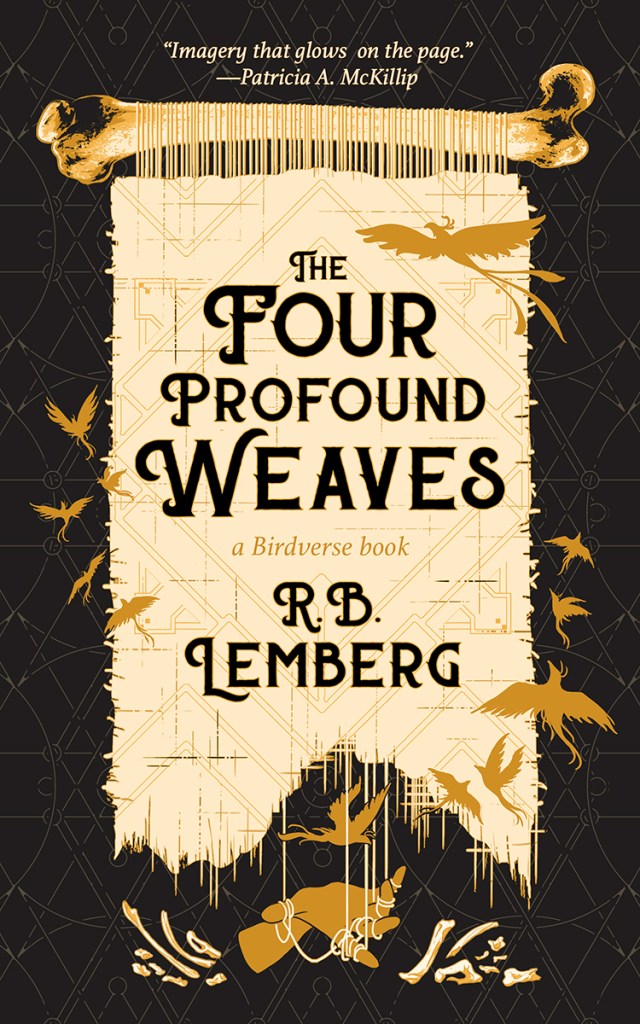
I’d been hearing a lot of buzz about the Birdverse series, and when a book club picked up The Four Profound Weaves for November, it was time for me to take it off the shelf as well. This book hearkens back to magic as mystical, inspects the internal journeys of an elderly trans man’s late transition, and takes us on a jaunt through several different cultures. Ultimately, I was disappointed in this despite liking a lot of individual pieces, and I’m curious to see if RB Lemberg’s short fiction will capture me more than this did.
The Premise
This book follows two main protagonists: the nameless man who struggles with what it means to be a man after transitioning late in life in a culture with rigidly defined gender roles (which map not at all onto our own, including as a reversal) and Uiziya a weaver who never realized her potential, and whom now seeks out her powerful and terrible Aunt to teach her the secrets to the weave of death. The two travel together, learn from each other, and must eventually face The Collector, who seeks to own all that is unique or special.
Read if Looking For: platonic bonding, characters with profound self-doubt, desert landscapes, magic carpets
Avoid if Looking For: novellas with a clear focus, nuanced villains, action scenes, happy queer stories
What Worked for Me
The Nameless Man (who thankfully does get a name eventually) has a really touching journey. A lot of trans narratives in fantasy focus on younger characters, often with parental drama. This gave a viewpoint I hadn’t seen: an elderly (or perhaps late middle age) trans man who physically transitioned late in life. His struggles with what masculinity looks like were by far the highlights of the story for me. The balance of craving the be like the men of his culture, anxiety about being accepted, and questioning whether masculinity has to look like what it looks like in his culture were handled excellently. He as a consistently well-realized character whose struggles felt relatable despite me not sharing his experiences in the slightest. It’s a real testament to the power of fiction, and this book was dripping with humanization. It was this, more than anything, that makes me want to seek out their short fiction, because I think there’s a lot of promise in how they approach storytelling from a character’s perspective.
There’s also quite a few times where I noticed imagery and language as a strength of the book. Especially when it tilted towards the macabre, I found myself really pulled into the language and visuals being used. It’s a world I’d be interested in exploring more in the future for sure.
What Didn’t Work For Me
I wish Lemberg had either lengthened this into a novel or cut a whole lot out of this story. It was 192 pages long, but I struggled with this book never settling into an idea. It’s clearest through-lines (namely the doubt that lingers even post-transition in many) were generally successful, but got dragged down by this book pulling in too many different directions. It wants to showcase at least three different cultures, each of whose norms have deep impacts on the two leads. It wants to investigate toxic family relationships, and it wants to explore the growing trust between two people who have been brought together again in search for a mysterious dark figure. It wants to highlight the four magical weaves (woven from wind, sand, song, and bone), but also for the Deepnames (another type of magic which I never understood at all despite several moderately lengthy attempts to explain it), and have both be important to the resolution of the main plot of the story. It wanted an evil villain representing imperialism. Too many things, not enough pages, and this lack of focus left the book mostly devoid of the emotional impact it was aiming for. As a novella, it felt busy and cluttered. Novellas can’t afford to not know what they’re doing, and the best novellas ruthlessly sacrifice elements to hone one or two portions that form the core of the story. That didn’t happen here, sadly.
In a complaint that says more about me than about Lemberg (this is by no means unique to them) but I wish weaving-as-magic was engaged with in meaningful ways. This is coming from the child of a weaver who tried to raise me as her successor, so I acknowledge that even my limited knowledge of the topic puts me in the ‘annoyed that authors don’t know as much about xyz thing as me’ which is patently unfair, especially when ‘magic as threads’ is one of the more common depictions of the arcane in western media. But in a book that has a loom on the cover and weaving so prominently featured, it never engaged with any of the mechanics of weaving. Just handwaved ‘yeah the song became thread became cloth’, when there is so much goddamn potential for actually using real concepts of weaving to deepen the depiction of magic and lend emotional depth. End rant.
Conclusion: some interesting ideas and deep themes, but it tried to do too much for its page count and felt rather disjointed as a result.
- Characters: 4
- Setting: 4
- Craft: 3
- Themes: 4
- Enjoyment: 3
 Marked for Plot
For whatever reason, I’ve consistently not-vibed with Lemberg’s novellas/novels, but loved all their short fiction. Hopefully you’ll have a better time with the short stories too!
LikeLike