
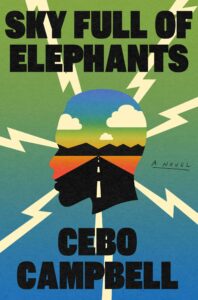
Sky Full of Elephants seemed to be making more waves in the literary and general markets than in spec fic corners of the reading community, which is usually a sign that a book probably isn’t for me (though I’ve been proven wrong before). As comparisons to Toni Morrison and Octavia Butler began popping up, however, I knew that I needed to read it. It didn’t live up to those comparisons unfortunately, but it’s a book that’s been lingering in my head. I think it has a heaping plate of flaws, ambitious ideas, and a captivating writing style. There won’t be many readers who have a tepid reaction to this book, which I think is a good sign that it’s speaking to something important.
As a disclaimer, as a white person, I’m not the target audience for this book, which likely affects my perceptions of this book. I think it’s worth people reading outside books targetted at them, but Sky Full of Elephants is written by and for Black Americans, and is very much about Black American joy, history, and hardship.
Read if You Like: books designed to make you uncomfortable, or to challenge your ideas, utopian societies, big twists, ethical dilemmas in books
Avoid if You Dislike: magic with clear and explainable rules, inconsistent character development, weird potshots at walking dogs on leashes, ambiguous endings
Elevator Pitch:
When The Event happens, seemingly every White person in America walks into the nearest body of water and drowns themselves. While not everything is perfect, Black Americans have been able to reimagine what society looks like, and most are flourishing in this new world. Charlie, a man wrongfully imprisoned for 20 years, is now a professor teaching about the energy grid. When he gets a call from a daughter he never got the opportunity to meet, he leaves Washington DC and heads straight to Wisconsin. Sidney is mixed race, and strongly identifies with the White side of her family. She hates her father, but has nobody else left except a note from her Aunt (who somehow survived) that there is a community of living White folks in Orange Beach, and she needs her biological father’s help to get there. This road trip takes them through Chicago to a pseudo-magical version of Mobile, Alabama, which will challenge both of them to redefine their relationship, come to terms with their own baggage and history, and fall in love with themselves.
—
Normally I split my reviews into pros and cons, but I’ve just sort of accepted that this entire review is going to be a tangled mess. Instead I’ll tackle things by topics.
Prose
This is the big winner for me in this book. I had a lot of trouble putting this story down. Part of that is the book tackling some cool ideas that got me doing a lot of thinking (always a positive), but also because it was just well-written. Not dense, literary prose, but something very tangible and accessible. It was successful at moving the story along, pulling at emotions, and very good at creating atmosphere and mood. The physical locations always felt alive, balancing on the edge of physical description and metaphor that can come off as corny, but Campbell does it so well.
I think one thing in particular that makes Campbell’s writing engaging is how he’s able to capture joy. He is very good at developing all types of emotions in characters, but his relentless push to showcase what a liberated experience for Black Americans might look like allows him to dig deep into the depths of happiness and joy in particular. The mood was infectious, and the emotional highs were counterbalanced by much darker and sadder elements, preventing a sense of monotony in the story.
Execution on the Core Premise of the Book
The common issue that reviewers have with this book is that they dislike the central premise of the book is a bad/uncomfortable/racist one. I don’t share that opinion. It’s an interesting premise for a book, and engages with a very real idea: can we get rid of racism if it’s so ingrained in the subconscious culture of America as it stands now? Certainly real change is going to need to be more drastic than what’s happening now (more on this idea later). This utopian-esque setting was better done than most, primarily because Campbell acknowledged the problems still facing society. On one hand, I definitely don’t believe that we’d suddenly stop using single-use plastics or drilling for oil, especially since the rest of the world is untouched by The Event. On the other hand, Campbell did acknowledge challenges, such as how airports probably only had a 2 year life expectancy before they ran out of fuel. The challenges of reinventing a society (even a better one) never coalesce into real plot points or impacts on characters, but they were present. These little bits of imperfection helped me silence the little pessimist in my stomach telling me Utopias are impossible, which bugged me in stories like Hands of the Emperor.
No, my first real problem is that the premise of the book is very wishy-washy on what happens to people of color who aren’t Black. It’s established early on that they disappear just like White people – presumably also drowning themselves, though that’s never stated. But not all of them? It comes up a few times, but but almost always feels like ‘oh wow, there’s an Asian person! Can you believe some of them are still alive??’ vibe.
Cambell clearly wanted to envision an America where Black culture was allowed to flourish without outside influences. In order to explore that space, it also means removing vast swaths of other cultures from the book. However, it doesn’t seem like Campbell wanted to imply that these other groups were also complicit in Black oppression, so some very few of them remain. Notably, we don’t get any descriptions of mass-suicide in Chinatowns or on reservations like we do from Wisconsin suburbia. Yet so much of the thematic weight of this book rests on those who are gone creating space for something new, so Campell is stuck in a pickle. Does he acknowledge other flourishing cultures who develop free from whiteness, or does he kill everyone else off, making the premise a lot less appealing at a glance? In the end, he waffles, trying to take neither road and instead leaving me in a state of cognitive dissonance. I found it undermined the very themes and world he is envisioning. You will note that this is a continuing complaint of mine about the book: bold ideas that Campbell isn’t quite willing to fully commit to.
Another thing that bugged me (but perhaps is less of a universal complaint about the book) was Campbell’s utter lack of understanding of the Midwest, where a decent chunk of the opening third of the book is set. Other than Chicago, it’s completely empty. I don’t share his core assumption that Black Americans wouldn’t begin to reimagine farmlands when free from the oppressive racism of rural white America. Certainly they are happy to in Alabama, just not in the Midwest for some reason. The cities are no better. When Charlie noted how Milwaukee was basically a ghost town I found myself rolling my eyes. Milwaukee is the 31st largest city in the US, and Black Americans are its largest demographic. Milwaukee would be just as much of a locus for community and culture in this world as other cities with large Black populations. I’ll fully admit this is – in the large scheme of things – an unimportant detail, but it bugged me.
Spoiler Warning for the Rest of this Section for Major Plot Twist, though I keep as vague as I can.
My favorite part of the book, the part that pushed the novel from an engaging utopian-esque setting to a book with actual teeth, was a doozy. It turns out that the mass suicide was actually not suicide after all, but a mass-killing as part of a push to heal the Black community in America. Charlie gets wrapped up in potentially recreating this event to fully heal the community of their trauma, connect them with their past, and create true liberation for Black folks around the world (no longer just the United States). This book has now shifted firmly into ethical thought experiment territory alongside an exploration of Black joy and liberation, and I love it when genre fiction delves into ethical questions. What if the only way to heal generational trauma and create a just world for Black Americans is through the murder of every White American? Do you make that choice? What a delightful little trolley problem. It’s fucked up yes, but I can’t think of a good ethics question that isn’t, including the most famous Ethical exploration in speculative genre fiction, The Ones Who Walk Away from Omelas. Unfortunately, I found Campbell’s execution of this idea lacking. It had the same problem as Hands of the Emperor by Victoria Goddard (a very different book, but one I keep drawing comparisons to). The potential for a second genocide did get some lukewarm resistance, but any questioning of the rightness of the action was steamrolled immediately by impassioned monologues. Dissent and doubt weren’t engaged with in meaningful ways, and a raw human reaction to the idea of killing millions of people never really had time to be explored. I think ethical quandaries like this only work when the narrative forces the reader to grapple with both sides of a tough question, and to live in the messiness. This book only really asked us to grapple with one side of it.
Notably, the book never revisits the plot point that this genocide also killed off a bunch of Asian/Latino/Native American people. Not all of them are killed, but it seems like the vast majority have been. There’s some Latino and Native American representation thrown in right at the end to remind you that some are still alive. Conveniently, they bear no ill-will towards the destruction of their communities or the death of their families, and have no objections to the destruction of large chunks of communities like theirs across the world. I get the decision. It goes back to Campbell being interested in exploring Black identity specifically, but unwilling to make the tough choices for that decision to make sense. Instead, this problem is tucked away into a corner, hoping that the reader won’t pay too much attention to the inconvenient detail the narrative glosses over. Have the hard conversation, and live in discomfort.
Another way Campbell sabotaged his own genius how White characters were a monolith. I can’t think of a single named White adult who isn’t an objectively horrible person deserving of prison time for repeated hate crimes. Sidney’s kid half-siblings seem mostly fine, and the book doesn’t ever really get into the whole killing White kids/toddlers/babies side of the thought experiment. The adults though, are universally beating up Black characters, tying nooses around their necks, lying to get Black men thrown in prison for crimes they didn’t commit, etc. All these are very real White people in our country, worthy of facing ridicule and rage and justice in a way that many currently don’t have to. However, it’s a lot easier to justify the murder of all White people in the country (and potentially the world depending on Charlie’s choices) when that’s the only type of White person represented. It’s tough for a novel-length book to explore an idea like this when presenting the simplest possible form of that idea.
To be clear, I think the simplicity with which Campbell handled the above two points mostly worked for the first ⅔ of the book when that focused on exploring what Black Utopias might look like. However, the thought experiment fundamentally changed. This was no longer an act of god; it was an intentional human choice that Charlie and company may expand to affect the whole world. The foundational questions upon which the book rests have shifted. The stakes have been raised. Dramatically, and in a way that made me excited to keep turning the page (or rather, listening to the next hour of the audiobook without stopping). Campbell didn’t engage with that idea as seriously as I think it deserved. It sucked the energy out of a book that could have landed within striking distance of some of my all-time favorites. It’s likely that the answer the book posits (that Black healing should not come second to the concerns of others after what has been done to them in America, regardless of the consequences) would have remained the same. However, without the depth or nuance to really explore the ideas Campbell was putting on the table, that conclusion feels hollow and unearned in this novel.
Characters
I would describe the characters in this story as enjoyable, but rather one dimensional. Campbell really nails character voice; everyone was evocative, easily distinguishable, and had some interesting motivations and ideas pushing them forward. I loved following Sidney and Charlie on their journey, but I don’t think their character arcs were particularly sophisticated. They moved at the whims of plot, especially Sidney. Her character arc is primarily overcoming internalized racism, but it felt very disjointed. The clearest example of this is how near the start of the book she pulls a gun on a Black boy running across her front yard, out of her stepdad’s programming to see every Black person as a threat. However, a few days later she is kidnapped by a group of Black men with knives and put on a bus against her will. Her internal monologue describes how it’s the safest she’s ever felt in her life. The abrupt 180 just doesn’t make sense (it is later revealed that these are tools, not weapons, and they were never under actual threat of violence. However, Charlie and Sidney were told on no uncertain terms they did not have a choice about getting on that bus, and Sidney perceived them as weapons at the time). There were some other moments like this for Sidney, and I think her development in the final third of the book was a lot more interesting than what I saw in the first sections.
Sidney and Charlie also had big main character energy. Of course, they are main characters, so it makes sense on some level. For example, both of them start falling in love almost immediately upon arriving in Mobile with influential members of the society. They’re also immediately brought to the leaders of the community, and drawn into the inner circle. Presumably this doesn’t happen for every new arrival in this very large and growing city. However, there’s never an acknowledgement about what makes these two so visibly special to this community so quickly. Later in the book, Charlie is inventing a totally new way to channel physics/magic/etc to maybe possibly change the world forever, and he talks about being ‘nobody special’. He is quite possibly the single most special person in the world, even putting aside the fact that he’s a savant who could fix near any machine by the time he hit 12 years old. None of this is a problem on its own, but it was another point of tension between the really serious thematic work that Campbell was attempting, and the more casual genre conventions he relied on. Both are wonderful things, and at times they can work together well. However, the consistent push for me to consider these really profound and uncomfortable questions juxtaposed with tropes I’d find in Red Rising was jarring and discordant.
Conclusion
I just don’t know about this book. On one hand, I couldn’t put it down, and I loved how ambitious it was. I also think it failed to execute almost every single big idea it tried to accomplish. In the end, I’m glad I read this book. However, I wish it had been written by Campbell later in his career, or perhaps by a different author. I’d have killed to see Rivers Solomon, Eden Royce, or Marlon James’ take on this idea. However, I’m definitely going to be thinking about this book for a while, which says a lot about the quality of a book.
 Marked for Plot