
Much like Will of the Many last year, The Raven Scholar has taken my little corner of the internet by storm. It’s a mystery, but not a mystery. A tournament arc, but for adults not teenagers. It’s got a scholar main character, but feels as ambitious as epic fantasy! The hype is real, and I’m seeing a lot of people rave about this as their book of the year.
I’m a little bit more pessimistic than most. It’s a good book, and I absolutely intend to pursue the sequels. However, I think there are more issues than a typical review is ready to admit. If you’re willing to commit to the premise and enjoy the ride, I think it’s absolutely worth a read. If you like internal consistency, this book may get under your skin.
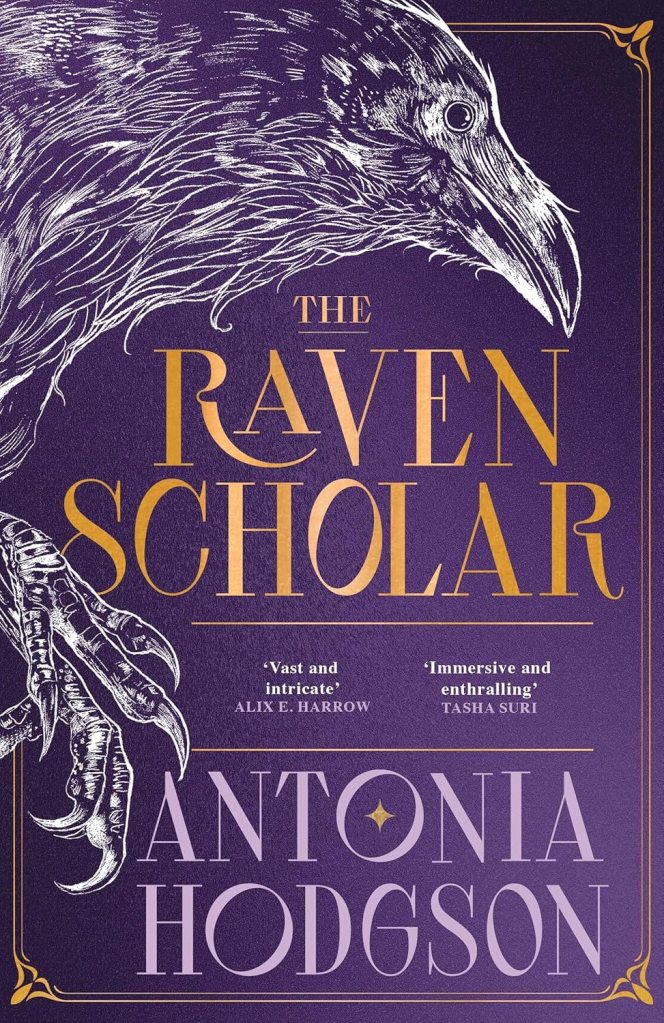
Read if Looking For: readable prose, sassy ravens, tournament(ish) arcs, mystery(ish) plots, political maneuvering to set up for an epic fantasy trilogy, tropes executed in fun ways
Avoid if You Dislike: the nagging voice in the back of your head reminding you that the explanations for badass twists don’t make sense if you think very hard about what’s happening, a protagonist whom everyone hates for no discernable reason
Elevator Pitch:
Neema rose to the leader of the Ravens (one of eight branches of the government and society, each represented and paying homage to an animal god) through her research that captured the eye of the Emperor. Also by scribing the Writ of Exile that put her in the Emperor’s orbit,. It was for a 16 year old daughter of a noble family living in squalor after her father’s attempted coup. Neema’s role in the punishment has haunted her for years. Now the time has come to select a new Emperor. The Raven representative is her childhood nemesis, the Fox contender is her ex-boyfriend who left because she scribed the Writ of Exile, the Hound contender carried it out, and the Tiger contender is the dead girl’s twin brother who sent her to Exile in the first place. When a contender turns up dead, Neema is thrust into an investigatory role, into the competition to decide the next Emperor, and into the attention of the gods she resolutely believes don’t actually exist.
What Worked For Me
The Raven Scholar is a rather delightful bundle of tropes. I think Hodgeson dabbled in a lot of different styles, and they gelled really well together. You get a little bit of the Dystopia/Harry Potter societal sorting elements, but handled in a way that is actually fun – more like churches. The Foxes in particular are riotous fun, though she didn’t manage to make the Tigers (the token ‘evil’ faction) that much more complex than Slytherins. There’s some murder mystery elements, but it never takes so much time or energy that you’re having to keep track of theories or suspect lists in your head. The tournament arc is present, full of delightful fights and challenges that fade away as the BIG PLOT begins to interrupt the proceedings. You get some epic fantasy ‘end of the world as we know it’ elements, but without the travels or giant armies. It’s a very playful story that dances on so many different threads of modern speculative fiction that feel representative of the whole. I’d be hard pressed to find a book that better encapsulates the state of traditional fantasy publishing right now than The Raven Scholar.
Another highlight was Cain. The whole cast was consistently fun to read about, even if their actions didn’t always make much sense. Cain however, was delightful. He’s Neema’s on-again, off-again partner, though they’ve been off for 8 years. Like most Foxes, he’s a bundle of inconsistencies, contradictions, and whimsy. He’s always eating something, and always has a backdoor escape hatch. He was charismatic, both in-universe and on-page, and is one of the more immediately captivating fuckboys with a golden heart I think I’ve ever seen. The quality of writing consistently went up whenever he was on screen. To a lesser extent, I’d say that the Raven God, the Fox Abbot, and mother of the central exiled (dead) girl all are more compelling than the average character in a fantasy book. In this respect, this book was a lot like Red Rising. These characters won’t win awards for depth, nuance, or complexity. However, I fucking love reading about them.
Finally, I think the prose carried a lot of this book. The Raven Scholar sits pretty squarely in a style of writing I call ‘brutally readable’. Hondsgon gets a little bit experimental at times – mostly with her omniscient raven narrator – but almost always is executing a classic page-turner prose. Her pacing grows in intensity, eventually doling out enough twists that you stop guessing and just strap into the roller coaster. She knows how long to spend describing a scene and how long to drift into memories, thoughts, or reflective musings. Her dialogue is not realistic, but it is believable and snappy in a way that keeps you engaged. It’s just really well done all around. The type of book you start daydreaming about as you try to fall asleep for the night.
What Didn’t Work For Me
This story has more holes in it than a colander. I spent my entire time reading this book in a state of cognitive dissonance. I enjoyed the story, had trouble putting it down, but there were constantly little things that didn’t seem quite right. Characters acting differently than the narrative told us they should be. Odd decisions that made little sense. Plot twists that didn’t quite hold water. Most of this I can forgive in books that are as fun to read as The Raven Scholar. However, these came frequently, and often. Occasionally they were explained to my satisfaction, functioning as good storytelling – I was meant to see that as odd! How clever! – but usually even these explanations fell short of satisfying their own purported reasoning. The Raven Scholar wants to be a grand fantasy epic that is taken seriously, but unless the next two books tighten the plot and character consistencies up, I’ll not be able to count it as one of the true greats of the genre. As it stands, I had one eyebrow perennially raised the entire book.
I think it’s worth honing in on the first, and most important, illogical contradiction. For the life of me, I couldn’t figure out why the exile from the prologue was so important to everyone. The punishment was horrible; exile here effectively is extended torture. However, this moment haunts so many characters in this story (both their internal struggles and how other people treat them because of this event eight years ago) that you would think this to be a meaningful moment defining the history of their culture. But the Empire routinely commits acts of barbarism, including putting entire families to death for the crimes of one person. Yet this single act is all-consuming; killing a disgraced noble teenager (not even the whole family!) hated by nobility and commoners alike is remarked upon by all. It keeps coming up as a reason to drive characters, motivate them to push forward with their goals, or to treat Neema like a pariah (but mostly not the others who were part of the punishment? Why is writing the document so much more heinous than the guard who carried it out?). A plot point that prominent needs to be airtight. Instead, it holds up about as well as raw flan. It just wasn’t a believable enough motivator when taking the rest of the worldbuilding into account. The twists related to it make it even worse, to my astonishment while reading. And this core inconsistency made every other point of suspended disbelief so much harder to justify. Unfortunately, I think it would require monumental reworks to make this idea function, and it’s hard to overstate how big of a problem this single elementwas for me, even though I’m normally the type of reader that likes to accept a books’ premise at face value.
Finally, Neema is a weak character amongst a fun (if inconsistent) cast. She’s got major ‘not like other girls’ energy. She’s an outcast. Purportedly because of the writ of exile thing, and also that she’s a commoner, and also that she’s bad at making friends. But plenty of people are widely liked and accepted who have all of those things against them. And Neema’s behavior doesn’t even seem remarkably unreasonable. She’s the living embodiment of “well actually,” but it never comes across as annoying. Hell, it came up rarely enough for me to forget it was a character trait of hers. The author needed Neema to be disliked, but didn’t make the commitment to create an actually unlikable protagonist. As a teacher, I can attest that if nearly everyone has a problem with you, some self-reflection needs to happen. It isn’t even a case of an unreliable narrator, since we get the narration from the Raven God’s point of view (sometimes a rather invisible third person narration style, at other times a very heavy handed alien god. I’m not mad at this choice, but it would have been cool to see more consistent arcane musings from a deranged hivemind of ravens who don’t understand time as a construct). Thankfully Cain and the other characters were delightful enough for me to get past my eye rolling at how Neema was written. And it looks like book 2 will feature a lot less of the social and political maneuvering than was present here, so it will matter less that Neema seems like a pretty typical person other than her love of research and good memory.
These are some fairly significant negatives for me. The fact that this book is still sitting at a comfortable 4-4.5 in my enjoyment scale is a testament to how much I enjoyed the writing. And Cain. I really like Cain.
In Conclusion: an adrenaline-inducing blend of political, thriller, mystery, and tournament fantasy with evocative prose and far too many plot holes to be quite taken seriously.
- Characters: 3
- Worldbuilding: 3
- Craft: 2 (plotting) 5 (pacing)
- Themes: 3
- Enjoyment: 4
 Marked for Plot