
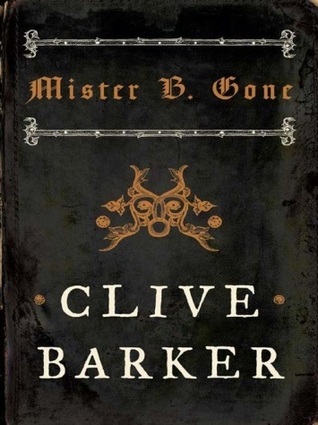
I’ve known the name of Clive Barker for a while now. Hellraiser is influential enough that even someone who absolutely despises horror movies knows its basic imagery. He’s an author lauded as a pioneering queer writer and an author I had no intention of touching with a 10 foot pole. Mister B. Gone was recommended to me by a friend who swore it was their favorite book of all time though, and so I took the plunge into this dark comedy. It wasn’t a perfect book, but the writing was engrossing enough that I’m curious to try some of his books that are more widely lauded.
Read if You Like: Fourth-wall breaking, morally bankrupt (but likeable) protagonists, humorous asides, demons and angels
Avoid if You Dislike: books without a strong A-Plot, engrossing climaxes, straightforwardly gay characters
Elevator Pitch:
Jakabob Botch is a demon. A rather incompetent and pathetic demon really, who can’t even work magic properly. And he’s trapped inside a book, the book you’re reading incidentally. Throughout his recounting of his life’s story on Earth, he besseeches you to burn the book in your hands, to end his pitiful existence trapped in ink and paper. But fine, why not, he’ll tell you a little bit more, but only if you promise that you really will destroy the book by the end of it all.
What Works for Me:
I’ll be blunt, the 4th wall breaking in this book is it’s defining feature. I think it can be a bit repetitive at times, but overally I think it’s a conciet that works really well. In the hands of a less charismatic narrator (and a less competent writer) I think this book would be an absolute train wreck. And a lot of folks seem to view this as one of Barker’s weakest works (it’s got a 3.35 rating on Goodreads, which is far lower than I normally see, and certainly the lowest rated book I’ve read this year). To me, it read as the wheedling of a rather pathetic imp, doing whatever he can to trick a human into doing his will. Which, I think, is a really solid premise to build a book around, and the right type of situation to acknowledge that the story you are reading is, in fact, a story.
I think one of the key things helping the meta-textual premise is the fact that Botch is just a really delightful character to follow. He’s demonic in all the right ways, embracing the realities of demonic behavior without slipping into the ‘he’s not that bad of a demon’ like in Good Omens. No, Botch will happily spend time describing how he punishes hypocritic and pedophilic priests, only to turn around and tell you that he kidnapped and murdered 31 babies so he could bathe in their blood, but that keeping them all alive until he reached the bathtub was a real pain. You would absolutely not want him anywhere near you, but he’s got that casual sense of charisma that makes following his misadventures an enjoyable ride. In fact, had this book stuck more closely to the slice of life elements, this could have reached a 5/5 stars for me.
Finally, there was a really solid development of queer identity in the story that I absolutely wasn’t anticipating (it wasn’t on my radar as a queer book at all). Despite enjoying kissing girls greatly, Botch falls deeply in love with a male demon and is in utter denial (and disgust) towards the idea at first. It was a weirdly realistic portrait of a person coming to terms with their sexuality, and the relationship (or perhaps fixation is a better term) was quite successful. Unfortunately, it makes absolutely no sense that a demon who murders babies and is generally ambivalent to morality would ever see homosexuality as bad or ‘sinful’, and that was a rather large sticking point for me. Considering how the little I know of some of Barker’s other stuff is pretty blatantly queer, I’m tempted to place the plame at the feet of the demands of traditional publishing houses in 2007. It was jarring, however.
What Didn’t Work for Me
The plot was bad. Really bad.
Barker tried to introduce some elements of mystery elements, hinting at world-changing events. The story was never structured in a way that felt like any real build up happened, and when we did arrive at the climatic moment it was the definition of underwhelming. The ideas weren’t bad, but it’s excecution was very, very poorly done despite clearly wanting some buy-in from the reader on how momentus this moment in history was. Even really humorous negotion scene between an archangel and demonic heir couldn’t salvage the ending of the book
Conclusion: a delightful dark comedy sabatoged by poor plotting decisions.
- Characters: 4
- Worldbuilding: 2
- Craft: 2
- Themes: 3
- Enjoyment: 3
 Marked for Plot
One thought on “Mister B. Gone”