
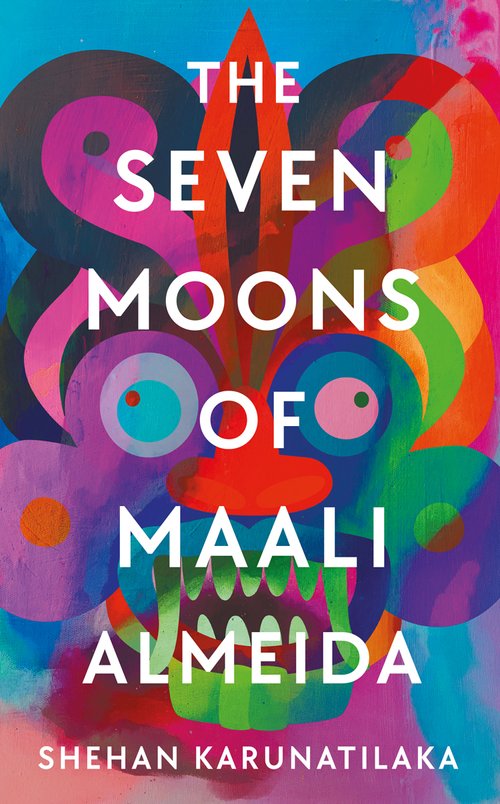
Sometimes, incredible books fall in your lap for no seeming reason (and by no seeming reason, I really mean Audible’s algorithim has learned that I like books about gay men). It’s certainly not my normal fare: I don’t read a ton of magical realism, and even less that pushes more on the literary end of things than the genre fiction side of that subgenre. Yet I’m so incredibly thankful I indulged the whim to dive into this book. It isn’t perfect, and likely won’t crack my favorite reads of the year, but it’s going to stick with me for a long time.
Read if You Like: Magical Realism, ghosts, critiques of colonialism, dry humor
Avoid if You Dislike: tight plotting, morally upright characters, books lacking answers hard questions they bring attention to
Elevator Pitch:
Maali is dead, stuck in a queue to find his way to the next life. He doesn’t know how he died, but he knows that he has unfinished business in the land of the living. He’s a war photographer in 1990 Sri Lanka, a gambler who loses more money than he makes, and a slut who has trouble remaining monogamous to the boyfriend he really does dearly love. He learns he has seven days before he is stuck forever in the in-between, and promptly sets off to try and get his partner and best friend to find his photographs, which have the power to topple a government.
What Worked For Me
The strength of this novel lies in its prose and thematic weight. While this book is very explicitly about Sri Lanken history and culture (specifically the more violent parts of that history), it also has quite a lot to say about power and systems and pragmatism that transcend that setting. You can’t ever seperate the two from each other, but I found myself frequently pausing the audiobook to think though what just happened and the bread crumbs of greater meaning that I was constantly chasing in this book. In some ways, it reminded me a lot of the Discworld Novels, if Discworld were serious historical magical realism instaed of a comedy in a high fantasy world. Karunatilaka would spin a series of events, or memories, or dialogue, and wrap up that moment with a level of incisive analysis about the ways in which power is leveraged to control citizens, only to quickly bounce back to Maali making out with a casino bartender.
And while this book isn’t a comedy in any sense of the word, it does have a rather dry sense of humor. Its the ‘eye roll with a smirked mouth’ type of writing, not the ‘I spit out my Lacroix while vacuuming because holy shit that was funny’ writing. Karunatilaka’s sentences are masterful and subtle, only to be interrupted by a wry one-liner that pulls you out of the story in the best way possible. And it all works because the book is ruthlessley cavalier about presenting the messiness of the world in a way that English speaking genre fiction is usually loathe to do, even those engaging with similar themes of colonialism or corruption.
Finally, I think this book wouldn’t have worked at all had the characters not been rock solid. Maali is indulgent and calculating; he’s both morally bankrupt in an intensley personal sense, but routinely puts his life in danger to record the atrocities happening in his country. He’s queer but doesn’t use that term, and lives in a world where being gay is a dangerous act, all the while facing far more danger that lets him brush this off with a levelheaded (arrogant?) sense of blasé. The constant sense of tension between Maali’s intensley personal narrative and life, mixed with the greater engagement in critiquing the great powers of his country (and the world), lends itself to something truly special.
What Didn’t Work For Me
Overall, I think this book would have worked better as a novella. Primarily, this is because the thematic musings on power and beautiful writing didn’t end up building in a satisfying way. I lay the blame primarily on Karunatilaka’s decision for Maali to be unable to interact with the living world for almost the entire book. It forced Maali into a very passive role throughout the story, and the first three quarters of the story felt like a mix of Maali’s memories and philisophical and political musing (or ranting) from side characters in the ‘present’ timeline. It was only the quality of writing and Maali’s deliciously complex internal voice that kept me hooked, but I don’t think a 380 page book could bear the weight of sustaining that, and I found that my interest began to wane around the halfway point. The climax felt appropriately dramatic though, and pulled me back in near the end.
There are two elements that aren’t issues for me, but will be for many others. First off, Maali is not a good person, but especially isn’t a good romantic partner. If you need to be able to consistently root for the decisions of your lead character, this isn’t the book for you. Additionally, this book is written in 2nd person, where ‘you’ are Maali. I’ve never seen it used in quite this way before, since typically 2nd person fantasy novels either have a relatively bland ‘you’ so the reader can fill in the details on their own, or it is a story told to ‘you’ by a narrator character. I think this decision worked seamlessly, and is a credit to Karunatilaka’s skills as a writer that this choice didn’t overwhelm the book. Many have issues with 2nd person narration though, so I think its worth flagging here.
In Conclusion: a book with a lot to say, written beautifully. Had some pacing issues and should have been shorter, but a lot to dig into here.
- Characters: 5
- Worldbuilding: 4
- Craft: 4
- Themes: 5
- Enjoyment: 4
 Marked for Plot
One thought on “The Seven Moons of Maali Almeida”