
The Nightrunner series is probably the single most recommended gay epic fantasy book, and was absolutely the type of story I wish I’d been able to find as a teenager. I knew going in that I was probably going to have some issues wht the eventual romantic pairing between the two leads, and have been frequently assured that the mentor/student dynamic isn’t a problem since they don’t get romantically entangled until later. Unfortunately, even though nothing concrete has happened yet, there’s already issues. I’m only one book into the series, and can already tell you that this is going to be a fantastic epic fantasy with, like so many older fantasy works, problematic elements that should be acknowledged instead of brushed aside.
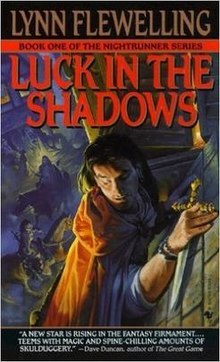
Read if you Like: 90s epic fantasy tropes, spy protagonists, down to earth wizards, a brewing war
Avoid if you Dislike: age gap or mentor/student romances, over-the-top evil villains, quick pacing
Elevator Pitch
Alec is a 16 year old orphan, sitting in a dungeon of a particularly sadistic lord when a new prisoner is brought in. Seregil is a spy and a noble, and takes Alec with him when breaking out. He then takes Alec under his wing as they travel back towards his homeland, bringing back dark tidings of the coming war and dark magic. But the land of Rhiminee has its own challenges, and the duo gets dragged into internal politics of the nation as soon as they arrive in Seregil’s homeland.
What Worked For Me
I want to start by acknowledging that this book isn’t just a carbon copy of every other book in the 90s that takes vague inspiration from Lord of the Rings. There are some core elements there: the simple life ripped away, a lot of travelling, epic scale, and irredemable evil. However, you don’t get a lot of the other classic elements from series like Wheel of Time or Shanarra, and I loved that it felt really old school while also feeling different from other older works. Part of this feeling is that I think it borrows a lot from the Fantasy of Manners genre in the second half, which gives the story a nice balance.
With that out of the way, I really appreciated the focus on spycraft in this book. It was definitely more James Bond than George Smiley, with lots of climbing through windows, searching for hidden traps, and dramatic (perhaps unbelievably successful?) disguises. You get small bits of training montages as Alec learns the craft mixed with bite-sized missions that play into the internal political struggles of Rhiminee. It was a nice balance and, while the book didn’t move particularly quickly, I never felt bored. Even though I knew that at least our core two characters would make it out of the book relatively intact. I always felt tension when the author wanted me to, interspersed with more calm moments.
Finally, I just think this book had really solid fundamentals. It didn’t feel like we got gratuitous infodumps, the dialogue was solid, characters felt internally consistent without being reduced to a few cheap character traits. Fight scenes were rare, but thrilling when they happened. I don’t think I’d ever throw an award at this book, but it’s definitely a meat and potatoes kind of fantasy story. It was also kind of joyful to see that homosexuality was (mostly) an unremarkable thing. It didn’t get a lot of focus in this book, and probably will vary from culture to culture, but for a book in the 90s this feels kind of groundbreaking.
What Didn’t Work For Me
I had some minor gripes about this book that probably aren’t worth mentioning except for two. The first, and much smaller one, is that this book definitely indulges in some tropes that raise my eyebrows. The main villain has a massive scar on his face as his defining characteristic. Also, you’ve got a few rather breasty women dressed in sheer fabric, though notably, you also get a lot of non breasty women. So far though, women have fairly minor roles in the narrative, even if they have societal positions of power just as often, if not moreso, than men.
However, my big gripe is with the budding romance. And despite the many claims that the romance doesn’t start until later in the series after Alec ages, the seeds are being planted very obviously – dare I say explicitly – by the text. And it’s clear that the author herself understands this is an issue, because she tries to introduce elements to subvert the problematic nature of this relationship, though wholly unsuccessfully in my eyes. There will be some minor spoilers for parts of Seregil’s character ahead, as discussing this issue isn’t possible without that context.
Alright, so here’s where the story stands
- Seregil immediately identifies Alec as a child. He does not view Alec as an adult or treat him as such, and almost exclusively uses the word ‘boy’ to describe him
- He also immediately acknowledges how attractive Alec is, and in the early parts of their relationship decides to frequently sing lewd songs to the clearly inexperienced Alec to make him blush and stammer.
- An oracle describes Seregil as a “father, brother, friend, and lover” to Alec, and obviously the placement of father/brother and lover in the same sentence is … not great
- For much of the book we don’t know Seregil’s age, other than that he’s an adult who’s gone on many adventures and feels (to me) like a full competent adult no younger than the age of 35, but realistically probably older.
- This is less about Seregil and more about the narrative in general, but Flewelling is very aware of whenever Alec takes his clothes off to a weird degree
And now we get to the parts of the story where the author tries to establish that actually this is all fine (and thus, by extension, that she understands how it isn’t a great look so far)
- We get a lovely little line from Nysander (Seregil’s wizard mentor and effectively the Queen’s spymaster) saying “the time will come when the master must accept his pupil as an equal.” As a teacher, sure I can accept this in theory: we all hope that our students grow up to be healthy, well-rounded adults. In the context of these two eventually falling in love though (which is referenced earlier on the page) it is absoutely not something we accept in our profession.
- It turns out that Seregil is an Aurënfaie which seem to be elves without the pointy ears (live a long time, do magic better than huamans, and have their own country, also they breed the best horses), and while he’s around 60 years old, this is basically a teenager in his community, because they go through puberty more slowly. Unfortunately Seregil doesn’t ever read like he’s in adolescence. He is treated as a full adult by others, acts like a full adult, and thinks about things like an adult. The fact that such a big point was made of this again points to the fact the Flewelling knew there were some issues with her intended plan for the pair and tried to get ahead of the criticism without actually addressing why things are problematic in the first place.
Now I want to be clear, I don’t mind age gap romances. I myself have gone on dates with men decades older than me with no complaints, and queer communities are generally more accepting of age gap romances than non-queer spaces. In fact, Wolf of Withervale also features a teenage protagonist who falls in love with a supernaturally older man. However, in that book he’s already very comfortable in his romantic and sexual identity, operates in the narrative more like an adult, and isn’t in a relationship with his teacher. Here, it is specifically Alec being established as a child in need of care and training, and the formal mentorship/teacher relationship that form the crux of the issues. I probably wouldn’t have even minded had the books been free of romantic foreshadowing (though is it really just foreshadowing if an oracle says you’re destined to become his lover?) and let things develop naturally after Alec became an adult. But the author clearly wanted to push in this direction from the start.
And you know what? I’m still going to read the sequels, because I like pretty much everything else. It didn’t blow me away, but it was fun and enjoyable, and old school in a way different than a lot of what I read. But I can acknowledge something as problematic and also still like a lot of what the book does, instead of pretending it isn’t an issue because I like the rest of it. This romance will be a deal breaker for many, and it’s good to know that going in.
In Conclusion: a fun epic fantasy/fantasy of manners mashup that has a problematic setup for a teacher/student relationship that the author is aware of, but didn’t try particularly hard to rectify.
- Characters: 4
- Worldbuilding: 3
- Craft: 4
- Theme: 2
- Enjoyment: 4
 Marked for Plot
3 thoughts on “Luck in the Shadows”