
Despite teaching a few different classes on graphic novels/comics to middle and high schoolers, I don’t actually read that many for fun these days – and almost never ones geared towards adults. In an effort to start changing that, I decided to pitch a graphic novel theme when I was asked to guest host r/QueerSFF’s July Book Club. Out of the nominees I selected, Abbott was far and away the winner, and I think it will lead to some great discussion! Books 1/2 left me with some frustrations (book 2 especially), but the final volume really blew me away and was an excellent ending. While I’m discussing my thoughts about the series as a whole, I won’t reference any specific spoilers for any of the books.
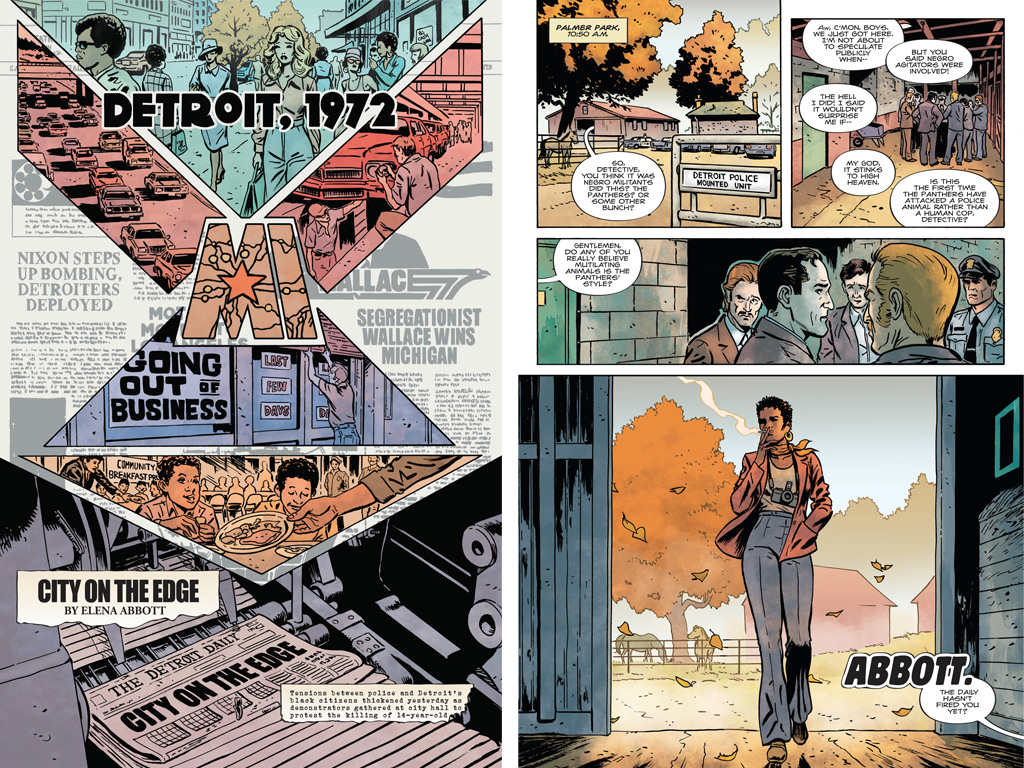
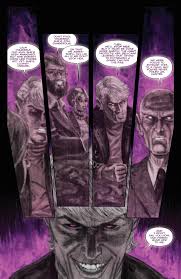
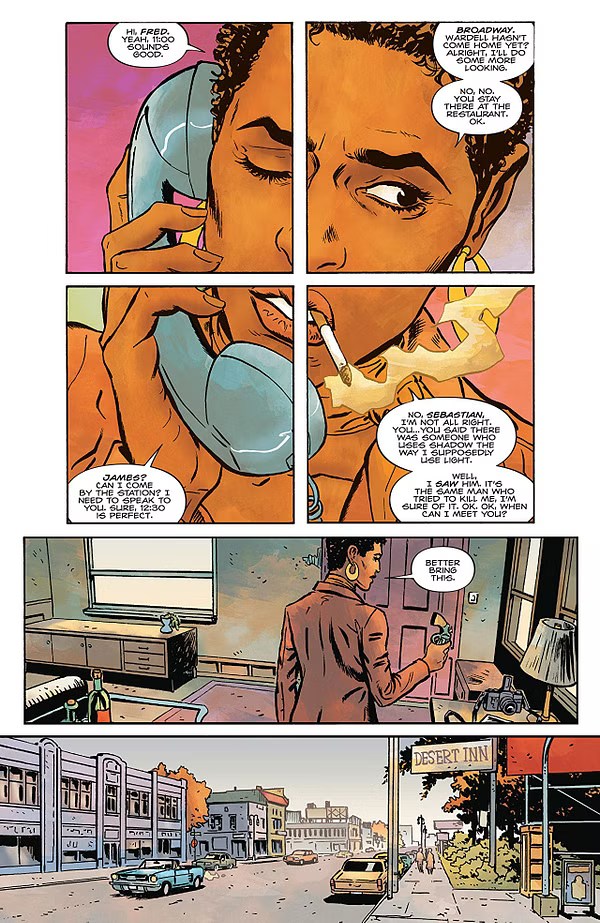
Additionally, I’ll include some images of the art at the bottom of this post for people who want to see some examples of non-cover art, which will become standard practice should I continue to review more sequential art.
Read if Looking For: nuanced depictions of sexism and racism, a historical Detroit setting, gruesome and evocative art, noir vibes
Avoid if Looking For: Dynamic fight scenes, properly-paced plots, innovative villains

Elevator Pitch:
Elena Abbott is a reporter in Detroit during the 1970s. She’s got a reputation for honest and tough stories, calling out racism, and not backing down when she’s found something interesting. When a series of gruesome murders begin to get placed on Detroit’s black communities without evidence, she decides to investigate, leading her into a den of occultism and magic, along with her destiny as the one who will bring light to the darkness. The sequels skip several years into the future, following her at different stages of her career (and different stages of the evil forces’ plans for Detroit). Throw in a late husband who died in mysterious circumstances, an ex-husband who’s her primary contact in the police force, and a girlfriend she’s trying desperately to keep hidden, and she’s got a lot on her plate.
What Didn’t Work For Me:
Normally I start with the positives, but since I thought the first two volumes were far weaker than the third, I think it makes sense to begin here. My core frustration with this series is that it tries to do far too much in far too little space. Each volume is 128 pages, split into five issues – which generally end with the conclusion of a major conflict and a cliffhanger to get us excited for the next installment. In these 128 pages, Ahmed is trying to develop the following elements in significant ways
- Various real-world events, issues, and social dynamics facing Detroit (most notably the election of the city’s first Black mayor in 1973)
- Exploring racism, sexism, and (to a lesser extent) homophobia, and how it can manifest in different ways
- Elena Abbott’s career as a journalist, and her relationship with work and her various bosses
- An evil and occult force which is mostly addressed through fight scenes as Abbott discovers and develops her abilities as The Lightbringer
- Her romantic relationship with her childhood friend Amelia
And it’s just too much in too little space. Sequential Art tends to need more pages to develop a single topic or plotline compared to novels, and this would be a lot for a 128 page novella to grapple with. It leads to almost everything being presented in a shallow and truncated way that doesn’t get the breathing room it deserves.
The big downer here though, is the fight scenes. They just aren’t interesting. Elena learns of her abilities through using her camera, which is cool! A great way to integrate her career as a journalist with light magic. But it saps the tension out of combat, the primary conflict resolution method of books 1/2, by me wondering why she spends an entire page running from a monster when she could just point her camera at it. Even when she grows beyond relying on the camera, fight scenes tend to be poorly choreographed and uninteresting (though the villains are visually stunning) which wouldn’t be a problem other than the fact that we get so many bad fight scenes.
I also think that the villains and good vs evil storyline was rather basic. Our villain of book 1 was rather interesting and evocative, but as the series progressed, it devolved into something tropey that didn’t bring anything new to the table. Again, not a bad thing in isolation, but the primary weight of the story rests on these plotlines, not her journalistic pursuits or the greater story of the city of Detroit. I think the core idea could work, but wish it had been pushed more towards some of the ideas expressed in book 1 about how The Umbra was a manifestation of people’s negativity and hatred, and by connecting that idea more firmly to the setting of Detroit. Unfortunately, that strand got lost a bit in the sequels, pushing it in a more generic direction.
If I weren’t running the book club discussion, I probably wouldn’t have read the sequels, but I am happy to say that book 3 addressed a lot of my issues around the dynamism of combat, as well as scaling back how many fight scenes there were. I want to also acknowledge that my early experiences with sequential art come from manga, which have a very different approach to combat choreography and the pacing of plot arcs, which probably biases my reading of books 1/2.
What Worked For Me
Despite me having some fairly serious reservations, there’s a lot to praise in Abbott, and I totally understand why it was nominated for a Hugo. Ahmed gave this story a rather large cast, and I found that he did a great job of giving each of them a distinct personality in relatively few pages. Some of my favorite characters had bit parts, including Henrietta, the clerk at the records office who reminisces about how much things have changed. Amelia (Abbott’s girlfriend) similarly was a bunch of fun: a hardass who called Abbott out on bullshit, worked with the mob to try and find a way to get ahead in the world, and chafes at Abbott’s desire to keep their relationship secret.
Another big point in Abbott’s favor is how themes around racism and sexism are developed. I loved how Ahmed balanced really big overt examples with smaller moments that illustrate bigotry in an everyday context. You get villain monologues that are racist diatribes, nasty comments from cops, and Abbott’s boss (who she has a great relationship with, fights for her place in the paper, and is generally portrayed in a positive light) brushing aside her pointing out racism. Well-meaning and ethically good characters are prejudiced, because that’s how social conditioning works. It’s the area that I think Ahmed was most successful at packing a lot of meaning into a small amount of space.
Finally, I thought the illustrator Sami Kivelä did a phenomenal job of using splashes (single panels covering an entire page) or creative panel layouts to illustrate Abbott’s emotional and psychological state. It hit hardest in the third volume where they really got to go wild, but there were consistently moments where the visuals carried the emotional weight of the storytelling, which I love to see in sequential art.
Conclusion: a comic that finished strong, but whose first two volumes were plagued by poor pacing, plot development, and fight choreography
- Characters: 4
- Worldbuilding: 3
- Craft (Writing): 2
- Craft (Art): 4
- Themes: 4
- Enjoyment: 3/2/5 for Volumes 1/2/3 respectively
 Marked for Plot