
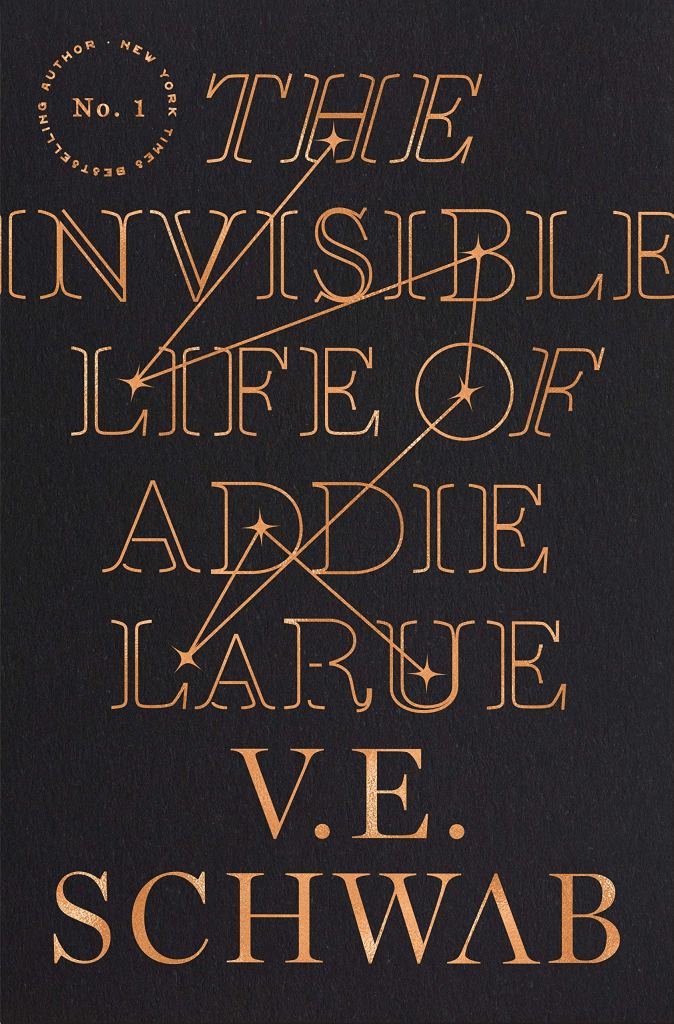
One of the things I love about fiction (and fantasy in particular) is that writers can operate within a shared bank of references, playing with old ideas and twisting them into new shapes. The Invisible Life of Addie LaRue is just that. It takes a deal with a devil, the moral ‘be careful what you wish for’ and spins out an engaging tale from it. This was a pick for an in-person book club, and I very much enjoyed my time with it, even if I thought it missed some golden opportunities.
Read if Looking For: resourceful women, hot demons, leads going from overwhelmed to hyper competent
Avoid if You Dislike: constant flashbacks
Elevator Pitch:
Addie LaRue made a deal with the devil, if he really is a devil, to avoid being forced into marriage. She’s spent the last 300 years with immortal life and freedom, with a catch. She cannot leave an imprint on the world: people forget her as soon as she’s out of sight, she loses all belongings, and she can’t even break a window without it fixing itself. She is a ghost. That is, until she meets Henry in 2013, who can somehow remember her. Her life changes forever.
What Worked for Me:
Schwab has always had an engaging writing style. She tends to prioritize readability and rapid pacing in a way that makes her books very hard to put down. Addie LaRue was no exception, especially near the start. You get a really clear picture of Addie’s various personas right away (it bounces back and forth in time almost every chapter), and the premise of the book is an interesting and dynamic one. Seeing how Addie shifted from desperately trying to find a place to sleep in 1700s Paris to her lounging in movie star homes in 2013 was an immediate hook.
I also thought her relationship with Luc (the devil) was a highlight of the book. Luc himself was a delightful picture of a demon or devil. Smoldering, prodding at moral convictions, both fickle and relentless. His appearances were consistently some of my favorite parts, and his shifting relationship with Addie over time was one of the deeper parts of the story. I have a soft spot for morally bankrupt male demonic beings (The Adventures of Amina Al-Sirafi comes to mind as another book featuring this trope), and, speaking generally, I think humanizing evil forces is something I enjoy. While the pitch of the book is Addie’s relationship with Henry (the man who remembers her), I think the relationship with Luc is really the core of the book.
What Didn’t Work for Me:
Speaking of Henry, I think the second half of the book lagged a bit for me because I didn’t buy into her relationship with Henry. Part of this is that I don’t think Schwab pushed hard enough to make us feel the intense pain and loneliness of Addie’s life. It was on page, but never felt visceral. This made her romance with Henry feel shallow, because it didn’t seem like her world got flipped on its head. I actually think the book would be better if their love story got heavily truncated. The relationship gets a lot of screen time though, and the lack of buy-in I had for their relationship made me reconsider other parts of the book.
I found myself wondering if I would enjoy this book had it been written in strictly chronological order. And I don’t think it would have held up, not at this length. In the end, the constant bouncing back and forth between timelines (and later perspectives) serves as a buffer to how shallow the character and thematic work actually is in this story. It’s a choice that prioritizes small hits of dopamine at the expense of interesting choices; doomscrolling in book form. Now, choices that prioritize engagement aren’t necessarily bad (I even mention that it was a powerful initial hook), but I think the choice would have played better had the story stayed on the shorter end. At 450 pages, once I noticed the stylistic choice, it kept nagging at me and consuming the story.
Perhaps this is me pining for the book that wasn’t. The version of this story written by Nghi Vo or Robin Hobb or Simon Jimenez. In the end, I think that Schawb’s style lends itself more towards action and thriller elements, rather than books that attempt to deeply study a lead character.
In Conclusion: an engaging read about a woman forgotten to history, which hooked me immediately only for me to slowly start seeing where the story frays and lags
- Characters: 3
- Worldbuilding: 3
- Craft: 4
- Theme: 2
- Enjoyment: 3
 Marked for Plot
I enjoyed this one, but didn’t love it like lots of other readers did – I think the same story by Vo or Jimenez would have rewired my brain, but for me Schwab is enjoyable but not that special. What you said about not feeling it viscerally – that’s literally my issue with her books; her writing always feels sort of detached, distant, to me.
Do you think you’ll check out her latest, the vampire book?
Also, we’re getting another novel with a kinda similar premise to Addie in November – As Many Souls As Stars by Natasha Siegel. Sapphic, but a similar deal-with-the-devil set-up. I’m very curious about how it compares to Addie!
LikeLike
This is a book that I definitely would have loved to have seen from someone who pushes more heavily on thematic depth.
Schwab is an author that I’m happy to read, but not usually eager to seek out. Her new book will likely be ‘audiobook hold, and if I have time when it comes due then I’ll listen to it’ type read. She’s not on my list of authors like Jimenez where I’m going to drop pretty much anything when his next book comes out.
LikeLike