
As a middle and high school English teacher, I get a lot of book recommendations from kids. YA and Middle Great books are fantastic, though I don’t tend to read very many of them. When some books – especially the books my LGBTQ+ students are recommending – get student momentum behind them though, I’ll give them a try. Sunbearer Trials was pitched as a mashup of Percy Jackson and The Hunger Games with a trans lead, which was a pretty convincing pitch. Add in that Aiden Thomas wrote one of my favorite paranormal romances in Cemetary Boys, and I was happy to throw a few audiobook holds at the library. In the end, I don’t think this duology is as tightly written as Percy Jackson, Hunger Games, or Cemetary Boys, but it has a lot of heart and will land well for its target audience.
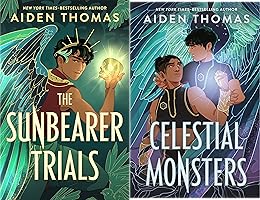
Read if Looking For: quality Trans-Masc representation, teenage angst, Aztec Mythology references, tournament arcs
Avoid if you’re Looking For: nuanced worldbuilding or themes, YA books that diverge from genre conventions
Elevator Pitch
Teo is a semidiós, the child of one of the gods that guard the world. Specifically, he’s the child of Quetzal, one of the weaker Jade Goddesses, whose domain covers birds. He also ends up chosen to be part of the sunbearer trials, where 10 semidióses compete for the honor of keeping the sun alive and Obsidian Gods sealed, at the expense of the life of the competitor who had the worst showing. The problem? He’s up against a bunch of teenagers whose parents are Gold Gods with a lot more power, more training, and who have known this was their path for years. Notably, one his best friend, one is a childhood crush, and another is a fellow Jade semidiós, child of the God of Bad Luck. Teo just wants to survive.
What Worked For Me
Teo being at the heart of this book was definitely the strongest part of the story. He’s got a lot of heart, and fits a relatively generic hero archtype (reluctant, weaker than everyone else, wants to do good things, etc etc) without feeling like a self-insert character or magically a gary-stu who ends up good at everything ever. I loved having such an honest and earnest trans lead, and Thomas nailed the representation here (which isn’t a surprise considering their previous works). It isn’t central to the plot, but is present and done thoughtfully. In book 2, we expand to include a second major POV character, who also added a lot to the book’s narrative style, and had a distinct voice, something I think a lot of YA lacked.
I also appreciated that Thomas was willing to take on some larger systemic issues. Book 2 gets into looking at how systemic class differences can have potent negative effects, even when those at the top have good intentions, and how making positive change oftentimes means more radical shifts to the status quo. I don’t think this topic was tackled with a lot of nuance (the ending was very neat and tidy) but at least it didn’t accept a lot of the ‘good people in authoritarian positions works just fine’ approach that I see so often in fantasy.
What Didn’t Work For Me
Unfortunately, I think I kept fighting against this book on what it was, versus what I wanted it to be. I wanted the world to be a vivid and captivating take on Aztec Myth; instead each city was ruled by a god and was different based on that god’s powers (this is the bird city, or the city in a volcano, etc etc). I wanted characters to sit with the messiness of their actions; instead there were a lot of misunderstandings and miscommunications. This story was never bad, but I couldn’t help but imagine the version of this story that was closer to Red Rising or Will of the Many in scope. In the end, that’s a me problem though, as the book very clearly telgraphed that it was never going to be headed in that direction.
I think a more concrete problem I had was that I never felt a sense of adrenaline in this series. The tournament arc never really felt heart pounding; the story never got me to stop everything to keep listening; the fight scenes didn’t really click into place. The interpersonal connections had great arcs – again, something Thomas has previous shone in – but the more action-focused story didn’t work with their writing style. It was good, and fun, and enjoyable. But it wasn’t notable, and that really disappointed me.
I do think that this book would go over better with a reader who was more invested in current YA writing trends. I’ve found I tend to prefer older YA or books in the genre that don’t conform to the same rigid style that publishers have been pushing (Andrew Joseph White and Eliot Schafer come to mind). My students however, are obsessed, and that recommendation goes a long way.
In Conclusion: I think this is a great pickup if you like YA books and want something queer and/or Central American inspired. If you primarily are drawn to adult books, I think there are better options.
- Characters: 4
- Worldbuilding – 3
- Craft – 3
- Themes – 3
- Enjoyment – 3
 Marked for Plot
I think your ‘avoid if you dislike’ section is mis-written, then. Since it seems these DON’T, alas, have excellent worldbuilding or nuanced storytelling! (Alas – these were on my tbr, but I think I’ll set them aside now…)
LikeLike
Whoops! Thanks for the catch! I’ve been swapping between ‘avoid if looking for’ and ‘avoid if you dislike’, and probably need to settle on one for good soon.
LikeLike
I sympathise, it can be so tricky to settle on a good review-template! (Or whatever you call it, I think you know what I mean!)
LikeLike