
I was so excited when I saw that Wolf of Withervale was a finalist for the Self Published Fantasy Blog Off! I left that book feeling a lot of joy at finding an old-school epic fantasy that leaned into queer identities and culture. It had its flaws (which largely continue in book 2) but I’m really enjoying this doorstopper series filled with ancient artifacts, massive armies, and a lot of gigantic animals. I was disappointed, but perhaps not surprised, at the lukewarm response it got compared to other finalists, and thrilled that this series is getting more eyes on it . This review won’t avoid spoilers for book 1, and you can see my review for that book here.
Read if Looking For: 90s style Epic Fantasy but Queer, Indulgent Worldbuilding, Tropes Played Straight
Avoid if You Don’t Like: Infodumps, Self-Insert Main Characters, Explicit Sex Scenes
Elevator Pitch:
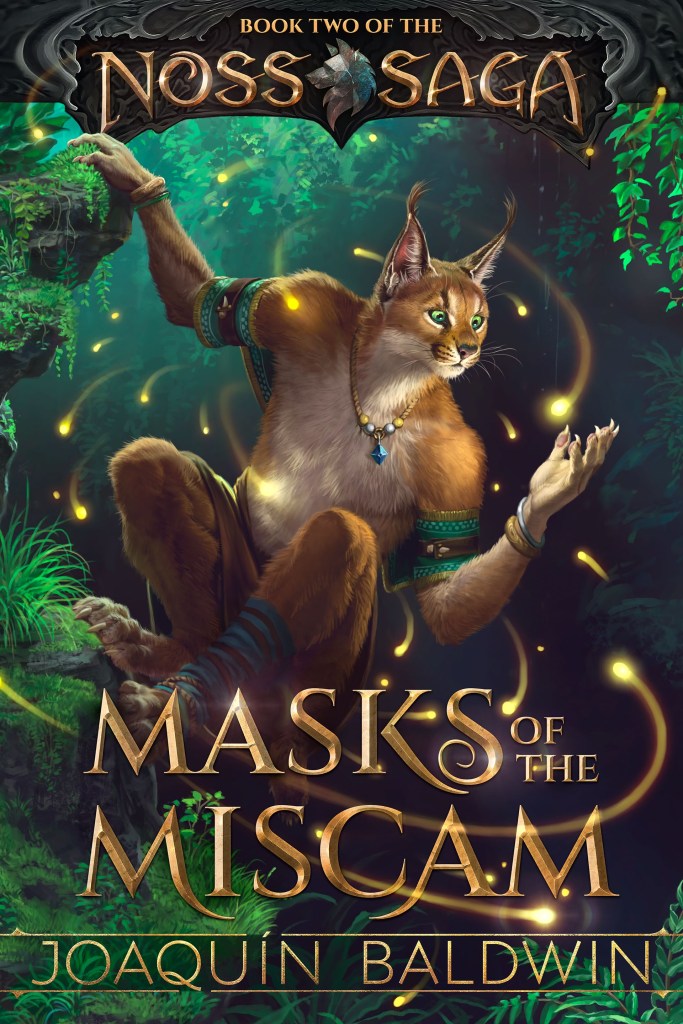
This book starts with Withervale burning. Lago & Company need to escape with two armies hunting them and start finding other mask users to help them chart their course. This book takes them to a few domes, but the majority of the time is spent in the dome of felines, which gets the most cultural worldbuilding of anywhere so far. This book will also asnwer some key questions about the history of Noss, trace progress of the Red Stag (and several other characters who aren’t present with Lago on his journey) and generally speaking expand the scope of the worldbuilding. This book sees another romantic subplot, but unlike in book 1, it doesn’t overwhelm the story in such an abrupt tonal shift, and instead fits more neatly into the epic fantasy structure the rest of the book follows.
What Worked for Me:
It feels like this book is where the epic storylines truly begin. Many (rightful) complaints about book 1 involved the sheer amount of setup, followed by an immediate diversion to an intense romantic plotline with Banook. This book involves everything classic old-school fantasy has: travel montages, ancient ruins, artifacts of power, evil forces stirring, etc etc. If you like the era of knock-off Lord of the Rings books (which ironically were very little like Lord of the Rings in many important ways) but don’t want to see the same world repeated again, this is a great option. Noss’s focus on cultures influenced by animals and shapeshifting magic lends itself a very different flavor than many of those stories, despite fitting many similar plot beats to something like the Shannara series or Eragon.
And boy does this culture explore the world. I loved seeing various cultures inside the domes, especially in how different they are. Because each has been siloed away from the rest of the world for a millenia, they feel tangibly different from the cultures established in Book 1, and were all interesting to learn about and explore. Even the ones we only see glimpses into through interludes captured my attention. It’s the type of world that makes me want to build a campaign around for my regular tabeltop gaming group. A particular highlight was a sport in the feline dome that wasn’t unlike three dimensional soccer in trees, complete with cats and humans working together using telepathy while high on empathy drugs.
A recurring theme of this book that grows out of this cultural exploration is the idea that no culture has a monopoly on ethical thought. I think there’s a temptation to make cultures unilaterally good or bad, but each culture we see feels flawed in its own way. They have backwards rules that exist because that’s the way it always has, and the members of those cultures have blinders on about those rules because its normal to them. While the main characters were perhaps a little to easily able to break away from those cultural norms compared to others, it was good to see cultural clash over things that seem stupid and petty to outsiders, but were deeply important to those involved.
As an aside, I just want to say that the narrator, Magnus Carlssen, was phenomenal. Really made the story shine, and I highly recommend this story in audio format.
What Didn’t Work For Me:
A lot of my old complaints still stand from Wolf of Withervale. This book struggles with pacing because of how much information Baldwin is giving about his world. Noss’s geography, history, and culture is probably the single most developed character in the book, and the story often takes a backseat to show off how interesting the world is. And while the world is interesting, I could have done without an entire chapter that was exclusively different myths associated with various constellations. However, this was a problem that I knew already, and was well prepared for it.
More significantly, I’ve begun to feel that Lago himself is too bland a character. In book 1, he grappled with some tough internal struggles, but without that backdrop, I found that he was just too unremarkable. He’s agreeable, will usually try to do the right thing, but doesn’t have a lot that distinguishes him from a sea of other generically good protagonists, and there’s not enough of a personality for me to distinguish him from a rather crowded field. Lago is merely a vessel by which the readers experience the story, which is a shame because he could be a real asset. By comparison, I’ve found that most other viewpoint characters are much more engaging and interesting, and the interludes, like in book 1, continue to be a highlight of the Noss Saga. The Red Stag continues to be terrifying, and his new general is also an interesting character to burrow into the mind of. Lago … less so.
Finally, and this is also a continuation from book 1, if you can’t deal with werewolf sex, this isn’t a good fit for you.
In Conclusion: a sequel stronger than its original, which stayed laser focused on expanding the scope of the world and story. Still too many infodumps though.
- Characters – 2
- Worldbuilding – 5
- Craft – 3
- Themes – 4
- Enjoyment 4
 Marked for Plot
One thought on “Masks of the Miscam (Noss Saga #2)”