
A recent friend of mine works at a local romance-focused bookstore. When I asked about great gay romantasy books, this was one of the first titles to come to her mind. And while I don’t think this touches on some of my all time favorites, there’s a lot of good things happening in A Strange and Stubborn Endurance that you don’t find in many other romance/fantasy hybrids. I’m curious to see what the sequel brings to the table, as it felt fairly resolved in book 1, but I’m definitely going to read it.
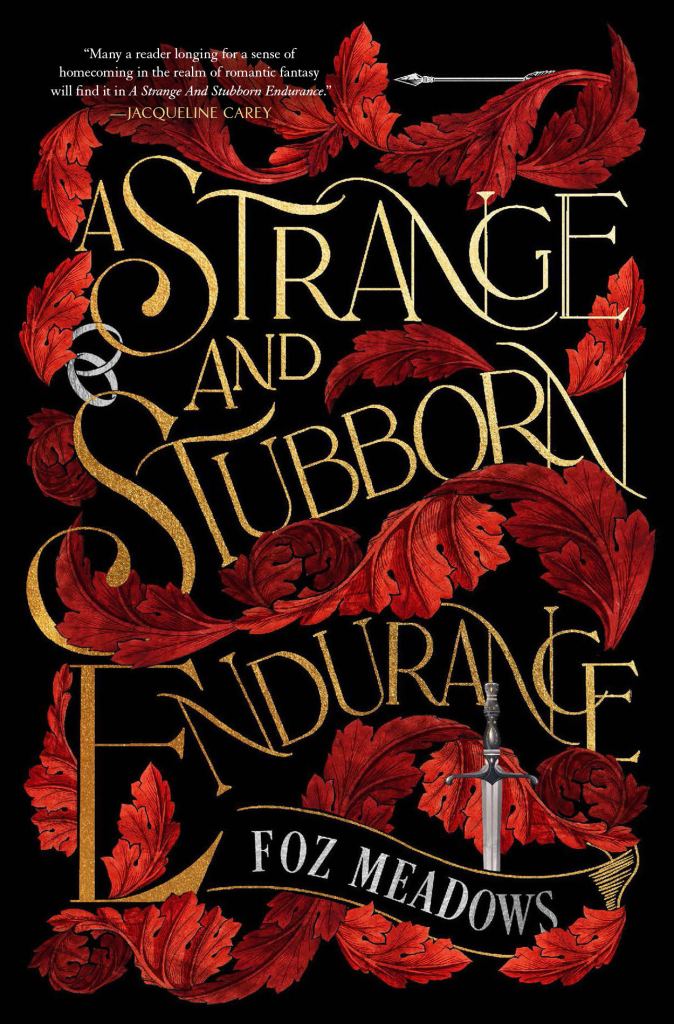
Read if Looking For: Romantasy, traditional romance tropes and plotlines, serious considerations of sexual assault, wholesome leads
Avoid if Looking For: lots of magic, political intrigue, characters that aren’t pure good/evil
Elevator Pitch
Velasin is an unimportant child of a minor(ish) noble, and never expected to play any sort of significant role in his country’s politics. However, when he ends up engaged to a noblewoman from a neighboring country in an attempt to broker peace, he doesn’t know what to do. Homosexuality is taboo in his country, so he can’t even protest his father. When the ambassador who arrives to collect him sees Velasin being raped by his ex-partner, she mistakenly assumes a consensual act, and shifts Velasin’s betrothal to a nobleman: Caethari, the athletic scion of a noble house with little interest in ruling. However, their betrothal, marriage, and falling in love (in that order) is marred by a serious of brutal attacks that seek to either kill one of them, or to wreck the marriage (and the new alliance) before it can ever start.
What Worked for Me:
I think starting with how this book handles sexual assault is important. Fantasy and Romance genres (both separately and together) don’t have a great track record of handling sexual assault well. While I can’t claim to be an arbiter on good vs bad representation, I thought this book handled it significantly better than average. There’s an on screen rape right near the front of the book, and Velasin’s experiences and recovery afterword are a major aspect of the book. It doesn’t serve as a shorthand to show us how dark the world is; it isn’t magically better after two chapters; and it’s treated seriously by the text. I do think some of Velasin’s processing was extremely quick in-universe (the whole book takes place over about a single week), but Velasin’s humanity and worth is consistently centered in the novel, both by himself and Caethari.
In terms of romance elements, this book was a pretty good arranged marriage setup. It didn’t feel awkwardly shoehorned, there was satisfying chemistry between the leads (again, perhaps rushed due to the timeline of the novel, but the reading experience was good), and generally speaking was a great example of how couples can work through challenging conversations. I would have perhaps liked to have seen a little more friction between them, the bickering that comes from so much time spent together, but I can forgive it. There were some on-page sex scenes, but they didn’t feel overdone, and the scenes were written well. Most of the tension comes from internal hesitations, not wanting to overstep advances in a tricky situation, and not from personality clashes or stupid miscommunications.
A bright spot that I wasn’t anticipating was how featured mutism and sign language was to the story. Markel is Velasin’s friend (and servant, which is a bit thorny but I think the book handles the dynamic as well as can be hoped for in a story that doesn’t challenge the role of aristocracy). He’s mute, has a great sense of humor, and communicates mostly in sign language. He’s also probably the most three-dimensional character in the book (including the leads), and was generally a high point. I was rather hoping the sequel to this would be another romance focused on his journey towards love, but hope he makes appearances in it even though the sequel continues to focus on Velasin and Caethari’s story.
What Didn’t Work For Me:
For all that I enjoyed the romantic elements of the book, this story isn’t going to be a good fit for those looking for a story with load bearing fantasy elements. The worldbuilding is fine, if basic (one country is evil and greedy and abusive to most minorities; the other is a pretty great place where the law protects people as much as the law is ever able to), and magic is so minor as to be almost unmentionable. There’s a few fight scenes, a few assassination attempts, but it never really shines in those moments. This is a Romance first, and everything else comes second.
It tries to position itself as a political intrigue book, and spends a decent page count exploring different political reasons the attacks on Velasin and Caethari are happening. Maybe it’s an attempt to undermine a new diplomatic partnership, or maybe it has to do with the thorny succession situation Caethari’s family is in, or perhaps the motives are economic? In the end though, I didn’t find these elements compelling because I’ve found that the best political intrigue comes from a space of moral ambiguity. And these books … didn’t have that. Characters are generally either good/supportive/kind/loyal people, or greedy corrupt and lazy. There’s no real in between, which takes a lot of the interesting tension out of the story. Unfortunately, there’s enough time spent on this portion of the book to make it a significant negative, and I found myself itching for the long explanations and reveals to end so I could get back to the interesting parts of the book, which was the core romantic relationship.
Finally, this book really felt like it needed to have more of a critique of aristocracy. There were a lot of moments that presented the idea that everything could be solved if the right noble was in charge, and was filled with servant/noble dynamics. Hell, it was even self-aware in some ways of how problematic that was. But it was always presented through the lens that Velasin’s home country was bad, but Caethari’s was a utopia and the nobility cared for the people and that made it okay. China Miéville’s critiques of how fantasy upholds aristocratic dynamics as good kept bubbling to the surface. Now, is it fair that it bugged me here and not in The Goblin Emperor? Perhaps, but I think it’s possible to write a book about good nobles who try to make the world better, while more consistently acknowledging the flawed ethical premise that those nobles must operate within.
In Conclusion: a successful romance, but less successful political fantasy. Great if you’re looking for an arranged marriage between two care-bears.
- Characters – 3
- Worldbuilding – 2
- Craft – 4
- Themes – 2
- Enjoyment – 3
 Marked for Plot