
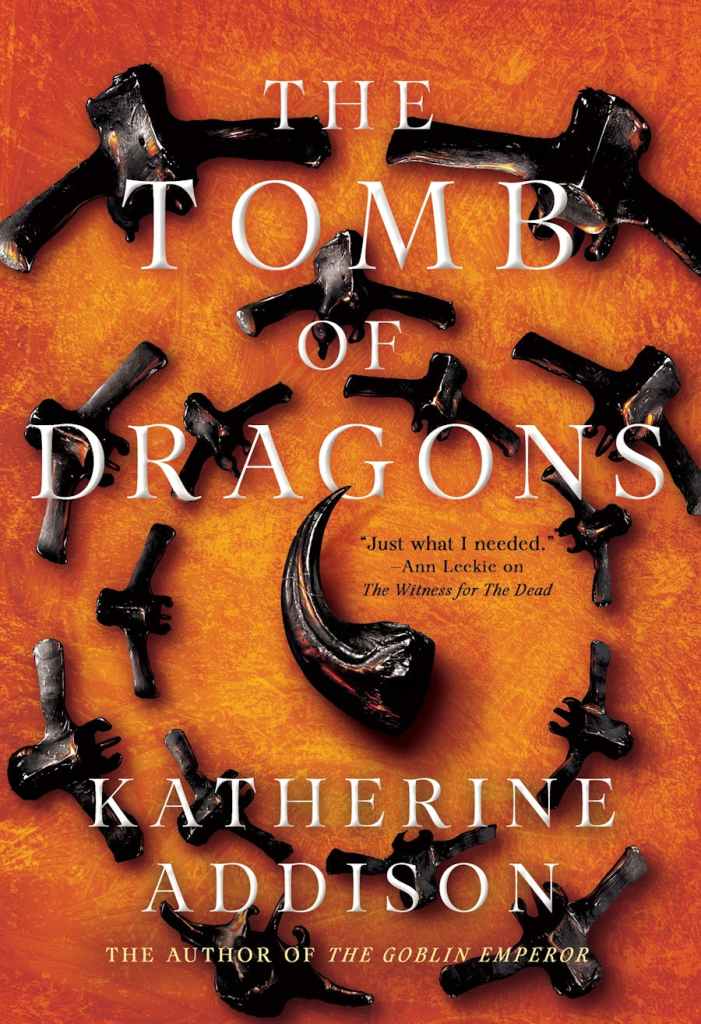
The ghost of a dead dragon; a tragic backstabbing in an opera; a man finally beginning to summon the will to move past condemning his own love to death. The Tomb of Dragons finishes the trilogy that Witness for the Dead started. In the end, I thought this was the weakest entry of the series, but it was well worth the read, and Addison continues to stand out as an author who staunchly refuses to adhere to modern conventions of how fantasy books ‘should’ read.
Read If Looking For: slice of life following a death priest with depression, comically evil corporations, gay leads in non-romance books
Avoid if Looking For: books without cross-series references, mysteries, fast pacing
Elevator Pitch:
Book 2 of this series ended with Thara’s magic destroyed after a traumatic incident. It picks up with a death in an opera house, the disappearance of a noble in danger of fomenting rebellion, and a completely dysfunctional cemetery that Thara has been set by the Archprelate to get back on track. As with the other books in this series, it floats between plotlines smoothly, but the central one concerns a graveyard of dragons, and a ghost that seeks justice for its death hundreds of years ago.
What Worked for Me
Addison is a true master of mood. In some ways her writing style in this series reminds me of Studio Ghibli movies: she’s willing to linger in scenes, devoid of plot relevance or character development, dwelling on utterly insignificant details, in order to create an emotional response from a reader. The mundanity of daily life, addressing paperwork and bureaucracy, and visiting a teahouse all become part of a larger emotional portrait this story produces. It works, I think, primarily because of her willingness to discard traditional adherance to an A-plot. While there is one (the titular Tomb of Dragons), it consumes Thara’s life in a very realistic way, not truly interrupting the flow of everyday life that fantasy books love to throw at protagonists.
Thara’s queerness is, in some ways, more present in this book than ever before. I won’t say much for fear of spoilers, but our lovely elf finally takes steps towards romantic attachments again. It’s more subtle and distant from the main plot than many would like, but it fit the story and Thara’s character. On the flip side, I felt like the internalized homophobia that made up so much of the first two books was gone, or at least dialed down radically. This isn’t a bad thing, but was notable.
Finally, I think this book successfully manages to connect more firmly back to The Goblin Emperor. Maia plays an important role in the story – though not central. It does mean that I can’t recommend this series independent of The Goblin Emperor anymore. Well, I probably could, but I think the reader would lose out on important context and details that affect the reading experience. Interestingly, Maia’s arrival on page tends to bring some of the relentlessly hopeful tone and conveniently easy resolutions of The Goblin Emperor into the series which staunchly moved in the other direction. I’m not sure this was fully intentional, but I enjoyed reading this shift in mood (and subsequent shifts back when Maia is offscreen) as an acknowledgement of how different these two protagonists were. It was a nice touch, and felt like home.
What Didn’t Work for Me
In The Goblin Emperor, I found Addison’s overly baroque language and web of titles to be a positive, reflective of a new Emperor’s experience after being summoned from exile in the prose. In earlier books, I found some of these elements to be present, but minor, which fit Thara’s relative familiarity with the setting compared to Maia. I’m not sure if it was distance from reading the first two over a year ago, but I really could have used a dramatis personae. I found it difficult to track characters, especially those who appeared briefly in previous books, and felt like my knowledge was out-of-step with Thara’s. It didn’t help that the cast was rather large for such a short novel.
A glossary would have been similarly helpful, for some of the conversations Thara had made very little sense beyond generalities, which I would have greatly enjoyed knowing more about. Had we been a bit more distant from Thara’s experiences, it might have flowed better, but we are so tightly connected to his worldview even in the prose style that I found this frustrating.
This is, overall, the weakest book in a very, very good series. I don’t think it expands far enough to capture anyone who didn’t like the first two, but is a very satisfying conclusion to Thara’s story, and left me satisfied and excited for more Addison in the future.
In Conclusion: a slightly more hopeful conclusion to a very gloomy series.
- Characters – 4
- Worldbuilding – 4
- Craft – 4
- Themes – 4
- Enjoyment – 4
 Marked for Plot
One thought on “The Tomb of Dragons (Cemetaries of Amalo #3)”