
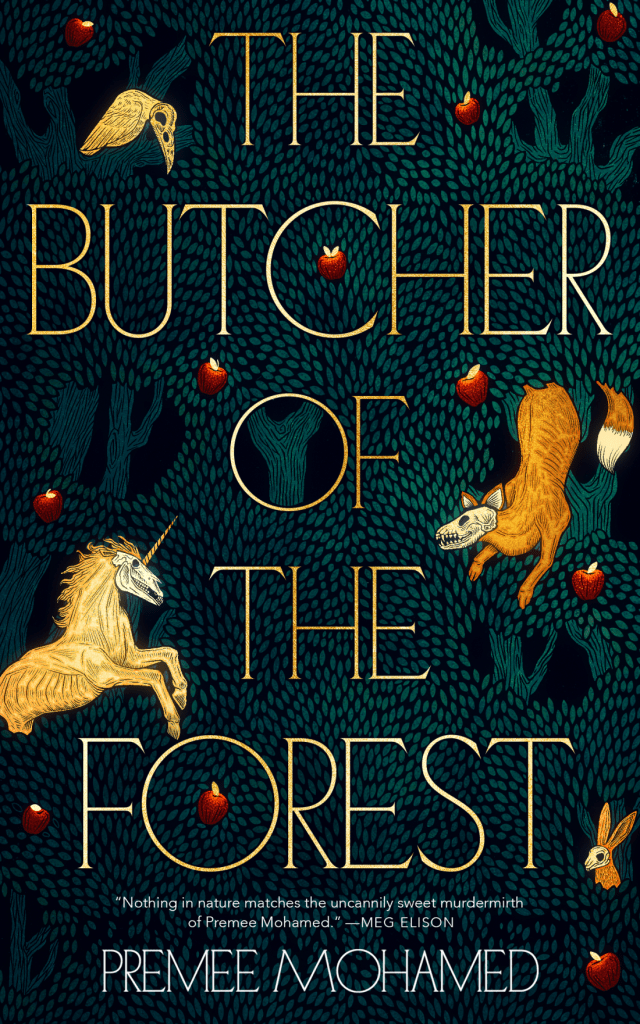
Dark, atmospheric fairy tales are right up my alley, and early reviews of The Butcherer of the Forest made it seem like a good fit for my tastes. This ended up being one part fantasy, one part horror, and one part wandering trip through an hallucination. It won’t be my favorite read of the year, but it was a great time in a small package.
Read If Looking For: dreamy (or nightmarish) prose, fairy tale settings, unknowable beings
Avoid if Looking For: plot driven stories, explanations and justifications for the setting, tidy character arcs
Elevator Pitch:
Veris is just a normal woman living under The Tyrant’s rule. She raises rabbits, pens letters for those who can’t write, and generally tries to avoid notice. Unfortunately, she’s the only person to ever return from The North Forest with one of the lost children. So when The Tyrant’s own children venture in, she is forced to once more visit her worst nightmares, for if she can’t save the children, her town will burn.
What Worked for Me
Reading this book felt a bit like lucid dreaming. The majority of the novella takes place in The North Woods, where nothing is as it seems. Mohamed’s descriptions were lush with detail, and successfully captured the unsettling feeling of things that aren’t quite right. Here’s an example of one of my favorite snippets
From the darkness at the far end of the table stepped a tall man who looked like a fox, or a fox that looked like a man; from certain angles he seemed to give the effect of the landscape itself, that of a folded piece of paper which should not, but did, somehow display the entire drawing, including the portion of it inside the fold.
Like any good fairy tale, you run into a lot of cliches, many of which are called out in the narrative, like the fact that things come in sets of threes, or that you should never give up your name to one of the strange beings in the forest. The Tyrant is a lovely example of this. He is unimaginably powerful, and in a setting more concerned with realism his outlandishly evil nature and vast empire would be comical, but within the realm of this fairy tale landscape, it makes perfect sense.
What Didn’t Work for Me
Those looking for a story with conventional plot structures are going to be disappointed by this book. Veris’s journey into the forest to find the children is not based on skills that can be understood, or clues to be puzzled out. You won’t find clever little bits of foreshadowing that let you guess ahead of time the next obstacle in her path. Other than one notable exception, there are no Chekov’s Guns in this story. It is about wandering and discovery, not about setting up dominos that will topple into a satisfying plot twist.
Instead you are as lost as Veris herself is, floating through a shifting landscape that defies the laws of physics, and creatures that are unexplainable and tangible and vividly realized. For me, this is mostly a positive, but it relies a reader’s willingness to engage with a story leaving more unsaid than spelled out.
In Conclusion: A moody fairy tale quest through a shifting wood filled with eldritch creatures. It is a dark and unnerving read
- Characters – 3
- Worldbuilding – 5
- Craft – 5
- Themes – 3
- Enjoyment – 4
 Marked for Plot