
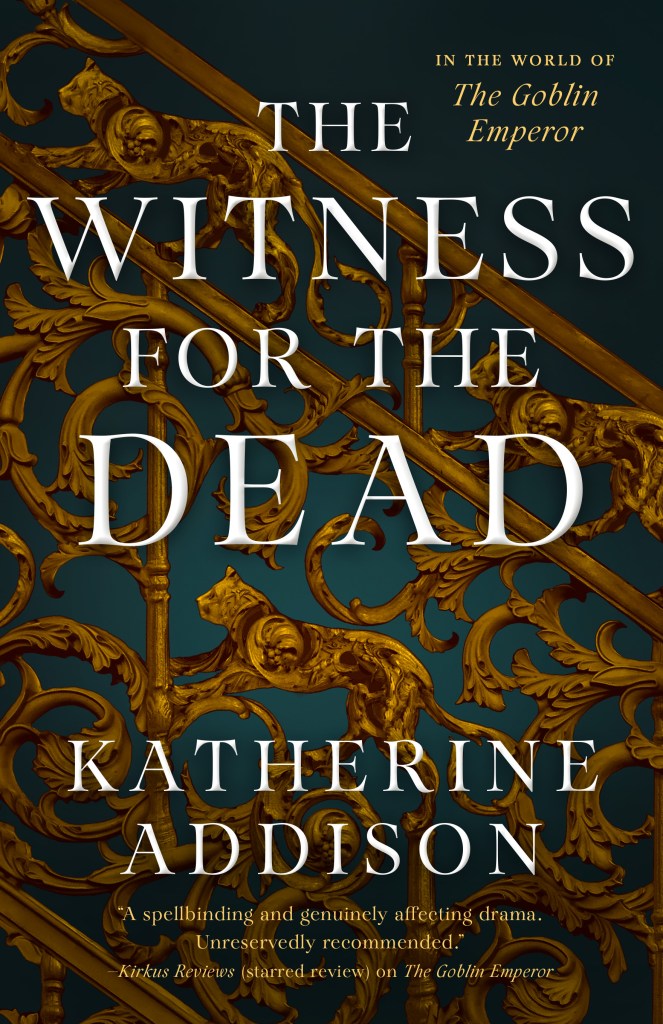
The Goblin Emperor won me over with its baroque tangle of royal ettiquette, its optimistic worldview, and a wonderful inversion of typical portrayals of monarchies. It’s sibling series is none of those things, and presents a story that feels very familiar in style, yet the polar opposite in tone. A subdued noir novella, Witness For the Dead does not require reading The Goblin Emperor to enjoy; it follows a side character far from the action and events of the previous story. In fact, there were surprisingly few easter eggs connecting the two.
Read If Looking For: gloomy priests, representations of internalized homophobia, simple and careful prose
Avoid if Looking For: upbeat stories, highly structured mysteries
Elevator Pitch:
Celehar is a Witness for the Dead, a priest with some small ability to connect with the souls of the recently deceased. He lives far from the courts of power, and mostly uses the skill to solve murders, arbitrate wills, kill ghouls, and make sure the dead are treated with respect. This book follows a nasty noble house dispute, an accusation of spousal murder, and the death of a famed opera singer. And all the while, Celehar hides his homosexuality from a world which despises him for it.
What Worked for Me
Fans of the language of The Goblin Emperor will find a lot to love here. Addison is a master at using invented vocabulary in a way that conveys a lot of meaning even when you wouldn’t be able to write down a dictionary definition. I felt immersed in her world, along for the ride without having an omniscient narrator hanging over my shoulder defining everything. It’s definitely more approachable in this book, as I never felt as adrift in confusion as The Goblin Emperor sometimes left me. Instead, it felt comfortable, walking the streets with Celehar as he looked over maps, navigated public transit, and walking through the opulence of opera houses.
The book is, if not dour, then certainly gloomy. It presents a much less rosy perspective of the world than in Goblin Emperor, reflective of Celehar’s outlook on life compared to Maia’s. The city is plagued with the corrupt, the gossipy, and the mean just as much as it is with foggy rivers and smoggy skies. The joy and wonder of the world is there for the reader to see as well, but Celehar doesn’t dwell on these moments, and the prose of the story reflects the character’s mind we inhabit.
Finally, I love seeing stories about gay men (or elves) that aren’t fixated on romance. While there may be something coming down the line in the series, it’s not a sure thing. Celehar is in no place right now to accept any sort of advance, leaving Addison room to allow the priest to develop in a wholistic way often denied gay characters. The representation is not happy, but wonderfully done.
What Didn’t Work for Me
My biggest complaint is that I want more of it. I could also see a version of this story that is tightly focused on one mystery, instead of slipping between cases, religious red tape, and slice of life elements. Overall though, I love this book just the way it is.
In Conclusion: a gloomy and reflective noir following a depressed priest who can talk to the dead
- Characters – 5
- Worldbuilding – 4
- Craft – 5
- Themes – 4
- Enjoyment – 5
 Marked for Plot
One thought on “The Witness for the Dead”