
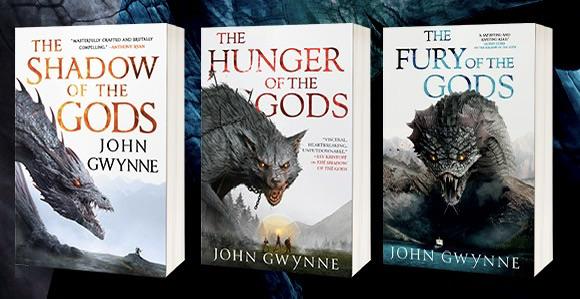
Normally I review books one at a time. The Bloodsworn Saga made a lot of sense to review as a full trilogy however. Some series develop and shift as they go on, each book taking on something new. They might expand the setting, embrace different themes, or focus on different characters. Bloodsworn Saga, however, is remarkably consistent. Book 1 would receive more or less the same praise and criticism as book 3, with my enjoyment depending on my joy and patience for both aspects. Also, it was tough to resist the call of displaying three of my favorite fantasy covers together. Bekki Guyatt (designer) and Marcus Whinney (illustrator) outdid themselves on these. If you’re looking for epic fantasy with lots of combat, lots of monsters, and big scary gods, this is your series.
Read If Looking For: Nordic settings, lots of fight scenes, epic scope, close attention to gear and tactics
Avoid if Looking For: books without plot armor, attention to theme and character development
Elevator Pitch:
In a very Nordic world, the gods are all dead, trapped, or sleeping after a war that nearly destroyed the world. Humans have inherited the land, enslaving those who have inherited fragments of the old gods’ blood and abilities. While later books introduce 2 new characters we follow, the core three leads are: Orka, a wolf-blooded ex-warrior desperately trying to find her kidnapped son; Elvar, daughter of one of the noble lords who travels in a mercenary company to prove her courage and skill; and Varg, a farmer slave who killed his owner when his wolf-blood manifested and is on the run, finding himself falling in with the famous Bloodsworn company who begin to train him in the art of war.
What Worked for Me
There are a lot of complaints online about how this series painstakingly tracks each character’s gear, how it’s cared for, how it gets damaged, and how it gets repaired and cleaned. I loved this. It isn’t something we see a lot of in fantasy books, which trend towards cinematic action over realism. Gwynne does LARP (live action roleplay) and it clearly shows that he understands how exhausting wearing full kit is, and how quickly a shield-arm will tire in battle.
To go along with this, the fights tend to feel grounded in tactics. While he sometimes lets loose and has his characters clambering up a troll’s back to slit its throat, usually battles feel grittier and more down to earth than what you’ll see in other books. This is likely either going to be a big mark in its favor, or it’ll be a deal-breaker, because there is a lot of combat in this series (more on that later).
The gods were a delightful central point. With how prominently they feature on the cover art, I would be immensely disappointed if they didn’t live up to this potential. They are gargantuan things, with the bones of dead gods forming the foundation for massive buildings, cities, or even mountain ranges. They provide an engaging – if not entirely original – plotline about ancient powers waking up, the ones we get to meet are everything you would expect from gods. They are capricious, self-serving, and more interested in centuries-old feuds than the lives of something so insignificant as humanity. A particular favorite of mine is Rotta, the Rat God. Rats have become something of a favorite for me in fantasy books (The Bone Swans of Amandale most notably) and I was happy to see them represented here in all their sneaky backstabbing glory.
Finally, I think the author did a great job of managing three (or, eventually five) storylines that spent far more time apart than together. It was rare for more than two POV characters to be in a scene together, and much more common for each to be on their own adventures. Gwynne managed to naturally weave in hooks into each of their plots though, which other characters conveniently bumped into, giving them reasons to find each other.
What Didn’t Work for Me
As much as I loved how the combat was written in this series, there was far, far too much of it. You’ll rarely go more than a chapter or two without a fight breaking out, and it isn’t uncommon for five chapters in a row to be devoted to a combat featuring more than one lead character. Unfortunately, this made Gwynne’s realistic depiction of combat an annoyance in the first book, and a major liability by the time I got around to book 3. They ended up bleeding together, losing any sense of identity of memorability. The frequency and grittiness of combat also managed to highlight the level of plot armor that Gwynne’s major characters (and most of his side characters) face. The enemies of Orka, Varg, and Elvar are depicted as formidable, deadly, and worthy opponents. As pages pass though, they make Stormtroopers look like competent and skilled combatants. If Gwynne wanted to take a more realistic view on combat, he needed to take a page from George R.R. Martin and be willing to cut off heads left and right to maintain a sense of tension in such a high action series.
Unfortunately, combat is a central element of the series, which made each book progressively less delightful to read. I still finished book 3, because I’m a sucker for huge gods. If it had continued on to a fourth installment though … I don’t know that I would pick it up. Character arcs are either nonexistent or superficial, themes are mostly limited to achieving glory (fitting, but not particularly thought provoking), and because it’s clear immediately how epic the scope of the story will be, it never quite feels like it escalates or spirals out of control.
Will I give Gwynne another try? Maybe. Probably. But if he keeps to a similar style, I’ll be hoping for something far shorter.
In Conclusion: epic fantasy in the grandest sense, with lots of fight scenes, lots of plot armor, and lots of descriptions of gear. I found diminishing returns, but your mileage may vary.
- Characters – 2
- Worldbuilding – 4
- Craft – 3
- Themes – 2
- Enjoyment – In order or publication 4/3/2
 Marked for Plot