
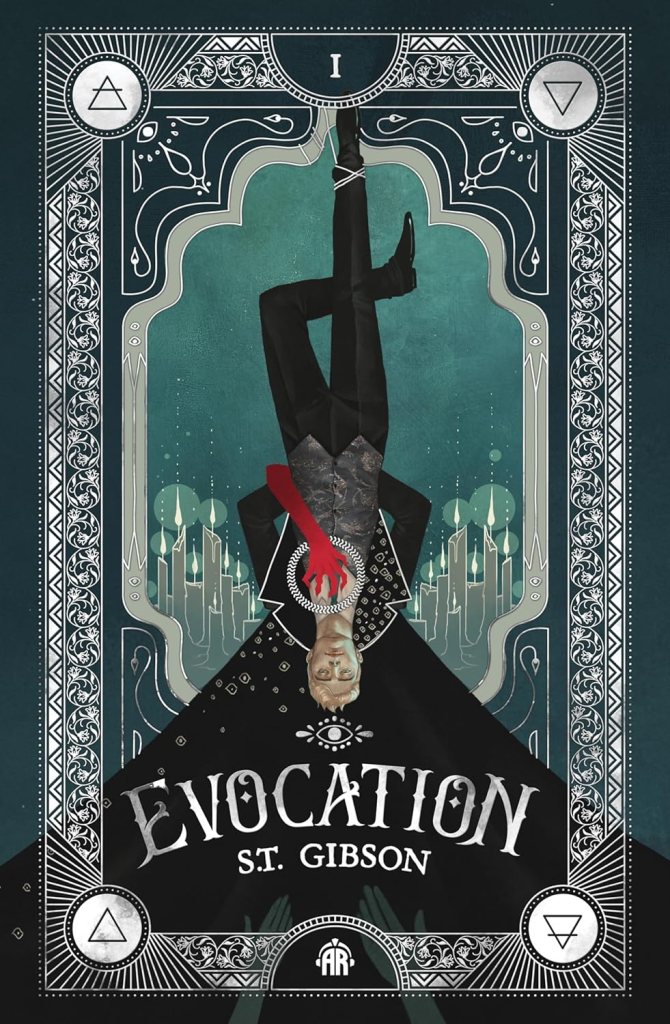
Evocation immediately caught my eye with its cover. While I’m not a someone who subscribes to Tarot in my personal life, I greatly enjoy how it can be used as a symbolic component in stories, especially fantasy ones where its easy for me to suspend disbelief and enjoy fortune telling. That, plus a queer cast made it an easy choice for me to read.
Read If Looking For: poly romance, dynamic narration, occultism
Avoid if Looking For: flesheshed out magic systems, mystery/thriller plotlines that satisfy
Elevator Pitch:
David is one of a long line of Occultists, the family line said to have traded something away to a demon for power and wealth. Central to David’s life is Rhys, his ex who is currently married to a formidable witch named Moira. Overworked and seeking to take over the occult society, David begins to experience magical episodes that leave him fearful that he’s victim to something sinister, forcing him to turn to his ex for aid, and shifting the relationship of all three forever.
What Worked for Me
After the first fifty pages of this book, I thought it was going to be a 5/5 read for me. There was some incredibly sharp writing in those opening sections that had me cackling in laughter. Gibson really found a great way to introduce our core cast of characters and creating a ‘snapshot’ of them immediately. As it floats between three points of view, this early work was incredibly important. Oftentimes I find that I struggle with a new book, reading only twenty pages at a time before I need to take a break as I get used to this author’s style and rhythm. This book drew me in from the start, and the characters remained a real highlight for the entire story. They hit that sweet spot of building up characterization that is just slightly exaggerated that I love in stories, especially those with romance elements.
I also think the developing relationships in the book were done well. Poly relationships are coming up more and more in speculative fiction, and the book had a good development of their interactions with each other. It never ended up feeling forced, and it was great to see characters interested in each other romantically but not physically, which isn’t something we see a lot of. It also modeled how to form poly relationships in healthy ways, and highlighted both healthy and unhealthy relationship dynamics, calling them out as such by the lovely levelheaded Moira.
Finally, the glimpses into different types of magic was cool. Gibson did a lot of work honoring various real world traditions of connecting with divine powers. Oftentimes it was just a glimpse or a bit of conversation, but it felt like a very wholistic way to tackle the story. Don’t expect
What Didn’t Work for Me
My chief complaint of this story is that I think the non-romance component needed some work. It wasn’t bad, but I think if you stripped out the romance content, the story left over would be rather underwhelming. The way that David’s problems were solved never quite felt like they got the attention or development they deserved. It was relatively clear that this book was more meant as a launching point for a series where each book focused on a different character (the three in the poly relationship, plus David’s cult-leader sister). However, laying the groundwork to make readers excited for all these characters left David himself with a rather underwhelming storyline, and generally the plotting and mystery components needed work for it to match the level of execution the romance elements got. Since the romance is more or less resolved by the end of this, the sequels will have to tackle this to remain interesting.
In Conclusion: A successful romance, but an underwhelming urban fantasy
- Characters – 4
- Worldbuilding – 4
- Craft – 3
- Themes – 3
- Enjoyment – 4
 Marked for Plot