
I like to think of myself as a fairly intelligent person. I was an English major in college. I read lots of fantasy books with invented words in them. I enjoy puzzles. And yet, never have I loved being so utterly lost in the beautiful red tape of titles and ranks in the Elven royal court in The Goblin Emperor.
Read if Looking For: the daily life of an unassuming Emperor, hopeful books, baroque invented fantasy language use
Avoid if Looking For: political intrigue as a developed plotline
Elevator Pitch:
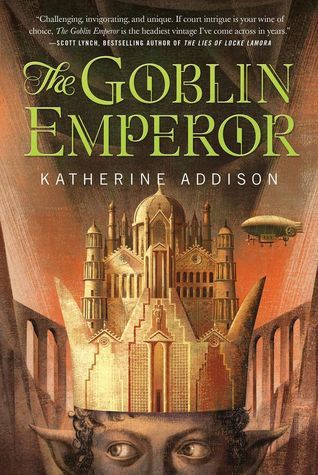
The child of a marriage of alliance between an Elven Emperor and a Goblin Princess, Maia has lived his entire life in exile simply for who he is. When his father and siblings all die in a mysterious airship accident, he finds himself thrust into the role of the emperor, and finds himself in a world he is utterly unprepared for. Lost and confused and just trying to be happy, Maia must learn to accept being Emperor, because it is all he will ever know for the rest of his life.
What Worked for Me
The thing that makes this book really special is how it manages to blend the feeling of being totally lost and overwhelmed with an optimistic tone that permeates the book. Just as Maia is lost in court life, so are we. Despite an extensive glossary, I quickly gave up on trying to understand the large vocabulary introduced to describe court life, and just accepted that I was going along for the ride like Maia was. The reason this worked, instead of infinitely frustrating me, most mostly due to how Maia himself was portrayed. Anxious, twitchy, and curious, his emotional and personal journey throughout the book, and the moments he finally chooses to stand up for himself, shine really brightly. He learns that his position is one that can be remarkably devoid of authentic personal connection, which is the thing he craves above all else. While this is undoubtedly a fantasy of manners book, I feel like the focus is less on political maneuvering or marriage alliances, but instead of the people and their humanity (if you can call it that) which populate the pages of the book.
Similarly, I found the world vividly imagined. There’s a sense of history and and legacy to the spaces. From the way characters talk about things, I felt like Addison had another whole book of lore hidden away to help her during writing. Thankfully, this lore didn’t seep into the story unless relevant or necessary, one of my largest pet peeves in fantasy. From a cultural standpoint, I think this book was a success as well, capturing the many facets of Elvish culture (and snippets of Goblin culture). I found myself lost in this story, uncaring that the more traditional fantasy plots were left by the wayside for something more introspective and exploratory.
What Didn’t Work for Me
If I had any criticism, it is perhaps that the story was maybe a hair too hopeful? The ending of the story, while satisfying, is very neat and tidy, and I think there’s a level of nuance that vanishes when trying to wrap up a book in such a manner. It definitely doesn’t bug me, but I would have enjoyed a little more messiness in the back half.
In Conclusion: A quiet, confusing, and hopeful book about a sudden Emperor, chronicling his daily life
- Characters – 5
- Worldbuilding – 5
- Craft – 4
- Themes – 4
- Enjoyment – 5
 Marked for Plot
One thought on “The Goblin Emperor”