
I really don’t know what to make of this manga. The Gay Who Turned Kaiju is the type of book where it makes a single really big choice, and how a reader responds to that choice is going to define their experience with the entire book. The story walks a tightrope between important (and uncomfortable) themes and wantonness. I can’t figure out which side it falls on. If protagonists committing sexual assault is a hard no for you, then avoid this one.
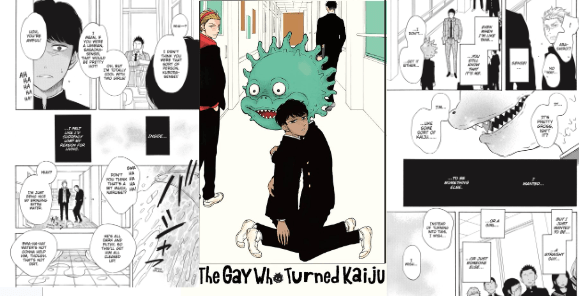
Arashiro is a closeted high schooler and ruthlessly bullied. When he hears his trusted teacher talk about how much gay people are disgusting, Arashiro’s head turns into a Kaiju, and he begins to lash out at those around him. He goes from a quiet kid to someone who is both literally and figuratively a monster.
This device is a straightforward and effective tool to explore how bigoted societies beget self-loathing. This loathing in turn brings out the worst in individuals. Managing the secret of one’s queerness can become all consuming, and overcompensating for the fear and hatred one feels for themself can get nasty quickly. The Boy Who Turned Kaiju doesn’t avoid that experience; it leans into it. Arashiro goes through a series of destructive choices. He cycles between getting high on his power, regret at the harm he causes, shame about all sorts of things, which drives him towards lashing out once again to restart the cycle. You can’t separate Arashiro’s actions from the environment that created them, and that bigoted environment bears some of the responsibility for the monster it created.
This is a side of the queer experience that I’ve found realistic fiction tackles more often than fantasy. In the books I read, the coming out process may be difficult, not received well, or accompanied by a dramatic fight scene. Rarely does the process of coming out showcase the brutality that the typical fantasy protagonist is capable of. Almost never does our hero take immoral actions, and never in connection to their queer identity. Yet in our world we see this time and time again; repression and internalized bigotry has the power to create people who are the worst things we wish to see in the world. Arashiro is certainly not a protagonist you’ll be agreeing with for the whole novel.
You see, one of those horrible things (and the worst by a fair margin), is sexually assaulting his homophobic teacher. Specifically, groping over the clothes, shown explicitly. Arashiro ripples between regret and pride at his actions, but the narrative frames the situation as the teacher ‘getting what he deserved’. He remains horrid the whole time, and the character that the reader loves to hate. Bigots get sexually assaulted as well, and his sins don’t excuse Arashiro’s. Certainly we don’t see the effects of this action played out in a serious light during the manga.
I don’t think including sexual assault in this manner was a necessary choice. Minamoto could have achieved a similar effect (cruelty via homosexuality) in other ways. Any time authors have protagonists take this type of action, the results are controversial at-best. It doesn’t matter whether the protagonist grows from the mistake or whether them being a monster is the whole point of the story. The Chronicles of Thomas Covenant come to mind in the Fantasy community, but Lolita is the most famous example. It is the fulcrum which pretty much every review of the story will revolve.
Is the choice implemented in a way that deepens meaning and gets explored meaningfully? How graphic is too graphic? How does one handle centering victims when a POV character isn’t repentant? I have a fairly high tolerance for sexual assault in books, and the example struck me as egregious. I see what Minamoto attempted with The Gay Who Turned Kaiju. I think it succeeds at a lot of what it sets out to do, and I’d like to see the harm of queer self-loathing explored in more depth in speculative fiction books (throw recommendations my way please!). However, I don’t think the way The Gay Who Turned Kaiju handled sexual assault worked, and the book would have been better off finding a different way of achieving it’s intended effect.
I think The Gay Who Turned Kaiju isn’t going to be a book that I recommend often. It’s not dense enough to feel Literary, but isn’t a ‘fun’ read either. It’s tropey in a very YA way, but this is not a book I’m handing to my students. What it gets right, I really enjoyed. However, I think the audience of folks who will benefit or enjoyment out of this story is pretty small. When read in a less generous light, it seems like Minamoto is endorsing all sorts of harmful queer stereotypes in this book. For the record, I don’t think that, but I think many will.
 Marked for Plot