
I grew up loving Greek Mythology and imagining that half the characters in the books I read were actually gay. I would have loved An Inexplicable Act of Doom, and wish more books like this had been published when I was a kid. While written with kids in mind, I think adults looking for a more low-key reading experience will enjoy it a lot as well. Plus who doesn’t love a sweet romance between a god of your inevitable and unexpected doom with a guy who’s supposed to perish horribly while flying through the air on mechanical wings?
Read if Looking For: harmless bickering, Greek Gods as narcissistic assholes, cozy adventures, witch Aunties who give great advice
Avoid if Looking For: typo-free books, positive depictions of Theseus, nuanced or complex themes & characters
Disclosure: I was asked to be an ARC reader for this book in exchange for an honest review, though I think this was closer to a final Beta-Read than a true ARC. I did also request that Cavehill would donate a single copy of the physical book to my classroom library for my students to read. I think they’ll quite enjoy it.
Elevator Pitch:
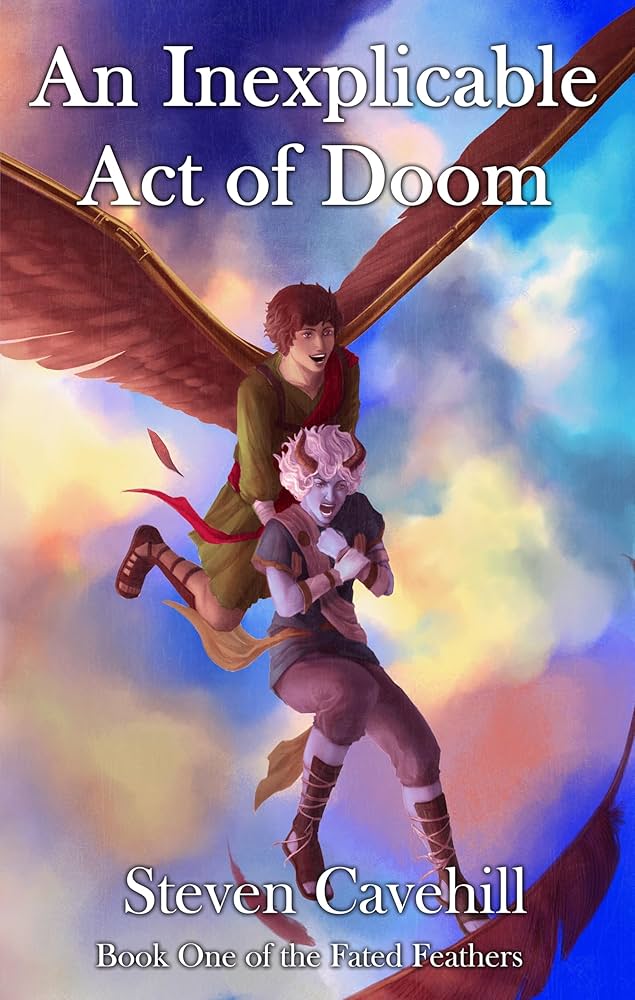
Moros, also known as Doom Incarnate, has been tasked with arranging the death of Icarus to appease Posiedon (who’s still pretty upset about the whole King Minos situation and is taking out his anger on anyone remotely involved). Icarus has been living in a tower on a deserted island for the past ten years, and has just built one of his late-father’s designs: a pair of mechanical wings. Moros can tell Icarus is about to die horribly and decides, against his orders, to intervene in order to save the young man from certain death-by-gravity. This sets them both on a journey that will thrust them into the machinations of the gods as each tries to defy what the Fates have foretold for them.
What Worked For Me:
It’s not much of a prophecy if the Fates require people to go about and do it. It’s more of a wish list. A request.
I thought this book had a wonderful blend of cozy and adventure elements. Yes Icarus and Moros go on adventures together, escape angry harpies, and generally manage to get involved in every divine feud they encounter. However, they also spend a good amount of time talking about delicious food, debating whether or not Moros is actually 6 feet tall, and challenging each other on their first impressions. It feels like a version of the Percy Jackson books set in Antiquity, but without the onslaught of bad puns and modernizations. Quite frankly, it’s the type of book that students in my GSA are craving at the moment, and I’m excited to introduce it to them. This is the type of story that you’re sure is going to have a happy ending, but which never feels boring despite that. Some of my favorite moments were honestly the descriptions of food and Moros’s undiluted joy at discovering just how wonderful things like eating and sleeping can be.
The flip side of this choice is that you’re not going to get any structural ambition or deep thematic work around tough issues. In some ways this is the inverse of how authors like Andrew Joseph White are tackling modern queer YA. This book is a lighthearted and enjoyable read, but not one that challenges your conceptions about the genre. It’s right on the low end of YA fiction in terms of age-range, and I’m almost (but not quite) tempted to call this middle-grade. None of these labels are good or bad, but useful in identifying the reading experience. Queer joy is in short supply in YA, and I was happy to see it here.
Cavehill did a fantastic job at capturing the capricious and uncaring nature of the Greek Gods. They’re self-absorbed, petty, and content to manipulate mortals to satisfy their own ego. Even the best of the Gods are depicted as uncaring, and the denizens of the underworld don’t come off much better. This book weaves a few different mythological plotlines together, but it always felt natural to the story. Never did I feel like characters acted in an arbitrary manner to push the plot forward, which was one of my primary complaints in Cavehill’s previous work.
This book isn’t winning any awards on the character front, but I think the decision to avoid having everyone feel gritty and realistic was a good one. Even aside from the gods, most characters are exaggerations of a set of character traits – especially the side characters. Theseus is a good example; he’s unabashedly a jerk. There are zero redeeming qualities about him, and the book doesn’t try to convince you otherwise. Thanatos is intense and has zero chill about his job. The little thief actually has a heart of gold and was just trying to help her struggling family. That sort of thing. This loops back into the cozyish nature of the book, where you pretty much always know what to expect as soon as you meet someone.
What Didn’t Work For Me:
As with most self-published fantasy, you’re going to find a good deal more typos and awkward paraphrasing than in a traditionally published work. I’m hopeful that many will get caught during the book’s final round of edits, but I have no doubts they’ll still be present. Cavehill has a few tells that bug me, such as a tendency to begin too many sentences with conjunctions and incorrect use of punctuation for speaker tags. I’d be lying if it didn’t pull me out of the story as I was reading. I’ll leave it to you to figure out whether this is important to you.
I think my other large complaint is around Moros. As Doom Incarnate he doesn’t have the ability to control his powers (to his knowledge), and simply being around humans is enough to cause them to die quickly. This adventure is the longest he’s spent on the surface by a large margin, yet he’s not terribly concerned or anxious about Icarus’s death from random happenstance because of his presence. This does get somewhat addressed as the book continues, and is a major part of both Moros’s plot and character arcs. I’m not entirely sold on the logical soundness of the answers Cavehill gives, and I certainly think that Moros would have felt a lot more anxiety around potentially causing Icarus (or other random humans he encounters) a fresh death every 20 minutes he spends with them, much like we see in his opening chapter as he kills a few generals simply by hanging nearby while they bicker with each other.
Conclusion: a middle ground between cozy and adventure, it doesn’t reinvent the genre, but it was an enjoyable take on Greek myth
 Marked for Plot