
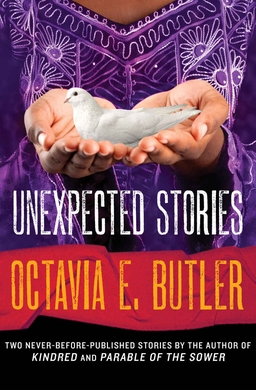
Octavia Butler is, rightfully, a legend and institution in the speculative fiction world. I’ve taught her books in high school classes, enjoyed them on my own, and have found that she is one of the best writers at engaging in the uncomfortable messiness of the human experience. Unexpected Stories is a novella and a short story published posthumously. Both stories are part of the Patternist series, but stand on their own without context – I haven’t read the main series yet. It’s worth noting that Butler wanted both stories published while she was alive – one story was sold to be published in an anthology which fell through, and the other never got picked up by a publisher despite Butler shopping it around – so neither story is being published against Butler’s wishes.
At 81 pages, it was easy to devote time to these two stories from one of the genre’s masters. I enjoyed the first and felt rather unimpressed with the second, making this far and away my least favorite of Butler’s writing. That this volume is still worth recommending is an indication of just how much of a gift Butler has been to Speculative Fiction.
Read If: you like reading Butler’s work, are interested in exploring alien social dynamics, enjoy short stories with themes of justice and power
Avoid If: you’re looking for Butler’s deeper explorations of ethics and morality, look for friction between narrative and protagonist
A Necessary Being
The story follows a very caste-driven society of aliens whose skin color determines one’s strength, power, influence, etc. The bluer you are, the bigger and stronger and smarter you are. The wholly blue Hao are the ruling caste, but are quite rare. Tahneh is her community’s only Hao, and her father (when he was alive) was crippled to keep him from returning to his homeland. When their scouts spot a young Hao travelling almost unguarded, Tahneh must balance her distaste for their society’s violent strategies to obtain Hao with the needs of her struggling community.
I thought this book was an interesting exploration of caste structures with the context that skin color has tangible differences divorced from societal expectations – though the story does spend some time examining whether or not the society is too fixated on this fact . Butler’s worldbuiding was consistent, intriguing, and led to enjoyable end-points that didn’t feel like shallow imitations of how human society operates. However, I think this story really shone as a snapshot of political speculative fiction. I wouldn’t say this story has political intrigue, but Tahneh and the young male’s negotiations to try and find an acceptable solution for all parties involved was certainly better thought out than most of the political intrigue stories I read. Their characters were fully fleshed out, their motivations and competencies impacted how they approached situations, and we weren’t spoon-fed every single consideration going through both of their heads at any point in time.
I liked this book a lot, but it lacked the thematic heft I associate with Butler. It was a phenomenal light read, and I’m excited to try out the Patternist series in the future.
Childfinder
Originally written in the 1970s, Childfinder is probably the Butler work I’ve enjoyed the least. Not because it’s bad, but because it lacks the nuance and insight that I’ve enjoyed from Butler. It follows a black psionic woman who has the ability to find pre-psionic children and shepherd their abilities. She’s recently broken from an organization of white (now that she’s left) psionics who now view her as a threat, especially since they don’t have the skills to find new psionic children on their own.
I thought this story was too straightforward for my tastes. There were strong thematic elements of self-sacrifice, justice, and parenting. However, it also featured a minor plotline where the main character had ‘crippled’ – her words, used many times – several white children who showed potential to develop childfinder abilities. Unfortunately, Butler didn’t examine this element in any meaningful way. Neither our protagonist nor the narrative seem interested in exploring this act itself as an ethical breach. This is a shame; in other Butler stories, I’ve found she’s at her best when she examines whether unethical actions can be justified by larger societal context or personal situations. This was one of Butler’s earliest stories, and it made clear how much she grew as a writer from when she started.
 Marked for Plot