
It’s almost the end of March, which means the ending of the r/Fantasy Book Bingo Competition! I’ve already done write-ups for my two main cards (Achillean and Graphic Novels respectively). However, I realized that in all my other reading, I had enough to throw together a third card with no additional restrictions. It’s got some real gems, and I’m happy to say that there’s only one here that I left actively disliking. However, highlights include The Memory of the Ogisi, The City that Would Eat the World, The Sign of the Dragon, and But Not Too Bold.
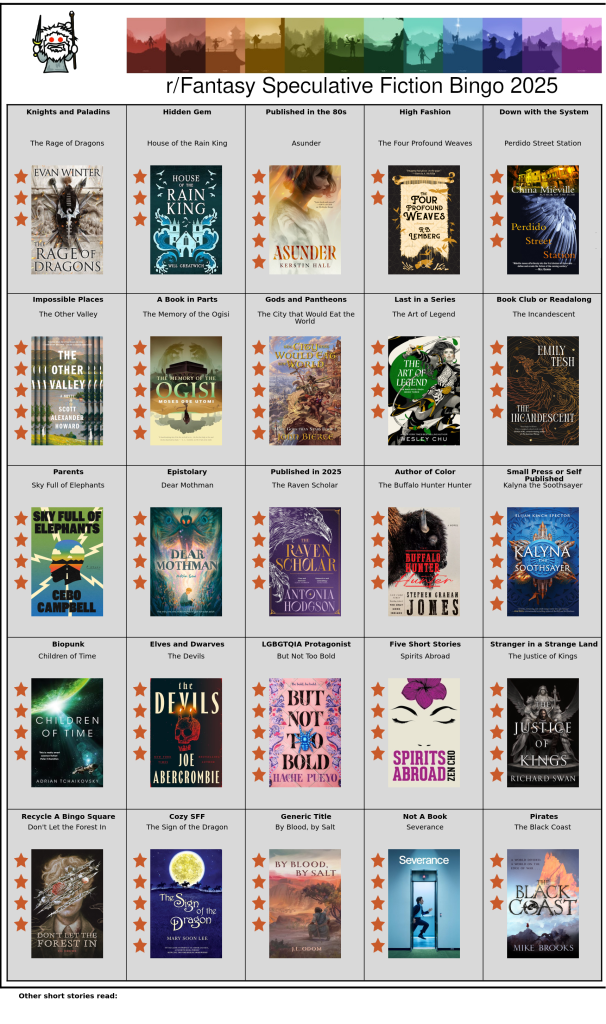
Knights and Paladins: The Rage of Dragons by Evan Winter
This action-packed series is pretty much one trope after another. Wrong protagonist is an outcast who has the grit to become the strongest in the world. Faced with unfairness and brutality at every turn he rises. The action scenes are pretty nonstop. Too many fight scenes for me, but the first 200 pages was enough for me. I likely won’t continue.
Hidden Gem: House of the Rain King by Will Greatwich
A Monastery is visited by its uncaring rain god. The book follows a young monk who isn’t happy about the corruption he’s finding and a mercenary band escorting the Rain King. The monastic vibes were executed well, feeling very low fantasy and focused on the experiences of real people. I though it had some pacing issues, and I wish the story had been more focused on the Monastary than diverging into a few different plotlines.
Substitution Square (Eldritch): Asunder by Kerstin Hall
This is a standout worldbuilding square. A world is healing from the passing of one set of gods to another, and what a dark twisted world it is. The prose in this book is simply astounding, and Kerstin manages ‘nothing really happens’ into something haunting and impossible to put down.
High Fashion: The Four Profound Weaves by R.B. Lemberg
Two different elderly trans folks seek out the most powerful Weaver of magic. Both have remorse for past decisions they made, and represent different paths towards transition. I thought the queer thematic development was wonderful, but ultimately found this story to be mostly a disappointment. It tried to do too much in too little space, and pretty much everything else (plot, character, other themes, a comprehensible magic system that kept trying to explain itself) all fell flat because of that.
Down With the System: Perdido Street Station by China Miéville
Another book with a really strange world, Perdido Street Station is focused on a single city, its corrupt politicians, ambassadorships with Hell, sketchy universities, and underground mobs. It’s first half is a communist exploration of oppressive governments and the power (and often futility) of unionized resistance in a strange strange city. The second half pivots to a horror action thriller which I thought was much weaker (and unnecessarily sidelined all female characters). Overall phenomenal on a thematic level, but I didn’t love the midpoint tonal shift.
Impossible Places: The Other Valley by Scott Alexander Howard
A town borders itself: future on one side and past on the other. Our main character studies to become one of those who decides who gets to visit their future or past, and faces the trials and tribulations of teenagehood. Don’t expect the time travel to make sense, but Howard succeeds in bringing a character to life.
A Book in Parts: The Memory of the Ogisi by Moses Ose Utomi
This is the conclusion to the Forever Desert series (which should probably be read in order, but actually works as a series you could read in any order) and its strongest entry. It married the fable-esque qualities of the first book with the interesting thematic explorations of truth and history of the second. It’s more nihilistic than the other, but this trilogy packs more into 400 pages than it has any right to.
Gods and Pantheons: The City that Would Eat the World by John Bierce
In a world where gods can grant blessings and boons to their worshippers, we follow a Mimic Exterminator (with a god of counting flagstones) and a ruffian (with a god of adventure) find themselves in possession of a godkilling artifact. They shepherd it across a megacity that threatens to consume the whole world, and we get to see a wide variety of vividly realized districts. Phenomenal action scenes and interesting (if rather blunt) takedowns of capitalism and expansionism.
Last in a Series: The Art of Legend by Wesley Chu
The War Arts Saga has great fight scenes, good politics, and is a fresh take on the Epic Fantasy genre. I loved how the individual character storylines progressed and wrapped up, but I thought the ending to the overarching plot was deeply unsatisfying. Steampunk Mongols, gigantic war-monks, a badass grandmaster who grumbles about her joints. What’s not to love?
Book Club: The Incandescent by Emily Tesh
This is the book club I ran! It was for a magic school themed book, and this follows a professor at a magical boarding school. There was lots of fun magic (and negotiating with a bunch of demons), but it didn’t blow me away. It was good, enjoyable, and I loved reading it. I won’t be rushing to recommend it however.
Parents: Sky Full of Elephants by Cebo Campbell
What if all white people suddenly walked into the nearest body of water, drowning themselves? In this world, a man finds his estranged daughter (raised with her white mother and white stepfather and half siblings) travel the countryside. There was a lot of interesting writing examining cultural oppression, Black Joy, and the relationship between a father and daughter that never had the chance to form. It also constantly undermines its own meaty thematic questions. Do just white people drown themselves, or anyone non-black? The book clearly wants the overwhelming number of people alive to be black and explore what black culture looks like. However, Campbell doesn’t want to commit to the idea that Native Americans also drowned themselves, and he ends up in a wishy washy most of them died but we won’t talk about it, and enough are alive that their culture isn’t eradicated but you only see them for it to be commented on how happy they are and how rare it is to see someone who isn’t black. He kept trying to have the best of both worlds when I really wish Campbell had committed to exploring the uncomfortable questions.
Epistolary: Dear Mothman by Robin Gow
A journal of an Autistic and Trans youth’s journal and letters after the death of his best friend. He writes to Mothman, hoping to discover the creature is real. It explores transness and Autism through the metaphor of being labeled monstrous. Feels more like realistic fiction. Written for kids, but I think adults will get different things from the book.
Published in 2025: The Raven Scholar by Antonia Hodgson
This book was HOT at the start of 2025. It’s an action packed book of tropes. It’s a murder mystery, and a tournament arc for the throne, and also a weird book kind of sometimes narrated by a flock of deific ravens. I thought this book worked well in the popcorn action flick space, and I loved some of the characters. However, the twists didn’t make a ton of sense, and there were far too many for the book’s good.
Author of Color: The Buffalo Hunter Hunter by Stephen Graham Jones
I really struggled with how slow paced this was. When the horror hit, it was phenomenal (especially the growing relationship between our two leads: a Lutheran Pastor and a Blackfoot Vampire). However, I think I’d have been happier if it were 250 pages shorter, because there was a good amount of bloat in the story.
Self Pub/Small Press: Kalyna the Soothsayer by Elijah Kinch Spector
A political fantasy with some dry comedic elements following a fake soothsayer who gets dragged into protecting the King from a coup. Strong main character, it made me laugh, and the setting had some really wonderful elements to it. This lives somewhere between The Lies of Locke Lamora and A Mask of Mirrors. It’s a gem.
Biopunk: Children of Time by Adrian Tchaikovsky
Super interesting evolutionary science fiction following spiders left of a seed planet with a virus that accelerates their growth over time. The human chapters felt like filler, and I think they largely could have been omitted or condensed into interludes Half the book was fascinating, the other half was a bit of a bore.
Elves and Dwarves: The Devils by Joe Abercrombie
A gang of misfits goes on a suicide mission for the Church. This has suicide squad vibes, and its generally a fun and mindless romp that’s perhaps a bit too predictable and structured for its own good. Abercrombie is phenomenal at characterization, and the cast of characters (rather than the plot itself) was what will keep me coming back to the sequel. We love a megolamaniac necromancer.
LGBTQ+ Protagonist: But Not Too Bold by Hache Pueyo
This is a gothic horror/paranormal romance hybrid where the monster actually feels … monstrous. It’s a blitz of a novella, and it was easy to consume this in a single sitting.The ending was a bit unsatisfying, but Pueyo really nails the discomfort of a giant spider who is happy to eat the help in its portuguese Art Deco mansion.
Short Stories/Anthology: Spirits Abroad by Zen Cho
This collection of stories mostly focused on the Malaysian Diaspora with magical realism and horror elements. There was a good sense of identity to the collection, with some hits and misses. My favorites were The Fish Bowl (a spin on The Monkey’s Paw), If at First You Don’t Succeed, Try, Try Again (a snake wants to become a dragon), Rising Lion (exorcists and Lion Dancing), and The House of Aunts (a dead girl lives with her elders who nag her constantly).
Stranger in a Strange Land: The Justice of Kings by Richard Swan
An apprentice to a travelling Justice gets wrapped up in some major political plots while investigating the murder of a minor noble’s wife in a river city. The book could have used some trimming down, but overall was an enjoyable read that wasn’t quite a murder mystery and wasn’t quite a political low fantasy, but something between. Looking forward to more in the future.
Recycle a Bingo Square (Forest Setting): Don’t Let the Forest In by CG Drews
I wasn’t sold on this YA horror at first, but the twist really blew me away. It’s a rich boarding school where more is going on than meets the eye, and a ‘troubled’ child’s best friend is suddenly being investigated for the murder of his parents. All while monsters from his book of drawings are coming awake in the forest.
Cozy: The Sign of the Dragon by Mary Soon Lee
An epic poetry collection following an unlikely and kindhearted Emperor from his ascension to his death. He’s warmhearted and has pretty strict ethics, which normally would be a bit too saccharine for me. Lee provided plenty of poems to flesh out the greater cast though, which led to a very three dimensional portrait of the Emperor’s reign. Seriously phenomenal, and reminded me of reading the Greek epics in some ways.
Generic Title: By Blood, By Salt by JL Odom
The most recent SPFBO winner, I can see why this book won. It does a great job at being a political fantasy where not everything is spelled out for you while also having some sharp insight into how various people react to being Othered and targeted by a militaristic regime. A bit slow paced in my opinion, but seriously well thought out and written.
Not a Book: Severance
Watched at the behest of my partner. I liked this corporate drama, but I haven’t been hankering to follow the sequel. That said, I don’t watch too much TV these days.
Pirates: The Black Coast by Mike Brooks
The setup for an expansive epic fantasy, this book follows two main storylines, each with its own set of POVs. On one hand a small farming town (the country vaguely themed around Feudal Japan but with dinosaurs) is visited by Viking raiders who are here to settle instead of fight (they’re on the run from a monster back home who is hunting them down). Across the world, a spymaster/real power behind the throne is trying to assassinate threats to her brother’s rule while a thief from the city ends up roped into her scheming. There’s some cool worldbuilding here, but some of it was clunky and not thought out as well as I’d like, stretching my suspense of disbelief in a few places. I wish this had focused more solidly on the viking settlement storyline, which had a lot more thematic teeth. The other plot could have been shrunk down to be expanded on in sequels. As is, it felt like filler a lot of the time.
 Marked for Plot