
I haven’t read a ton of the books in the Self Published Fantasy Blog Off competition. Some of the finalists I’ve liked(Wolf of Withervale) others I found supremely disappointing (By a Silver Thread), but the winners I’ve read have been universally good. By Blood, By Salt is the most recent winner. Its political and military pitch sounded very different from a lot of the self-published work I normally read, and there was enough in the blurb for me to grab a copy. The story feels surprisingly traditional and old-school, but Odom does a good job of layering fresh thematic elements on top of a tried-and-true framework. Imagine if Game of Thrones focused on a single storyline and was set in an Arabic-inspired society, and you’ve got a good portrait of By Blood, By Salt.
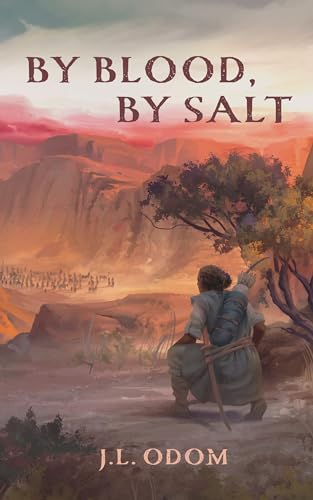
Read if: you appreciate minority cultural groups not being written as monoliths, scarily competent protagonists are up your alley, you want complex fantasy cultures influenced by West Asia
Avoid if: you like your books fast paced, want heavy supernatural elements, or are hunting for fight scenes, you want a breadth of female characters
Comparable Media: Game of Thrones, Traitor Baru Cormorant
Elevator Pitch:
Azetla is a Jackal. His land and people are forbidden from carrying weapons, from holding positions of power, and from living free from violence. He serves as an unofficial commander in an archaic military unit free from much oversight. When a bastard prince decides to make a play for the throne, Azetla finds himself hunting a creature (demon, djinn, or devil he doesn’t know) in the southern deserts. But when they capture her, she has just as much of an agenda as he does, and Azetla’s first priority is to his people, not his country.
What Worked for Me:
There are so many things to rave about in By Blood, By Salt. This is a book that takes Political Fantasy seriously, and I wish other authors in this space would take notes. There are times when Odom spells things out for the reader, especially when setting the stage for the world so you have necessary context. However, this novel isn’t afraid to present important conversations without telling you what each character got out of the exchange. When Odom does feel like spelling things out for you, she often waives away dialogue entirely, instead leveraging narrative descriptions of how the conversation went and the nuances each character implied. I almost never felt like I read several paragraphs of dialogue followed by several paragraphs spelling out exactly what that dialogue meant for the story. Even more crucially for political machinations, I believe Odom when she gives me a character trait. Those who are oblivious act obliviously. Those she tells me are shrewd do indeed act shrewdly. By the end of the story, Odom had built up quite a bit of trust to spend as more major political moves were made by various characters. Everything felt earned, foreshadowed, and in line with what we previously knew about the characters. To a certain extent this meant some twists didn’t come as much of a surprise, but I never felt like punching a character in the face because their actions don’t match what I’m told just happened.
I think that it’s especially worth highlighting how Odom refused to homogenize populations. In many books where our protagonist is part of an oppressed ethnic group, it feels like the author clumps them together into an easy bundle of traits for the reader to remember. Some characters might have disagreements (perhaps one is even an antagonist), but ultimately the cultural group is very united in a set list of traits and history that define them. By Blood, By Salt rejects all of that. The story goes out of its way to show the many different ways that people react to military occupation and oppression. Azetla himself is something of a rebel; he clings tightly to his cultural celebrations, ethical values, and traditions. He pushes back against any effort for him to assimilate or be seen as attempting to assimilate. Others actively resent Azetla for standing out and drawing attention to himself, and by extension to them. Still others maintain their traditions while being happy to share the holidays and traditions of the Empire, especially when with friends. It’s such a sharp contrast to how books like Red Rising handle this character premise, and I loved the book for it.
Odom herself is an interesting figure. She’s a white American author writing a very Arabic-coded world. I’m not familiar enough with the region and its stereotypes to talk about whether or not she stepped in any common potholes, but I can say that the world is three dimensional, interesting, and clearly done from a place of respect. When I got to the biography and learned she was an Arabic linguist I was surprised not a bit. I actually really appreciated the few times when linguistics shone through in the plotline. They were some of my favorite classes in college, and I wish I’d taken more of them.
What Didn’t Work for Me:
I think I would have enjoyed this book more if it were faster paced. I liked the nuance that Odom layered into the story, but I ended up dragging my feet a bit near the end. Ultimately, I think it would have been relatively easy to condense some travel scenes, remove a POV or two, and come out with a much more compact package that really hones in on the most interesting parts of the story. Dare I say I wish By Blood, By Salt were a novella? About halfway through the book I had a clear vision of why this book won the SFPBO. By the end I contemplated on whether or not I wanted to devote the time to its sequel because as much as I enjoyed the themes and characters and plot, I just wasn’t itching to pick it up and start reading again.
On some more nitpicky notes, this book doesn’t have a ton of female characters. The only one who gets more than a passing mention is the demon, who isn’t treated in the same way as other female characters in this world (it doesn’t get much focus, but the setting has pretty stereotypical and strict gender norms). Even the demon herself doesn’t feel quite like I hoped. She has a habit of knowing impossible things, yet in her POV chapters we don’t get any sense of how she knows as much as she does. She reads just as human as everyone else, except from other characters’ eyes.
Conclusion: a nuanced, deep, and plodding political and military fantasy in an Arabic world
- Characters: 4
- Setting: 5
- Craft: 4
- Themes: 4
- Enjoyment: 3
 Marked for Plot