
For the past three years, I’ve taught middle and high schoolers classes on reading and creating comics and graphic novels. What started as an impulsive decision quickly spun into a rekindling of my childhood love of sequential art. I grew up reading manga (unsurprisingly, I read a fairly equal balance of Shoenn and Shoujo; truly we gays get the best of both worlds) and finding my footing in what I like and dislike as an adult has been a fun adventure. Around November, I realized it would be pretty feasible for me to complete a bingo card comprised entirely of graphic novels. Some of these I read for school, others for personal enjoyment, and a few to explore things outside my perceived comfort zone.
Reviews are organized according to vibe so you can find the type of comic you’d enjoy, with my favorites within each category further towards the top. I anticipate that this is a challenge I’ll continue to pursue, though I think I’ll probably just read what’s interesting and see where the pieces fall for future years. Enjoy!
Interesting Premises, Executed to Perfection
While Tongues and Watchmen are probably my favorite comics of the year, these four were all truly excellent. Each pulled me in with a fairly unique hook, and all of them filled the promises written on the back cover. Because I don’t want to split hairs on which I liked more, this is organized alphabetically, but all get my full endorsement.
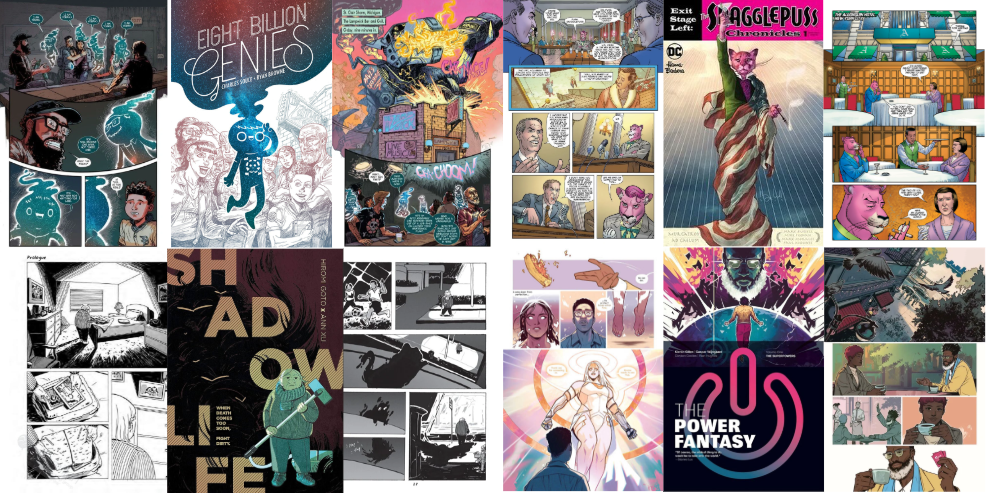
Eight Billion Genies by James Tynion IV: if all 8 billion people were given a single genie who can grant a single wish, what would happen? This comic series explores the lives of around 10 individuals who were in the same bar when the apocalypse hit. It spends time in the days, months, years, and decades after the genies arrived, and is filled to the brim with emotional moments, evocative characters, and a well thought out perspective on a zany idea.
Shadow Life by Hiromi Goto: an elderly woman is haunted by the shadow of death. To avoid her looming fate (and her pesky kids who are trying to get her into a retirement home) she’ll haggle with vacuum salsepeople, reconnect with her first love, and turn into stubbornness personified. Kumiko is a phenomenal protagonist to follow, and this slice of life comic made the most of her.
Snagglepuss Chronicles by Mark Russell: this comic examines what it meant to be a gay man (and an artist) during The Red Scare, but with anthropomorphic animals. To be honest, the animal bit largely could have been ignored, as it didn’t have any impact on the plot or story (and is the only speculative element). While there’s joy to be found here, it isn’t a happy comic. More importantly, as someone living and teaching in Minnesota right now, its message of speaking truth to power even when you know you aren’t making a direct impact was much needed.
The Power Fantasy by Kieron Gillen: like Watchmen, this story is interested in subverting and exploring superheroes from a different angle than is typical. Can those with the effective power of nuclear bombs truly be ethical people? This series follows the six beings who have that unique distinction, and how they constantly dance on the brink of calamity while everyone else suffers from their mere existence.
Experimental and Thinky
These were comics that pushed the boundaries of what I’ve experienced in comics before. Whether it be how they handle perspective, weird panel layouts, or arcane references, each of these were books that I chewed on, rather than blitzed through.
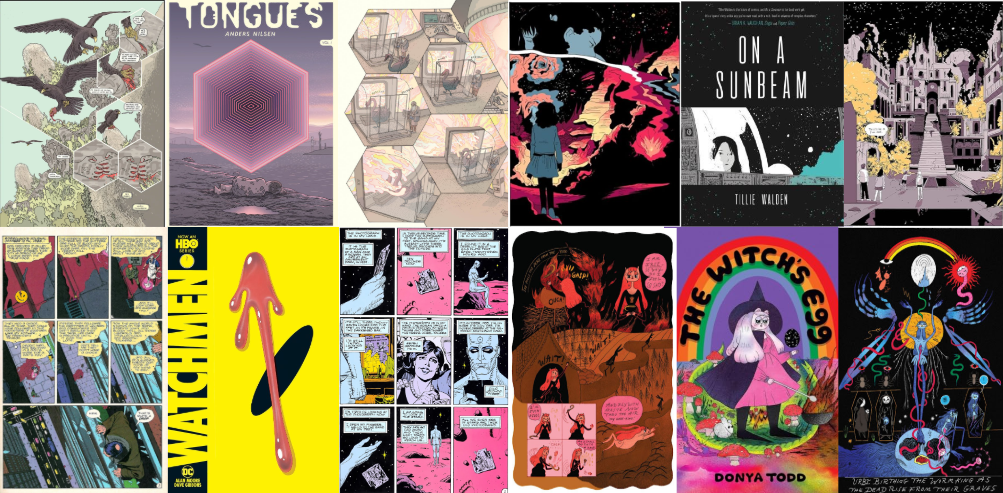
Tongues by Anders Nilsen: I was engrossed by this take on Greek mythology. It looks at the Greek Gods (or really, ancient creatures that the Greeks chose to label as gods and give human characteristics to) and explores what they’d be up to today, with a special focus on Prometheus and his budding friendship with the eagle who rips out his innards each day. I still have no idea about where the plot of this story is headed, but I always felt immersed in whatever scene I was in. It’s aggressively nonlinear, centers conversation over action, and is truly a love letter to the comic book form.
Watchmen by Alan Moore: Considered by many to be the best comic of all time, and I totally see why. My friends have seen the movie (TV Show?) and swear by how good it is, but after reading this, I can’t imagine it as anything other than a comic. It’s a deconstruction of the superhero idea, with the simplest explanation of its premise being that people who put on spandex to fight crime probably aren’t healthy or well-adjusted people. The series is pretty dense, not popcorn reading, but it makes excellent use of epistolary elements, an alternate history where pirate comics got big instead of superheroes, and perspective choices within simple panel layouts to make magic.
On a Sunbeam by Tillie Walden: So this book isn’t really that experimental, but I didn’t have a great place to slot this book. Walden’s ability to mix the still vast nature of space with swaths of color and movement is notable and pushed it here over somewhere else. It’s a slow burn mix of character study, romance and internal journey. It follows a woman’s life, swapping between a formative year of school and her first job as a restoration tech who visits ancient ruins. Gorgeous art, with fish spaceships. Don’t expect Walden to ever explain the worldbuilding, though.
The Witch’s Egg by Donya Todd: this book was weird. Unhinged? There were parts of it I really liked, and the art style inspired by Medieval wood prints was really cool. It follows a cat witch who sleeps with an eldritch horror and then raises her three children? That’s a bad explanation. I didn’t mind how unmoored from reality the story was, but I really struggled with Todd’s rapid shifts between medieval speech and modern texting lingo. It really pulled me out of the story.
Mindless Fun
This is what I would call my childhood comfort zone. Race through the story, enjoy the art, but I’m mostly trying to cram as much into my eyes as I can for each split second. When the mood hits, nothing’s better than pushing through two comics in a single night because of how much fun you’re having.
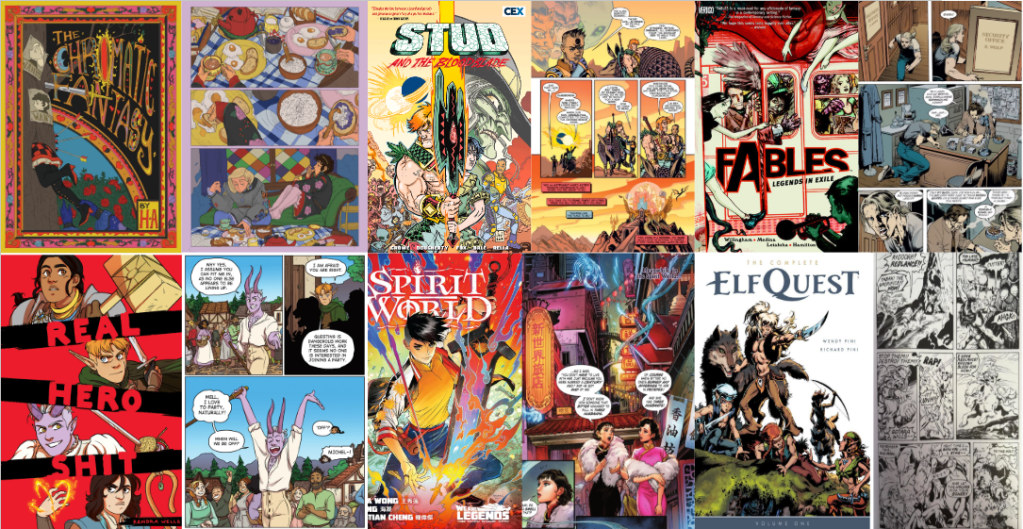
The Chromatic Fantasy by HA: a trans man makes a deal with the devil to escape a nunnery, then promptly falls in love and becomes a Robin Hood figure. This was a riot of a book that didn’t always make sense, but it oozed charisma. The art has no shading, making the entire piece feel like a stained glass window. Some will dislike the 4th wall breaking and anachronisms, but to me they meshed well with the silly vibes (and some more serious examinations of mental health).
Stud and the Bloodblade by Perry Crowe: this comic is both a love letter and satire of He Man, following a himbo knight who falls in love and promptly fails to accomplish anything useful. The villains are fun and silly (Roach Coach will forever have my heart) and I was surprised at how much thematic development Crowe was able to cram into a single volume that largely was lighthearted and fun.
Fables: Legends in Exile by Bill Willingham: the best way I can describe this series is the Once Upon a Time TV show, but written for adults in mind and without the meddling of Disney. The Wolf is our main character, but we’ll flit between plenty of different leads in a series that feels both urban fantasy noir and epic fantasy at the same time.
Real Hero Shit by Kendra Wells: This was a stupid and fun story about a D&D party who is forced to play nice with a bisexual fuckboy prince who’s looking for some adventure on the side. Lots of bickering, a subpar mystery plot, and a fun cast. It looks like the sequels will take the series in a more serious direction in terms of both content and theme (some pretty horrific torture-victim backstory has been alluded to) but this book is mostly just a fun romp.
Spirit World by Alyssa Wong: this DC comic has truly badass art, but the story is a bit of a mess. It takes the things I hate about superhero comic structure: a rigid adherence to page count, a conflict introduction/resolution in each chapter, constant references to other comics, and the need to repeat itself in case someone starts after issue #1. I get why these ideas exist, since comics developed this style pre-internet, but I wish DC had just handed Wong a 200 page graphic novel limit and let her work on a single cohesive story.
Elfquest by Wendy and Richard Pini: this comic has a pretty large following and ran for something like 40 years (with a spinoff series still going). I didn’t quite fall in love with it, but suspect that if I’d have read it as a kid I would be rereading the series every year. Old school epic fantasy vibes with a lot of problematic gender-based content you can expect from the 80s.
Cozy and Heartwarming
Unsurprisingly, a lot of my classroom library books fall into this category. Middle School graphic novels definitely trend towards wholesome. Even Kat Leyh’s adult comic here has kids-lit partners in my classroom.
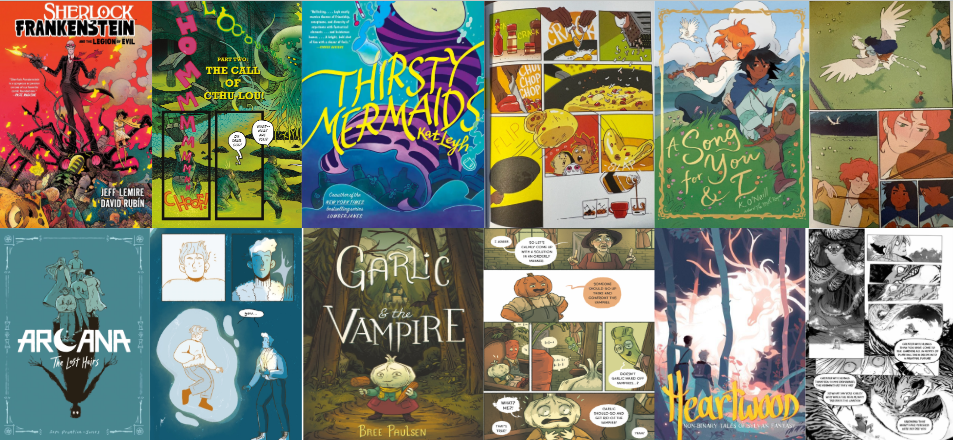
Sherlock Frankenstein and the Legion of Evil by Jeff Lemire: I did not think this was going to be as chill as it was. It follows the daughter of a dead (probably) supehero. Now an adult, she is chasing down the villains he fought to try and discover if her father is really dead. Most of the villains aren’t really evil, have sympathetic backstories, or have reformed, and you won’t find a single fight scene in the entire story. I want to read more from this series!
Thirsty Mermaids by Kat Leyh: a standalone about three mermaids who turn into humans but can’t figure out how to turn back. The first half is filled with all the misadventures you’d expect from mermaids on the surface (I don’t know how money works!) but the second half is very emotional. The vibrant art is a highlight for me here, along with really strong characterization across the board.
A Song for You & I by Kay O’Neill: O’Neill is pretty much royalty in the middle grade comic circuit, at least in my classroom of 6th graders. A Song for You & I isn’t O’Neill’s best work, but it definitely satisfies. It follows a pegasus-riding ranger who is struggling with their identity and a violinist who is scared to play in front of others. Their enemies-to-friends arc accompanies two chill but deep personal journeys. Expect lots of landscape shots, and generally very beautiful.
Arcana: The Lost Heirs by Sam Prentice-Jones: an urban fantasy about a coven of witches discovering the dark secrets their bosses are holding over their heads. It follows 5 POVs, is cute with big found family vibes, but I don’t think it was quite as meaty as the author was aiming for it to be. I read it in two or three hours though, and will definitely pick up the sequel.
Garlic & The Vampire by Bree Paulson: when a vampire moves back into an ancient castle, the vegetables of the witch’s garden get anxious. Garlic is voluntold to investigate and kill the vampire. This book doesn’t have much going on beyond ‘monster is actually not that monstrous’, but is sweet.
Heartwood: Nonbinary Tales of Sylvan Fantasy: this anthology was … rough. There were a few gems in here, but the overwhelming majority of stories were variations on ‘the power of friendship’ without anything more interesting to say. These are fine, but I was hoping for more diversity of perspectives. There were a few gems though, and I will be reading more comics by Verface for sure.
Dark, Creepy, and Unsettling
Horror used to be something I’d avoid at all costs. I watched The Mummy when I was 5 and had nightmares for months about being eaten by beetles. As an adult, I enjoy horror books well enough, but still avoid movies. Comics feel like a good way to increase my exposure, but none of these quite captured my heart.
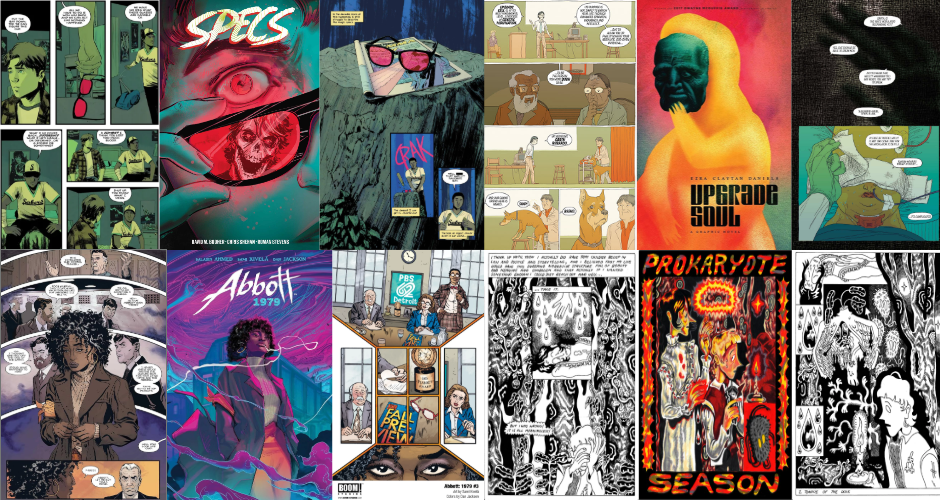
Specs by David M Booher: this book has major Stranger Things season 1 vibes. Small town kids get a pair of glasses that can grant wishes, and things predictably go wrong. It wasn’t super scary, but the unrequited yearning and failure of the main character was very relatable. It also did a good job of showcasing racism in small towns, and how even well-meaning people don’t really get it.
Upgrade Soul by Ezra Claytan Daniels: an elderly married couple participates in an experimental therapy to give themselves extended life. Instead, there are now two of each of them: their human bodies who are aged and rapidly declining, and fetus-like creatures who are the pinnacle of strength and intelligence. I liked a lot of ideas in this comic, but it never quite landed the plane, and the art didn’t help tell the story much in my opinion.
Abbott by Saladin Ahmed: Technically this is Abbott 1979, which would be at the top of this category. Unfortunately, it is book 3 of what was a trilogy with very weak first and second volumes (other than the art, which was phenomenal). Had I not been running the discussion for this at the QueerSFF book club, I’d have dropped it. Some really cool work around racism in Detroit, but the main focus on supernatural investigations and dark powers with a chosen-one hero fell flat, the pacing was a mess, and the author relied on the same gimmick to solve too many problems.
Prokaryote Season by Leo Fox: on the plus side, this book had a really great toxic love triangle situation. I think people looking for a really weird take on mental health will gravitate towards this book, but it didn’t do much for me. I appreciated that it took big swings though, even if the choices didn’t work for me.
 Marked for Plot