
This year for my r/fantasy book bingo challenge, I decided to limit myself to reading books exclusively with queer male protagonists. Specifically, I wanted to focus on gay/bi men in non-Romance stories when possible. I love romance books, but I wanted to push into some more ambitious spaces with this project. I ended up reading some books that easily fall into my all-time favorites. I also ended up with two more cards (a graphic novels card that I’m working on a post for and a ‘leftovers’ card when I realized I had enough books that worked for a third), but this was my focus for the year.
My goal was ‘read some gay shit and have a great time,’ and I have achieved that goal magnificently.
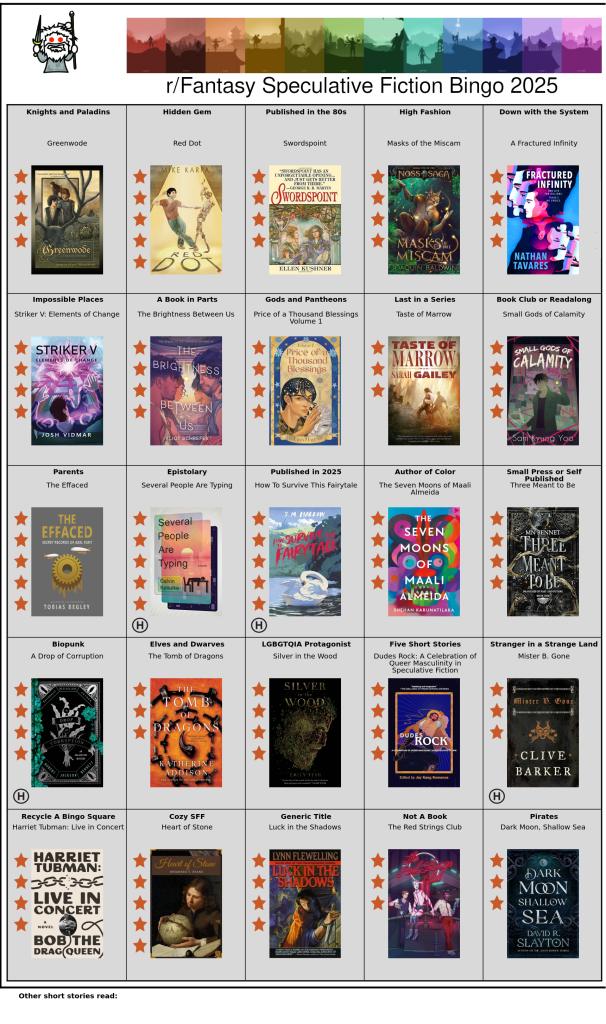
I’ve included short, one paragraph reviews of the 24 books (and one video game) that made the card below. For people who are more visual, I also made at-a-glance slides with pros/cons for each of the ~45 Achillean books I read since bingo started. While I could keep reading more to get an even more perfect card, I’d rather bank the reads I’m excited about for April and focus on reading other things for now.
New Favorites
How to Survive this Fairytale by SM Hallow – easily my book of the year. An emotional roller coaster following Hansel after the Gingerbread House, exploring the ripples of childhood trauma (content warnings for suicidality and eating disorders specifically), how to find happiness, and a man cursed to be a swan. Think Robin Hobb’s treatment of character in a faster-paced prose that sometimes breaks the fourth wall and treats the narrator as a character in the story itself. So much good to say about this book, and this review is already too long.
Red Dot by Mike Karpa – an artist in a vaguely utopian post-climate change world struggles with imposter syndrome. Lots of making art, a relatively large romance storyline with his arch-rival’s identical twin. This felt very authentically queer, super grounded, and made me feel seen and heard in life. Not high stakes, but heartwarming despite not being a cozy book either.
Heart of Stone by Johannes T Evans – a vampire love story that ended all other vampire love stories for me. Slow conversations that unfold in the way real relationships do, tension you could cut with a chopstick, and very little in the way of camp or cliche. An honest and immersive story that is quiet and powerful.
Several People are Typing by Calvin Kasulke – a comedy/eldritch horror story about a PR grunt stuck in a Slack chat at work. Epistolary format used exclusively and to great effect. Good balance of workplace drama/comedy and weirder stuff. Surprisingly grounded and human characters despite the batshit premise and execution. Very quick read as well.
Would Love to Reread
Fractured Infinity by Nathan Tavares – sold as a romantasy, but falling in love happens mostly offscreen or in hindsight. More like a trolley problem involving the love of your life vs the entire universe. Tavares is probably my favorite author for capturing what being gay feels like to me. “Obligatory coming out stories” probably won’t ever leave my vocabulary. Strong characterization, but the worldbuilding was a bit weak imo. The android drag queen activist was a big highlight.
The Tomb of Dragons by Katherine Addison – this was the conclusion to the Cemetaries of Amalo trilogy, which followed a depressed elf who can talk to the dead and solves mysteries in a city that mostly hates him (sounds bleak, but its kind of a heartwarming trilogy). This was the weakest of the three books, but that just shows how good the trilogy as a whole was!
The Seven Moons of Maali Almeida by Shehan Karunatilaka – a Literary Fantasy about a war photographer who was murdered, and now has seven days as a ghost to get his life’s work out in the open. This had lots to say about power, a great sense of dark humor, and a lead who is as unethical in his personal life as he is ethical in his professional one.
Swordspoint by Ellen Kushner – this is one of the original Fantasy of Manner Stories. Both of our lead characters are immoral psychopaths, which I authentically loved. Great setting and building of tension. My rather large criticism is that our main characters were very reactive, and didn’t ever end up feeling like they took action of their own. The side characters felt far more central to the plot than our central POVs.
Dudes Rock: A Celebration of Queer Masculinity in Speculative Fiction – while there were some real clunkers in this collection (mostly at the opening and closing), the middle of this anthology was banger after banger. Highlights included a bisexual awakening via magic vibrator experiment gone wrong, a gothic story of a wizard helping put a ghost to rest, a fucked up young man in a fistfight with the Devil so he could feel something, an age gap romance on a spaceship, and a job application essay about one young man’s history in a Himbo cult.
The Effaced by Tobias Begley – an action packed book that reminded me a lot of Arcane. A retired assassin now works as an airship mechanic when he’s framed for murder and thrust back into the underworld when his old boss returns to town. Great fight scenes, cool metal magic, but the book is probably best read after the Journals of Evander Tailor series (a phenomenal magic school series) where the magic systems are explained a bit more robustly.
Three Meant to Be by MN Benett – a telepathic high school magic teacher tries to keep his students alive after reading the mind of his clairvoyant situationship. The urban fantasy elements were … fine, but the tangled and vaguely toxic romance is what kept me engaged in this series. Can two psychics not fully in control of their powers ever have a truly healthy relationship? Probably not.
Striker V: Elements of Change by Josh Vidmar – a superhero story focused on mental health, trauma, and red tape. The first half is some of the best superhero stuff I’ve read in a while. The back half gave easy answers to serious mental health challenges and pivoted to a more traditional action-forward approach. That I still want to reread it shows how much I enjoyed the first half.
The Tainted Cup by Robert Jackson Bennett – me and everyone else is using this for the Biopunk square. An armchair detective solves mysteries involving alchemical grafting and modification that has helped the Empire rule most of the known world. Lots of cool ideas here, and I liked the sequel. That said, my relative ambivalence (right now) about reading #3 compared to the instabuy of #2 leaves me wondering if this is going to have staying power for me.
Enjoyed My Time, but Once Was Enough
Greenwode by J Tullos Hennig – a Robin Hood retelling that did great work dissecting homophobia in Christian and Pagan religions. Book 1 is more origin story/enemies to lovers, while book 2 pivots to some more classic Robin Hood elements. Book 1 teetered on greatness, but Book 2 was a big letdown by rehashing all the same ground as the original. I think Book 1 is absolutely worth a read if you’re okay with a cliffhanger ending. Book 2 is probably only for the most ardent fans.
Masks of Miscam by Joaquín Baldwin – I have a lot of thoughts on how the queer elements book 1 (The Wolf of Withervale) was treated with what I read as thinly disguised homophobia by some of the SPFBO reviewers last year. The series isn’t perfect – it is heavy on worldbuilding – but this book centered the epic fantasy components of the narrative over the romance ones. I like a lot of the stuff happening in this series. The villain is especially compelling, and the worldbuilding is exceptional. The only thing hampering it in my mind is that our lead is a bit too much of a self-insert.
Luck in the Shadows by Llyn Flewelling – this is Book 1 in the most recommended Gay Fantasy series out there. It’s got classic 90s vibes, with a bigger focus on spycraft than adventure. If you strongly dislike that era of fantasy, avoid this. Otherwise it has a lot to offer. Book 1 handles an age gap and mentor relationship exceptionally poorly in my mind, despite the author’s clear understanding that there were issues and trying to alleviate them. Book 2 handled them much better (haven’t read books 3+ yet), but it wasn’t great.
The Brightness Between Us by Eliot Schrefer – the first book in this duology was (I think) originally meant as a standalone. It was also one of my favorite books of all time because of some really daring choices Schrefer made. He tried to replicate that magic here, following our same characters across two timelines (now as parents!), but it didn’t capture the magic of the original. It was good, but Darkness Outside Us is the superior novel.
Small Gods of Calamity by Sam Kyung Yoo – a paranormal police procedural that didn’t quite hold together as a mystery or a thriller, but which had an engaging lead character and a vividly imagined urban fantasy setting that held together a lot better than most I’ve read. Bonus points for quality Mental Health representation (though it wasn’t a focus of the story).
Silver in the Wood by Emily Tesh – a delightfully quick Novella that has big Folklore vibes. An eternal man of the woods tries to save the life of the new landowner who owns the woods. The atmosphere and vibes are wonderful, and I liked how the focus of the story wasn’t wholly romance. This was good, because the romantic dialogue was clunky when it happened, and the two had zero chemistry. I’d have disliked this strongly if it were structured as a traditional romance novel.
Mister B. Gone by Clive Barker – a darkly humorous book about a demon telling his life’s story while haunting the physical book you are reading, beseeching you to burn it. The breaking of the 4th wall is the main highlight of this book, and our narrator is wonderfully charismatic and likeable while also being perfectly comfortable murdering babies to bathe in their blood. Unfortunately, the plot was an irredeemable mess, and it it had been much longer I would have lost my patience with it.
Harriet Tubman: Live in Concert by Bob the Drag Queen – a struggling music producer gets recruited by a reincarnated Harriet Tubman to help her out with an album. Bob’s relentless admiration for Tubman carries the book, but don’t come into this story expecting a particularly deep exploration of her life. This isn’t a biography, but it is about our relationships with the past, and a great portrait of the struggles that older queer folks face.
Raised Eyebrows
The Price of a Thousand Blessings by Ginn Hale – I loved the serious take on magitech and Fantasy Kremlin, as well as the setup for a delicious slow burn reincarnation romance. The prose was gorgeous, and I can see why so many people love Hale’s writing in the m/m Fantasy community. Unfortunately, the large cast of characters blurred together in my mind, and the slow pacing was at odds with what should have been some tense spy thriller elements. I’m still on the fence about picking up the sequel.
Dark Moon Shallow Sea by David R Slayton – dead gods (and the ripple effects), pirates, and impure knights are major elements of the book. I should have loved it, but instead I found this rather unmemorable. So many good ideas, and yet I felt like the least interesting choice was made each time.
Taste of Marrow by Sarah Gailey – the second half of a duology Alternate History about Congress importing a bunch of hippos to help with meat production (something they legitimately considered for a while). Book 1 introduced a great cast of characters, but this book was driven by some romantic connections I found wholly unconvincing. I also wish it had pushed the alternate history and western elements further.
The Red String Club – this was a video game I picked for my ‘not a book’ square. The vibes are mostly low-stress, and it feels more like a cyberpunk choose your own adventure novel with some interactive elements than an escape room proper. Your choices impact the narrative in really interesting ways. There was an escape room-esque segment near the end that I thought was fairly poorly designed though, and it killed a lot of momentum I had for what should have been an emotional ending to a fairly short game.
 Marked for Plot