
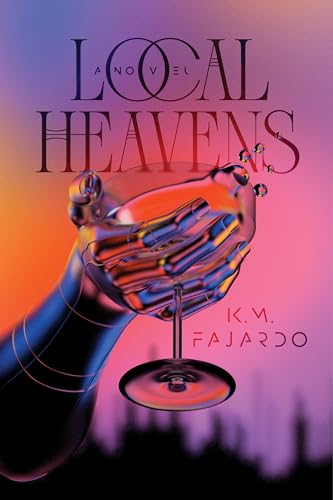
I came excited for a queer Gatsby retelling, and left disappointed by how it was handled. I’m not a diehard Gatsby fan, but it’s definitely on the higher end of ‘proper English’ books I was forced to read in high school. I think it’s a story with rich potential for reimaginings considering how little the original plot of Gatsby actually matters. However, I left this book wishing almost every choice Fajardo made was a different one. Should I have DNF’d it? Probably, and it’s a lesson for me to learn as I start 2026. Building good habits in the new year and all that.
Read if Looking For: extremely faithful retellings, casually bisexual protagonists, thieves with bird aliases, Mech-Jazz lounges
Avoid if Looking For: thematic inversions or commentary on The Great Gatsby, lavish Cyberpunk parties
I won’t give my usual Elevator Pitch here. If you’re familiar with The Great Gatsby, and can imagine it in a fairly typical Cyberpunk setting, you’ve got the gist. If you haven’t read Gatsby, I’d recommend reading that over this in almost every case. If queer characters in cyberpunk worlds is your interest, try Welcome to Forever, and if you want early 1900s Queer Asian leads, try Siren Queen.
Why I didn’t Like It
My biggest complaint of this story is that it’s a bit too direct of a Gatsby retelling for me. Generally I like it when retellings take a fair amount of liberties with the source material, which I’ve found allows them to really examine ideas from the source material in a new light. Think Circe, by Madeline Miller, which takes the titular character’s appearances in Greek Myth as a framework to explore ideas around self-worth and forgiveness. This book felt a lot more like a reskin than a reworking of Gatsby. Yes, our narrator is bisexual corporate net-diver now, and bio-modifications take the place of auto-mechanics. However, the story was a bit too close to a scene-for-scene remake than I’d like. I kept thinking ‘aha, I remember this scene from the book I read 15 years ago,’ and I don’t think that’s a good thing. I wish Fajardo would have wandered further afield in this reimagining, as I think it gives more space to rework and reimagine themes and characters. This felt fun, but ultimately kind of safe, and it relied heavily on the symbolism of the original without adding anything new to the mix. It felt a bit like fanfiction rather than a professional retelling. I say this as someone who loves fanfiction, even if he doesn’t read a ton of it.
If Fajardo had managed to keep so close to the plot and scenes of the original Gatsby, I might not have minded how similar the two books were. Unfortunately, she took (in my opinion) the least interesting possible path towards exploring the romantic tension between Gatsby and Nick in the original book. There’s also an attempt to explore racism as Fajardo shifts Nick to be the child of Filipino Immigrants, but it didn’t go much past ‘rich people in charge of a white colonial system are racist’. Even the parts of the book that diverged from the Gatsby storyline, mostly a Cyberpunk corporate espionage subplot, ended up feeling rather tepid so it didn’t interrupt the plotline of the original novel too much.
But this book’s biggest sin in my opinion, is its failure to capture the critique of capitalism and consumerism in the original story. One of the things I loved about The Great Gatsby is how it revels in decadence, drowning the reader in absurd luxuries and showing how empty those lives really were. A cyberpunk setting is perfect for pushing this angle even further, but Local Heaven’s never committed to properly showcasing what this might look like this version of the future.
I’m not quite sure why I kept reading this, which is perhaps damning the book even further with faint praise. However, even though I found the ideas behind the book to be subpar, and the prose/dialogue average, I kept reading. Certainly Fajardo did a good job of stringing me along with romantic tension between Gatsby and Nick – though again, I wish Fajardo had more radically reimagined the dynamics between the five main characters to make a more sensible story. I’m a sucker for a swimming pool scene, and this book filled that need admirably. If there was a benefit to how closely Farjado followed the original Gatsby, it is that I was never lost or unmoored in the story. It was a good listening experience, as I always had an anchor to cling to.
 Marked for Plot