
December this year has, apparently, been the month of mildly disappointing sequels. If you’d like to see my review of book 1 in this take on gay Robin Hood, see Greenwode. It lost a lot of the things that made it interesting, rehashed old ground, and didn’t succeed in raising the stakes of book 1 in a satisfying way. Just frustrating all-around. I think it’s a good recommendation for people who want fantasy gay yearning, but I needed the series to move past that.
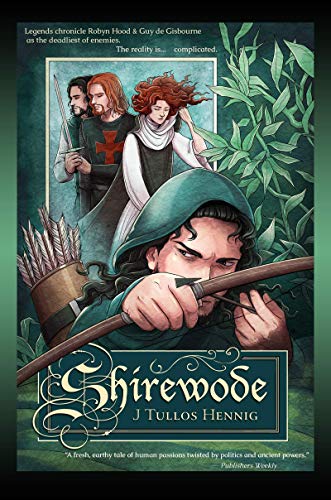
You would think from this cover art that archery and action were going to be at least a little more prominent in this book? Too bad! Think again!
If you loved and wanted more of the ‘enemies by fate and religion’ vibes in book 1, you may like this one a lot more than I did. It remains the focal point of the series.
Elevator Pitch:
Book 1 ended pretty tragically. Gamelyn thinks his first love is dead. Rob thinks his first love betrayed him and is responsible for the death’s of his parents and sister. The Abbess and Sherriff are just generally horrible people. Book 2 picks up several years later as Gamelyn returns from his time in the Crusades as a Templar. Meanwhile Rob is finally the bandit we all knew he’d become. Gamelyn is assigned to hunt down the false pretender to the pagan god’s power by the Templars, not realizing the love of his life is actually alive and the very man he’s hunting. Meanwhile, Rob’s sister Marion is also alive, has amnesia, and is the kept pet of the evil Abbess.
What Worked For Me:
There were times where I thought Hennig used the timeskip excellently. Rob has come into his divine power, and he’s got a level of confidence to him lacking in book 1. Gamelyn’s time in the crusades left him scarred and, at times, cruel. I wish Hennig would have leaned harder into how war had changed both of them (especially Gamelyn), but if you’re going to have a large timeskip between books where major events happen, this is the way to handle things. I just wish she’d used that character growth to leverage new and interesting character dynamics.
What Didn’t Work For Me:
My biggest complaint about this book is that it felt like it retred so much ground from book 1 without layering anything new into Rob and Gamelyn’s relationship. While childhood love has moved to tragic yearning, Hennig didn’t stray too far from mortal enemies who shouldn’t want to fuck but can’t keep their hands off each other. The only real piece missing from the relationship dynamic in Greenwode is Rob’s struggles with his parents, who pressure him to enter a heterosexual relationship so he can beget heirs for his divine power to pass on to. This take on how paganism and homosexuality interacted was one of the more interesting religious elements in book 1, yet it has vanished entirely from this book. This alone isn’t necessarily a bad thin – after all, I dislike how much of book 2 feels the same as book 1 – but Hennig only changed the most interesting part of their relationship. In the end, so many scenes felt like I’d seen it before, without meaningful new context or growth. It’s tough to not compare this book to the Captive Prince series, which has such a delightful growth in enemies to lovers character dynamics across books. A quick peek at the blurb for book 3 shows that Hennig hasn’t finished with the ‘we don’t totally trust each other, but totally want to bone’ dynamic, and I’m just tired of it.
Another ill-fated hope for Shirewode was an increased focus on more traditional fantasy elements. To be fair, more time is spent on the cat and mouse game Rob and Gamelyn play before they realize each other’s true identities. Unfortunately, the villains of this story lacked agency and any real agenda. The Abbess in book 1 played politics, pulled strings to facilitate her perverted view of a holy world, and generally was an excellent and foreboding villain in a world that denies women any official power. In this book she lacked almost any teeth whatsoever, despite being the closest thing this book had to an antagonist. Meanwhile Rob is theoretically a notorious bandit famous across the land, but you wouldn’t know it from the scenes that Hennig chooses to show us. We do get a rather important archery contest at the end of the book, but that’s about the extent we see Rob firing arrows in this book. In book 1, the tension came from Rob and Gamelyn’s relationship. Hennig tried a repeat of that here, but when that failed to land for me, there was precious little to hold this story together in my mind.
Conclusion: a disappointing sequel to a very promising book 1.
 Marked for Plot